
5 Life-Changing Benefits of Martial Arts for School-Aged Kids in 2026
What if the hours between 3:00 PM and 6:00 PM weren't just a gap to be filled, but the most transformative part of your child's day? Many parents find that martial arts for school aged kids offers a powerful solution to the common struggle with excessive screen time and classroom focus. You want your child to be safe, yet you also want them to thrive in an environment that builds character rather than just "babysitting" them until dinner. It's natural to feel concerned about their social development or physical fitness during those quiet afternoon hours when they could be achieving so much more.
Discover how martial arts provides the perfect blend of discipline, fitness, and leadership for your child’s development after school. In 2026, with new Texas safety standards ensuring higher quality enrichment programs, there's a unique opportunity to turn that "dead time" into a leadership laboratory. We'll explore five life-changing benefits that bridge the gap between the classroom and home. You'll learn how structured enrichment improves grades, boosts self-esteem, and provides a secure, nurturing space where your child can grow into a confident, disciplined leader ready for future success.
Table of Contents
Beyond the Classroom: Why School-Aged Kids Need Structured After-School Activity
The Physical and Mental Blueprint: How Martial Arts Shapes Growing Minds
Choosing the Right Path: Martial Arts vs. Traditional Daycare and Team Sports
A Parent’s Checklist: Finding the Best Martial Arts Program in Houston
The Bushi Ban Difference: Building Leaders in Pasadena, Deer Park, and La Porte
Beyond the Classroom: Why School-Aged Kids Need Structured After-School Activity
The hours between 3 PM and 6 PM represent a critical crossroads in a child's daily life. While the school day provides academic rigor, the immediate hours following dismissal often lack the direction needed to sustain that momentum. This period, frequently called the "after-school gap," is a time when children are most vulnerable to boredom or digital overstimulation. Traditional daycare models often fail to engage older children because they focus on passive supervision rather than active growth. School-aged kids need more than just a safe place to wait for their parents; they need a high-energy environment that rewards their effort and builds their confidence.
The Problem with Unstructured Afternoons
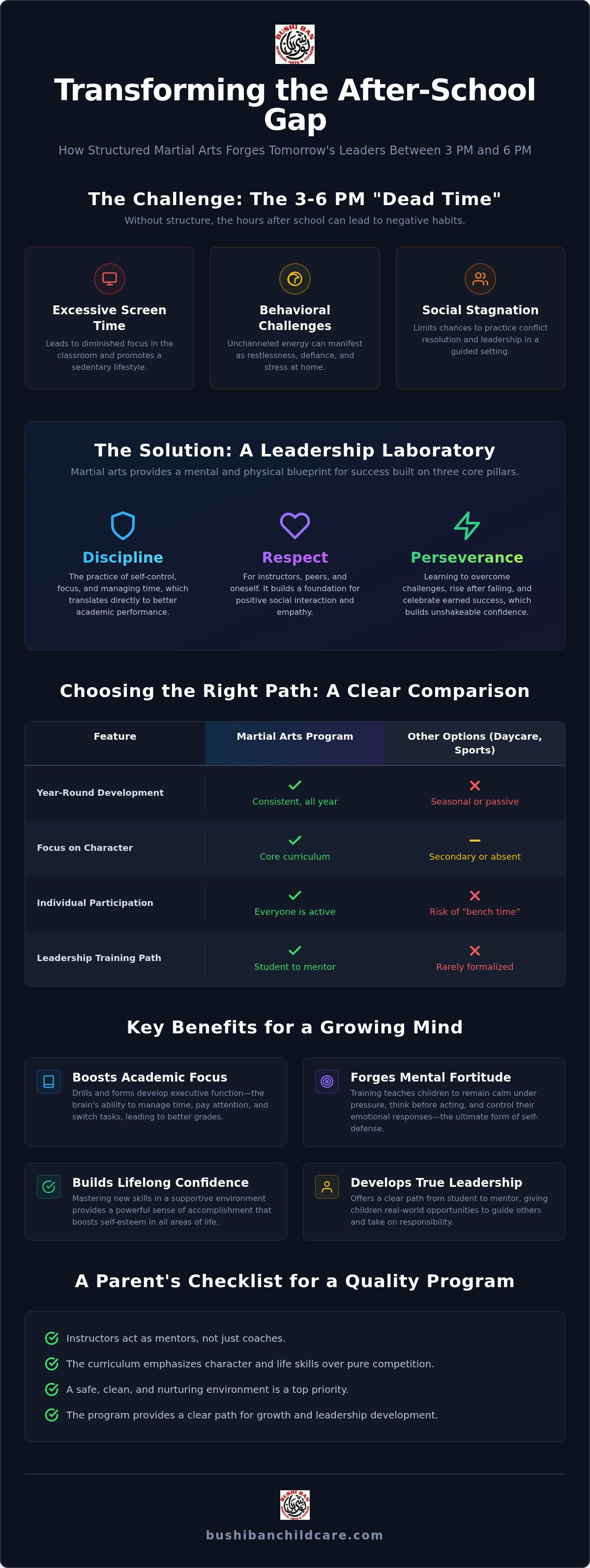
Without a clear routine, many children default to sedentary habits that can impact their long-term well-being. Unstructured afternoons are often dominated by excessive screen time, which research suggests can diminish a child's ability to focus in the classroom the following day. Parents in the Houston area, particularly in communities like Pasadena and Deer Park, are increasingly seeking alternatives to standard "babysitting" services. They recognize that a lack of structure after school can lead to:
Behavioral challenges: Energy that isn't channeled into a productive activity often manifests as restlessness or defiance at home.
Physical decline: Replacing active play with tablets or television contributes to a more sedentary lifestyle during formative years.
Loss of social momentum: Unsupervised time limits the opportunities for kids to practice conflict resolution and leadership in a safe, guided setting.
Martial Arts as a Developmental Bridge
Choosing martial arts for school aged kids transforms this afternoon gap into a powerful laboratory for leadership. It is helpful to look at a comprehensive overview of martial arts to see how these traditions have evolved into modern systems for character education. Unlike a simple hobby, a structured after-school program provides a consistent mentor who acts as a partner in a child's upbringing. The dojo serves as a developmental bridge, reinforcing the discipline required in school while offering a physical outlet that team sports often lack during the off-season.
A truly structured program doesn't just teach kicks and punches; it creates a psychological anchor for the child. When a student steps onto the mat, they leave the stresses of the school day behind and enter a space where respect and perseverance are the primary currencies. This consistent routine complements the structure of the classroom, helping children maintain their focus and emotional balance. By the time you pick them up, they aren't just "tired out" from play; they are fulfilled, disciplined, and ready to enjoy a peaceful evening with their family.
The Physical and Mental Blueprint: How Martial Arts Shapes Growing Minds
Martial arts for school aged kids is far more than a series of kicks and punches. It is a holistic system designed to strengthen the body while simultaneously forging the character. While many sports focus solely on the scoreboard, the dojo focuses on the internal blueprint of the child. This foundation rests on three vital pillars: Discipline, Respect, and Perseverance. These aren't just abstract concepts. They are practical tools that children use every day to navigate the complexities of growing up.
This training develops a unique form of physical coordination that directly impacts mental clarity. When a child learns a complex kata or a new defensive move, they aren't just moving their limbs. They are practicing the art of self-control. This "internal" strength is the ultimate form of self-defense. It teaches a child to remain calm under pressure and to think before they act. Recent research on the benefits of martial arts highlights how these mental health and social advantages often surpass those found in traditional competitive sports.
Boosting Academic Focus and Grades
The connection between the mat and the classroom is rooted in the development of executive function. This is the brain's ability to manage time, pay attention, and switch focus between tasks. Martial arts drills require students to follow precise, multi-step instructions while maintaining physical balance. This mental exercise builds the focus needed to block out distractions during a lecture. Black Belt Focus means applying the same unshakeable concentration used to master a new technique to completing a challenging homework assignment or staying calm during a standardized test. Teachers often report that students enrolled in a Bushi Ban After School Program show a marked improvement in their ability to stay on task and participate constructively in class discussions.
Developing Social Skills and Emotional Intelligence
The dojo provides a safe, supportive environment where children learn to navigate social dynamics with confidence. Here, students learn to win with humility and lose with grace. This emotional resilience is essential for curbing bullying, as it builds empathy and teaches children how to resolve conflicts without aggression. For shy children, the structured progression of the belt system offers a clear path to finding their voice. They learn that their contributions matter. They discover the joy of achievement alongside their peers, transforming from quiet observers into active participants in their own lives.
Choosing the Right Path: Martial Arts vs. Traditional Daycare and Team Sports
Choosing the best environment for your child after the school bell rings is a significant decision. While many parents instinctively look toward traditional team sports or standard daycare, these options often leave gaps in a child's development. Martial arts for school aged kids provides a unique alternative that eliminates the "bench time" often found in soccer or baseball. On the mat, every child is an active participant. There are no sidelines here. This constant engagement ensures that your child is always moving, learning, and improving, rather than waiting for their turn to play.
Martial Arts vs. Seasonal Team Sports
Traditional sports are often bound by seasons, leading to a "start and stop" rhythm that can hinder long-term habit formation. When the season ends, the structure often vanishes. Martial arts offers a consistent, year-round routine that builds lasting discipline. It is also remarkably inclusive. While team sports can sometimes feel exclusionary to children who don't consider themselves "naturally athletic," martial arts allows for individual progress at a child's own pace. Every student follows their own journey toward the next belt, ensuring they feel successful based on their personal growth rather than a comparison to a teammate.
The Difference Between Enrichment and Daycare
It is vital to distinguish between passive supervision and active enrichment. Traditional daycare often provides a safe space, but it rarely challenges a child's mind or body. Specialized programs in Pasadena and Deer Park cater specifically to the needs of school-aged children by replacing "babysitting" with a clear, goal-oriented curriculum. The belt system serves as a powerful motivator, teaching kids that consistent effort leads to tangible rewards. This structured approach helps martial arts for school aged kids stand out as a superior choice for parents who value growth over mere convenience.
Beyond physical skills, there is a clear "leadership gap" in most after-school care. While general recreation focuses on keeping kids busy, a structured martial arts program explicitly teaches mentorship. Through a dedicated Student Leadership Program, older or more experienced students learn to guide their peers. This transition from student to leader is a cornerstone of the Bushi Ban philosophy, ensuring that the hours spent after school are an investment in their future character. Specialized centers also offer a higher level of supervision and safety protocols than general recreation hubs, providing parents with the ultimate peace of mind.
A Parent’s Checklist: Finding the Best Martial Arts Program in Houston
Finding the right fit for your family requires more than a quick search online. You are looking for a community that aligns with your values. When evaluating martial arts for school aged kids, the goal is to find a program that prioritizes personal growth alongside physical technique. A high-quality school should feel like an extension of your home, offering a safe, structured, and encouraging atmosphere. You aren't just choosing a gym; you're choosing a partner in your child's upbringing.
Use this practical checklist to ensure the program you choose meets the highest standards of professional excellence:
Instructors as Mentors: Look for teachers who emphasize character development, respect, and life skills over pure combat or competition.
Holistic Curriculum: Ensure the program includes a structured path for leadership training and recognizes academic achievements alongside physical milestones.
Welcoming Environment: The facility must be clean, well-maintained, and safe. A transparent program encourages parents to observe classes and stay involved.
Reliable Logistics: For working parents, convenience is key. Check for programs that offer transportation from local schools and have hours that fit your work schedule.
Vetting the Instructor and Culture
Ask the head instructor about their philosophy on discipline. A great mentor uses mistakes as teaching moments rather than moments for punishment. Look for "green flags" during your visit, such as students who bow with genuine respect and instructors who know every child by name. The emotional register of the dojo should be optimistic and inclusive. It should be a place where children feel empowered to try new things without the fear of being judged. Does the instructor project a balanced blend of warmth and authority? This balance is essential for building trust with school-aged children.
Local Considerations for Pasadena, Deer Park, and La Porte
In the Pasadena, Deer Park, and La Porte areas, logistical support is a top priority for busy families. A program with deep roots in the Houston community will understand the specific early dismissal days and holiday schedules of your child's local school district. It is also wise to ensure the facility offers specialized support during school breaks. Choosing a program that provides Seasonal and Holiday Camps ensures your child maintains their routine and discipline even when school is out of session. This consistency is what transforms a simple after-school activity into a life-changing experience for your child.
The Bushi Ban Difference: Building Leaders in Pasadena, Deer Park, and La Porte
The legacy of Bushi Ban Child Care is rooted in a philosophy that extends far beyond the four walls of a dojo. Founded around 1980 by Grandmaster Zulfi Ahmed, the Bushi Ban Child Care system was created to be a vehicle for total life success. For families in Pasadena, Deer Park, and La Porte, this means access to an institution that has spent decades refining the balance between physical prowess and character development. We don't just offer generic classes. We provide a comprehensive After-School Martial Arts Program that acts as a dedicated partner in your child's upbringing. Our focus remains fixed on vitality and character building, ensuring your child develops the internal strength needed for the real world.
While many programs focus exclusively on the physical aspect of training, we prioritize the Student Leadership Program. This unique track is designed to bridge the gap between being a student and becoming a mentor. Martial arts for school aged kids at Bushi Ban Child Care is about more than just earning a new belt color. It's about earning the respect of peers through service, integrity, and a commitment to excellence. We believe that every child has the potential to lead, and our structured environment provides the perfect laboratory to test those skills.
The Student Leadership Path
Our leadership curriculum teaches students how to assist instructors and lead group activities with confidence. This hands-on experience develops vital public speaking and mentorship skills in elementary-aged kids that are rarely addressed in a traditional classroom setting. By taking on responsibility early, children build a foundation of confidence that serves them well into their college years and future careers. They learn that true leadership is about helping others achieve their goals. This long-term impact on readiness and maturity is what truly sets our martial arts for school aged kids apart from other extracurricular activities.
Join the Bushi Ban Child Care Family Today
Consistency is the primary key to progress. Beyond our daily after-school sessions, we offer Seasonal and Holiday Camps to ensure your child remains active and engaged during school breaks. These camps provide a familiar, structured environment where children can continue their journey of self-discovery without the interruption of a long vacation. It's the perfect way to maintain the discipline and fitness they've worked so hard to achieve throughout the school year. You won't have to worry about a "summer slide" in their behavior or focus when they have a year-round community supporting them.
Are you ready to see your child thrive in a supportive, high-energy environment? We invite you to experience the Bushi Ban Child Care difference firsthand with a trial class at our Pasadena, Deer Park, or La Porte locations. Our team is dedicated to providing a safe, professional space where your child can grow into the leader they were meant to be. Discover our after-school programs and build your child's confidence today!
Empowering Your Child’s Future Beyond the School Day
Choosing the right environment for those critical afternoon hours can redefine your child's trajectory. You've seen how martial arts for school aged kids provides a structured bridge between the classroom and home, replacing passive screen time with active leadership training. By focusing on the three pillars of respect, discipline, and perseverance, your child doesn't just learn self-defense; they learn to defend their own potential. They transition from being a student to becoming a mentor, gaining the "Black Belt Focus" needed to excel in academics and social settings alike.
Since 1980, Bushi Ban has remained a cornerstone of the Pasadena, Deer Park, and La Porte communities. Founded by Grandmaster Zulfi Ahmed, our unique Student Leadership Program is designed to foster integrity and confidence in every member of our family. We invite you to step into our dojo and see the difference that professional, character-driven enrichment makes. It is time to turn the after-school gap into a season of achievement and joy. Enroll Your Child in the Bushi Ban After-School Program Today and watch them grow into the confident leader you know they can be.
Frequently Asked Questions
Is martial arts safe for elementary-aged children?
Martial arts is exceptionally safe for elementary-aged children when practiced in a professional, supervised environment. Our instructors prioritize safety and proper technique above all else. Every class follows a structured curriculum designed specifically for developing bodies. We emphasize non-contact drills and controlled movements to prevent injury. In 2026, new Texas safety regulations ensure that licensed youth programs maintain strict protocols, providing parents with additional peace of mind regarding their child's physical well-being.
How does martial arts help with my child's focus in school?
Training in martial arts for school aged kids directly improves classroom focus by developing executive function. Students learn to follow multi-step instructions and block out distractions while practicing their forms. This "Black Belt Focus" naturally carries over to schoolwork and testing. Teachers often report that our students are better at staying on task and participating in discussions. By practicing mindfulness and self-control on the mat, children gain the mental tools needed to succeed academically.
Does my child need to be athletic to start martial arts?
Your child does not need to be naturally athletic to begin their journey. Martial arts is unique because it allows for individual progress at a child's own pace. We welcome students of all fitness levels and physical abilities. Our instructors focus on incremental growth, helping each child build coordination and strength over time. This inclusive approach ensures that every student feels successful, regardless of their starting point, making it an excellent alternative to competitive team sports.
What is the difference between your program and a standard daycare?
Unlike standard daycare, which often provides only passive supervision, our program is a structured after-school enrichment experience. We focus on character development, physical fitness, and leadership skills rather than just "babysitting." Every afternoon is an opportunity for growth through goal-oriented training and mentorship. While we do not offer all-day child care, we provide a high-energy transition from school to home that keeps children engaged and productive until you pick them up.
Do you offer transportation from local schools in Pasadena or Deer Park?
We provide reliable transportation from many local schools in the Pasadena, Deer Park, and La Porte areas for our martial arts for school aged kids program. This service ensures that your child arrives safely at our facility immediately after dismissal. Our team coordinates closely with local school schedules to handle early dismissals and district-specific holidays. By bridging the gap between school and the dojo, we simplify your afternoon logistics while providing a secure and familiar routine.
What age is best for a child to start martial arts training?
Most experts agree that the ideal time to start is when a child begins elementary school, typically around age five or six. At this stage, children have the motor skills and attention span necessary to follow basic instructions and participate in group activities. Starting early helps establish a foundation of discipline and respect that lasts a lifetime. Martial arts is beneficial at any age, and we tailor our curriculum to meet the developmental needs of each specific age group.
How often should my child attend classes to see results?
Consistency is the key to seeing meaningful results in both physical skill and character development. We generally recommend that students attend classes at least two to three times per week. This frequency allows them to retain what they've learned while building the stamina and muscle memory required for advancement. Regular attendance also reinforces the habit of discipline, helping children understand that steady effort leads to tangible rewards like earning their next belt rank.
What is the Student Leadership Program at Bushi Ban?
The Student Leadership Program is a specialized track founded by Grandmaster Zulfi Ahmed to train the next generation of mentors. Advanced students learn to assist instructors, lead warm-ups, and guide their younger peers through drills. This program focuses on developing public speaking, empathy, and organizational skills. It transforms students into leaders who take responsibility for their community. This experience provides a significant advantage as they move toward high school, college applications, and future professional careers.


Comments