
How to Improve Child's Listening Skills in Deer Park Through Play
Listening improves when children get timely, simple instructions and playful chances to focus, remember, and respond. To understand how to improve a child’s listening skills in Deer Park, start with one clear direction, give them time to process it, and build practice into games and everyday routines. Listening and cooperation grow together: children learn to attend to what’s being said and take part in what happens next.
It’s understandable to expect a child to respond right away, but listening takes practice, and attention can shift with age, energy, and distractions. This guide shares practical ways to use structured activities, songs, stories, and play, while explaining how the brain’s interpretation of sound is part of listening. With patient, consistent practice, everyday moments can help children strengthen focus, follow directions, and cooperate with greater confidence.
Table of Contents
1. Giving children instructions at the right time
Choose a moment when your child can pause and listen. Say their name, move close, and give one clear instruction, such as “Put your shoes by the door.” Start with one-step directions before adding another step. Then wait a few seconds; slowly count to 10 before repeating the request. Repeating it immediately can turn a simple direction into a power struggle. Notice the effort with specific, positive praise: “You listened and put your shoes away.” This makes the desired action clear.
Build practice into play and familiar routines at home. Simon Says teaches children to act only when a command begins with “Simon says.” While cooking, invite your child to follow one spoken step, such as stirring after ingredients go into a bowl. For drawing, try, “Choose a red crayon, then draw a circle.” Keep directions brief and pause before adding the next step. These activities make practice engaging and give children a reason to listen for details.
Clear, consistent expectations help children understand what to do. If your child is tired, distracted, or resisting a new task, simplify the direction and offer a calm reminder. For unsafe behavior, stay close while your child settles and is ready to listen. Parents and teachers can support communication by sharing which directions work well, using similar wording for routines, and noticing progress. For example, both adults can say, “Hang up your backpack, then choose a book.”
In Deer Park, families can practice through home routines and structured activities. Speech-language therapists may be relevant when listening concerns accompany communication difficulties; parents can discuss ongoing concerns with the child’s teacher or pediatrician. For toddlers, concerns about development are a reason to ask a doctor about developmental screenings. Whether using a simple game or a classroom routine, give the child time to process, follow one instruction at a time, and praise the specific response.
2. Practicing listening in structured activities
Active listening means paying attention to a speaker and working to understand the full message. Passive listening is hearing words without trying to understand or remember them. A child may be quiet but miss an instruction while distracted. In a short conversation, take turns speaking and listening. Ask, “What was the best part of your day?” Then let your child finish before responding. Families looking for ways to improve a child’s listening skills in Deer Park can begin with these everyday exchanges.
Model the actions you want your child to learn. Face your child, listen without interrupting, and ask a specific question about what they said. For example, if your child says, “Recess was fun,” ask, “What game did you play?” Then restate the main point: “You liked playing tag with your friends.” Your child can correct you if you misunderstood, helping make the message clearer for both of you.
Turn-taking activities give children a structured chance to wait, listen, and respond. In a conversation game, each person shares one idea before the next person speaks. Invite your child to remember the previous speaker’s point before adding their own. You can also practice noticing emotion by asking whether a speaker sounded excited, disappointed, or calm. This helps children attend to both the words and the feeling behind them. These activities can help families in Deer Park build listening practice into everyday life.
These routines can strengthen classroom comprehension, communication, and problem-solving. They also give children practice staying focused while someone else participates, rather than preparing a reply before hearing the full thought. Keep the activity brief and clear, then praise a specific action, such as waiting patiently or asking a thoughtful follow-up. For more opportunities to build attention through structured group activities, choose games that invite every child to listen and take a turn.
3. Building attention through play, songs, rhymes, and stories
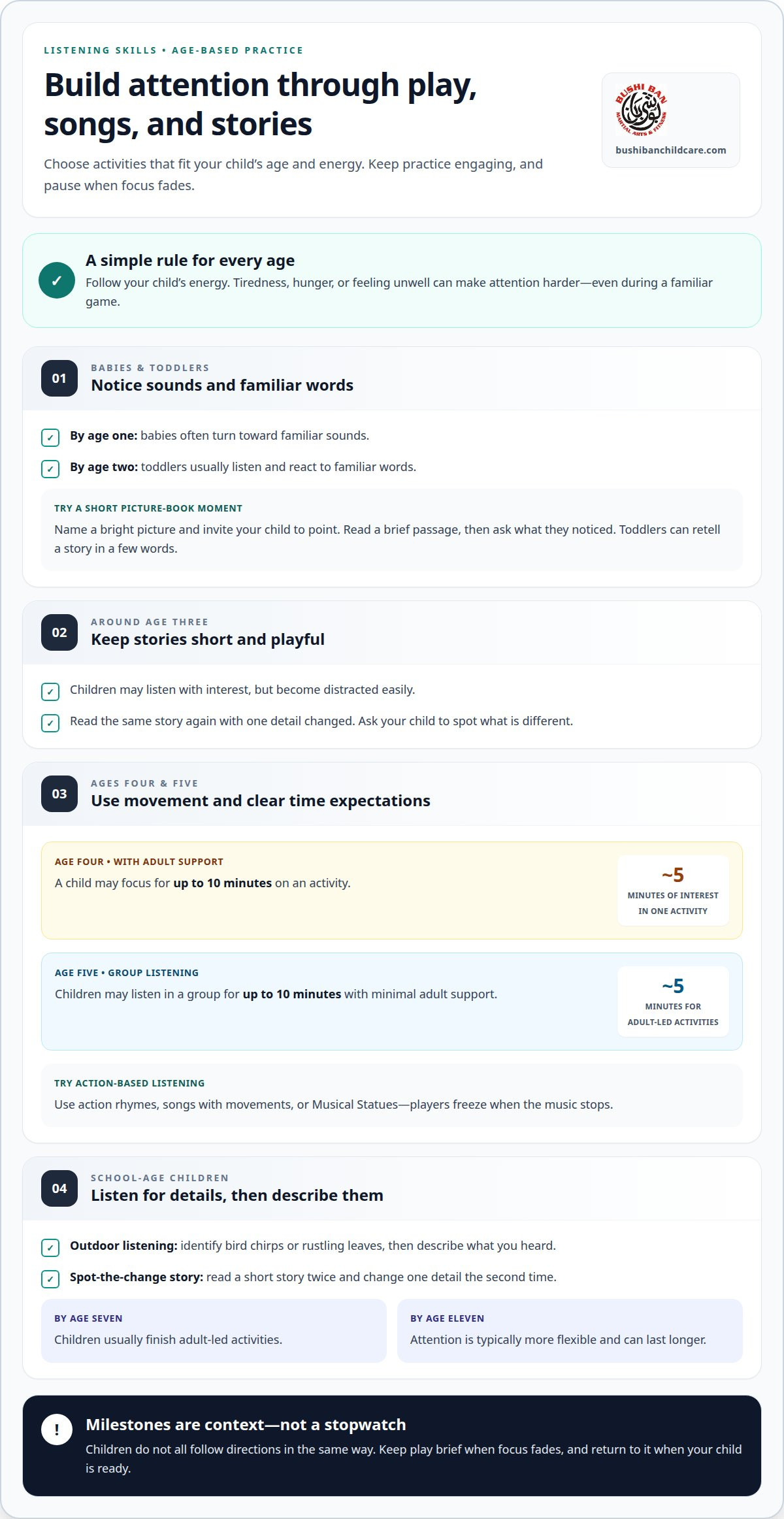
Attention develops over time, so match activities to your child’s age and energy. Tiredness, hunger, or feeling unwell can make it harder to pay attention, even during a familiar game. Babies often turn toward familiar sounds by age one. By age two, toddlers usually listen and react to familiar words. At age three, they may listen with interest but become distracted easily.
For babies and toddlers, try short, engaging activities. Share a picture book with bright colors, pause to name an image, and invite your child to point. Read a brief passage, then ask what they noticed. Toddlers can retell a story in a few words, practicing recall. Read the same story again with one detail changed and ask your child to spot it.
Age-based activities can grow with attention. At age four, a child may focus for up to 10 minutes on an activity with adult support, while interest in one activity may last around five minutes. By age five, children may listen in a group for up to 10 minutes with minimal adult support, though adult-led activities may hold attention for around five minutes. Use action rhymes, songs with movements, or Musical Statues, where players freeze when music stops.
For school-age children, outdoor listening games encourage participation and attention to detail. Ask your child to identify bird chirps or rustling leaves, then describe what they heard. For a spot-the-change story, read a short story twice and change one detail the second time. By age seven, children usually finish adult-led activities; by age eleven, attention is typically more flexible and can last longer. These milestones offer context, not a reason to expect every child to follow directions in the same way. Keep play brief when focus fades, and return to it when your child is ready.
4. Listening, hearing, and brain interpretation
Hearing lets a child detect sound; listening also involves the brain interpreting it. A child must notice speech, connect words with meaning, and remember what someone said. Babies between 6 and 12 months usually focus on different sounds, locate a voice, and look toward a caregiver when their name is called. These early responses show how listening develops alongside communication.
Consider discussing it with a professional if your child regularly struggles to follow directions, stay focused, or manage routines at home or school. Following less than half of regular instructions, especially alongside arguing, demanding, or doing the opposite, may signal a listening concern. These observations alone can’t show whether the difficulty involves hearing, understanding, attention, or another factor. Share specific examples with your child’s doctor, such as missed spoken directions during a quiet routine.
One common mistake is interrupting before a child finishes speaking or correcting every response immediately. Let your child complete a thought, then respond to what they said and the feelings they expressed. During a story, pause until your child has finished describing a character before asking a follow-up question. Reduce background distractions during conversations, and speak at your child’s level to make the message easier to follow.
For toddlers, a diagnosed developmental delay or disability may make them eligible for Early Intervention Services from birth to three years old. If you’re concerned about a toddler’s development, speak with a doctor and ask about developmental screenings. Keep notes on routines or stories the child finds difficult, and share those examples during the conversation. To add guided opportunities for listening and responding, explore structured group activities.
Listening is one of the early building blocks children use when learning a language. If a child regularly follows less than half of the instructions given, especially while also doing the opposite, arguing, or demanding, it may be worth discussing the pattern with a professional.
Ongoing difficulty following directions, staying focused, or managing routines at home or school may mean additional support could help. In conversation, let the speaker finish a thought before responding. When speaking to your child, get down to their level and make eye contact to help them attend to the message.
Bushi Ban Child Care
Bushi Ban Child Care’s structured programs give children opportunities to practice listening, following directions, and participating with others through shared activities. For families in Deer Park looking for active routines beyond home, the After-School Martial Arts Program, Martial Arts & Fitness Classes, Seasonal and Holiday Camps, and Student Leadership Program offer options to consider. The Student Leadership Program also helps students develop teaching and activity-leading skills. These programs can complement practice at home; discuss concerns about hearing, speech, or development with a healthcare professional. Choose an option that fits your child’s interests and your family’s routine, and contact Bushi Ban Child Care to learn more.
Make the Next Step Feel Natural
Listening grows through connection, not one perfect instruction. As you consider how to improve a child’s listening skills in Deer Park, think about where your child feels engaged, supported, and ready to participate. Those settings can make practice feel meaningful rather than like another demand. Notice what captures your child’s interest, then choose activities that encourage confidence and cooperation.
For families looking for a structured setting to complement everyday practice, Bushi Ban Child Care offers children opportunities to take part in guided activities and develop life skills. The right next step is one that fits your child’s needs and feels manageable for your family. You can learn more by contacting Bushi Ban Child Care. Keep celebrating steady effort, and give your child room to grow one listening moment at a time.
Frequently Asked Questions
What are listening skills and how are they linked to cooperating?
Listening skills help a child understand what another person is saying and respond in a way that fits the situation. Cooperation draws on those skills when children share materials, take turns, or adjust plans with others. For example, during a board game, a child listens to the next player’s suggestion and helps decide whose turn comes next. Listening supports shared action, not simply quiet attention.
Why do kids need help learning to listen, communicate and cooperate?
Children are learning to understand messages, express their needs, and coordinate with others. These abilities matter in school routines, friendships, and everyday family tasks. A child who can explain, “I need more time,” or listen to a classmate’s idea has more ways to participate constructively. Adults can support these skills by making room for children to speak and practice resolving small disagreements.
How can parents teach children to follow multi-step directions?
Build multi-step directions gradually, using a familiar routine and a clear sequence. Start with two connected actions, such as, “Put your library book in your backpack, then place it by the door.” Ask your child what comes first and what follows. Once that feels manageable, add another step or use a simple picture checklist. If your child misses a step, calmly restate that part instead of repeating the whole sequence.
Comments