
Kids Fitness and Coordination Classes: A Parent’s Guide to Physical Literacy
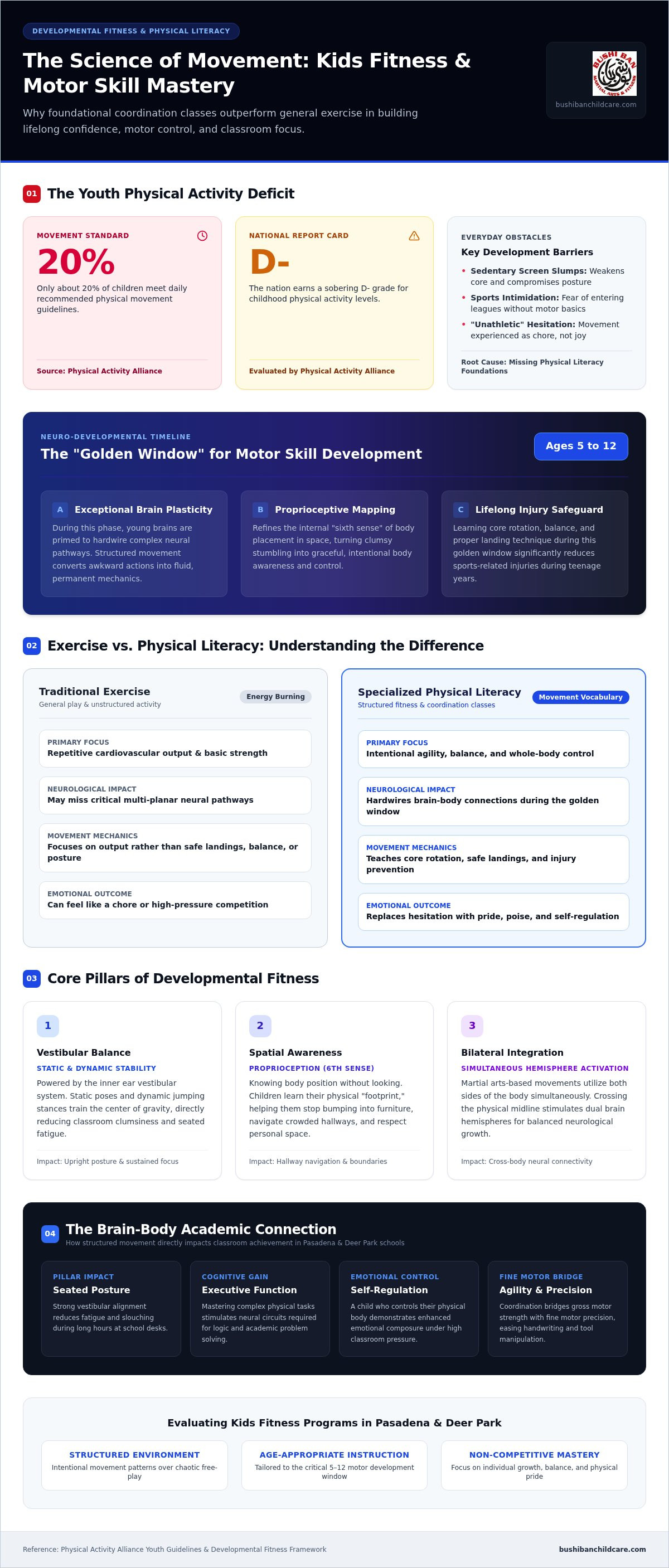
Did you know that according to the Physical Activity Alliance, only about 20% of children meet the daily recommended movement guidelines, earning our nation a disappointing D- grade? It's a sobering reality for parents who watch their kids struggle with sedentary habits or feel unathletic compared to their peers. You likely want your child to feel capable and strong, yet traditional team sports can feel intimidating if they haven't yet mastered the basics. Enrolling your child in kids fitness and coordination classes offers a supportive path to bridge that gap. By focusing on physical literacy rather than just competition, we help children move past the frustration of screen-time slumps and postural concerns.
This guide explores how specialized training builds the essential physical foundation your child needs for lifelong health, confidence, and even academic success. We'll dive into the five pillars of developmental fitness and show you how structured movement patterns can lead to better focus in the classroom. You'll discover how a balanced approach to fitness helps your child trade hesitation for excitement, turning physical activity into a source of pride rather than a chore. Let's look at how we can help your child unlock their potential through the joy of achievement and disciplined growth.
Table of Contents
What Are Kids Fitness and Coordination Classes?
Many parents wonder if their child's natural energy is enough to ensure healthy development. While running around the backyard is wonderful, it doesn't always provide the structured skill-building found in specialized kids fitness and coordination classes. These programs are designed to develop physical literacy, which is the foundational ability to move with competence and confidence in a wide variety of physical activities. Think of it as a movement vocabulary; just as a child learns to read by mastering phonics, they learn to move by mastering balance, agility, and body control.
The period between ages 5 and 12 is often called the "golden window" for motor skill development. During these years, the brain is exceptionally plastic, making it the perfect time to hardwire complex neural pathways. Structured training during this phase focuses on proprioception, which is your child's internal sense of where their body is in space. By refining this brain-body connection, children move from "clumsy" stages into a state of graceful, intentional control that serves them for a lifetime.
The Difference Between Exercise and Physical Literacy
It's a common misconception that simply "burning energy" is the same as training. Traditional exercise often focuses on repetitive cardiovascular work or basic strength. In contrast, physical literacy emphasizes intentionality. Every jump, pivot, and strike in kids fitness and coordination classes serves a purpose. This focused approach builds neural pathways that general play might miss. It also acts as a vital safeguard for the future. By learning how to land properly, rotate their core, and maintain balance now, children significantly reduce their risk of sports-related injuries during their teenage years.
Why Coordination is the 'Secret Ingredient' of Athleticism
Coordination is the bridge between gross motor skills, like running, and fine motor skills, like catching a ball. When a child masters this bridge, their physical confidence soars. They stop worrying about being "unathletic" and start enjoying the process of movement. This stability isn't just physical; it's emotional too. There's a documented link between a child's ability to regulate their body and their ability to regulate their emotions. When a child feels in control of their physical self, they often show better focus and composure in high-pressure environments, whether that's on a sports field or inside a classroom.
The 5 Pillars of Developmental Fitness for Children
Building physical literacy requires more than just high-energy play. It requires a structured framework that addresses how a child's body interacts with the world. While general exercise might focus on speed or endurance, kids fitness and coordination classes prioritize five specific pillars of development. These pillars ensure that every movement serves a purpose, helping children transition from tentative steps to confident, athletic action. By understanding these foundations, you can better support your child's journey toward total body mastery.
Balance: More Than Just Staying Upright
Balance is the silent engine of all human movement. It relies heavily on the vestibular system, which is located in the inner ear and helps the brain understand motion and orientation. When this system is well-developed, children find it significantly easier to maintain focus on complex tasks. In a structured environment, we practice both static balance, such as holding a steady martial arts pose, and dynamic balance, which involves staying stable while jumping or switching stances. This training helps reduce the "clumsiness" often seen in the classroom, as children gain a more refined sense of their own center of gravity. Better balance often leads to better seated posture, which reduces fatigue during long school days.
Spatial Awareness and Proprioception
Proprioception is often described as our "sixth sense." It's the brain's ability to understand where each body part is without having to look at it. Children who struggle with spatial awareness might frequently bump into furniture or struggle to stay within their lane during activities. We use specific drills to help children map their surroundings, which has a surprising social benefit. A child who understands their own physical "footprint" is better at respecting personal boundaries and navigating crowded school hallways with ease. This physical confidence naturally translates into a more relaxed and self-assured social presence.
Beyond balance and awareness, a complete program integrates rhythm, reaction time, and functional strength. Rhythm and timing help children sync their movements with external cues, while reaction drills sharpen the mind's ability to process and respond to physical challenges. Functional strength ensures the body is resilient enough to handle daily life, from carrying a heavy backpack to participating in weekend sports. According to the CDC, regular physical activities that challenge the body in these ways improve cognitive function and academic achievement by enhancing memory and attention spans. If you're ready to see these benefits in your own family, martial arts and fitness classes offer a proven, structured environment to help your child thrive.
Martial Arts vs. Traditional Sports: Which Builds Better Coordination?
When choosing after-school activities, many parents naturally gravitate toward popular team sports like soccer, baseball, or basketball. These programs offer wonderful social opportunities, but they often focus on sport-specific skills that can lead to asymmetrical development. A soccer player might spend years perfecting their right-footed kick, while a baseball player primarily develops their throwing arm. In contrast, martial arts-based kids fitness and coordination classes emphasize bilateral coordination, requiring students to practice every strike, block, and stance with equal precision on both sides of the body. This symmetrical approach ensures that both hemispheres of the brain are engaged, leading to a more balanced and capable physical foundation.
One of the most significant neurological advantages of martial arts is the frequent use of cross-midline movements. These are actions where a limb crosses from one side of the body to the other, such as a cross-body punch or a diagonal block. These movements are essential for brain development, as they force the left and right sides of the brain to communicate more effectively. Mastering these patterns helps children reach milestones in developmental readiness for sports and motor skill development, providing a level of neurological integration that many traditional sports simply don't address in early childhood.
Why Martial Arts is the 'Ultimate' Coordination Tool
Self-defense training introduces a level of physical complexity that challenges a child's brain and body simultaneously. Unlike the repetitive motions of running or swimming, martial arts requires students to memorize and execute "forms" or Kata. These are specific sequences of movements that demand high levels of concentration and physical sequencing. Martial arts improves hand-eye coordination more effectively than ball sports because it requires tracking and responding to unpredictable human movement at close range rather than following the predictable trajectory of a ball. This constant adjustment to a partner's movements sharpens reflexes and builds a refined sense of timing that carries over into every other physical activity.
The Discipline Factor: Mind-Body Connection
The "Dojo" environment is purposefully designed to be different from a chaotic playground or a high-pressure sports field. It's a structured space where physical stillness is valued just as much as explosive movement. This unique setting helps children develop a profound mind-body connection, teaching them that true coordination begins with mental focus. By learning to stand perfectly still before executing a technique, students gain better control over their impulses and their bodies. If you want to learn more about how these traits translate to life outside the gym, read our martial arts for focus and discipline guide. This disciplined approach ensures that progress is measured by personal growth rather than just the score on a scoreboard, making it an ideal choice for children of all temperaments.
How Coordination Training Boosts Academic Success in Houston Schools
Many Houston parents look toward traditional tutoring when grades begin to slip, yet the solution often lies in the physical foundation of the brain. The connection between movement and cognition is profound. When children participate in kids fitness and coordination classes, they aren't just building muscle; they're priming their brains for the rigors of the classroom. Complex physical tasks require the brain to plan, sequence, and execute movements, which directly improves executive function. These mental skills include working memory, flexible thinking, and self-control, all of which are essential for academic achievement in local school districts like HISD and Pasadena ISD.
Research indicates that brief bouts of physical activity increase cerebral blood flow and stimulate brain-derived neurotrophic factor. This biological response yields immediate improvements in attention spans and classroom focus. By engaging in structured coordination training, children develop the neurological integration necessary to process complex information more efficiently. This means that a child who spends time mastering a difficult physical sequence on the mat is often better equipped to tackle a challenging math problem at home.
Core Strength and Classroom Focus
It's a common sight in many classrooms: a child slouching, leaning on their hand, or fidgeting constantly. While this is often labeled as a lack of discipline, it's frequently a sign of a weak core. Core strength is the foundation of desk endurance. When a child's abdominal and back muscles are weak, their body works twice as hard just to stay upright, leaving very little mental energy left for reading or writing. Our kids fitness and coordination classes focus on functional strength to build the postural muscles needed for long school days. Exercises like planks, balance drills, and controlled strikes help children develop the "sitting stamina" required to stay engaged during long lessons without the distraction of physical fatigue.
From the Mat to the Grade Book
The discipline required to master a physical skill has a direct carryover to homework and study habits. When a child learns that they can overcome a physical obstacle through persistence, they build academic resilience. A growth mindset in physical training is the understanding that athletic ability isn't fixed but is something that can be developed through consistent effort and dedication. This shift in perspective is powerful; it teaches children that "hard" doesn't mean "impossible." By experiencing the joy of achievement in the gym, they become more willing to face academic challenges with confidence. If you want to give your child the tools for both physical and mental excellence, consider enrolling them in the Bushi Ban After School Program to see these benefits firsthand.
Choosing the Best Fitness Program in Pasadena and Deer Park
Selecting the right environment for your child's physical development is a decision that impacts their health, social confidence, and academic habits. In the Pasadena and Deer Park areas, parents are often faced with a choice between high-pressure competitive sports or simple recreational play. However, the most effective kids fitness and coordination classes offer a middle ground: a structured, professional environment where the focus remains on personal growth and movement mastery. When evaluating a local facility, look for a curriculum that explicitly targets the developmental pillars we've discussed, such as bilateral coordination and spatial awareness, rather than just general cardiovascular exercise.
A high-quality program should feel like an extension of your child's education. This means the instruction must be age-appropriate and led by professionals who understand pediatric motor development. Safety is a non-negotiable foundation, but it should be paired with a sense of optimistic encouragement. Does the facility feel like a community? Is there a clear progression of skills? Most importantly, the program must balance discipline with a genuine "fun" factor that makes your child excited to stay active. When these elements align, fitness stops being a chore and becomes a highlight of their daily routine.
The Bushi Ban Difference: Fitness with a Purpose
At our Pasadena and Deer Park locations, we don't just provide a place for kids to go after school. We offer a structured enrichment experience that prioritizes the long-term benefits of physical literacy. Bushi Ban Child Care integrates kids fitness and coordination classes into a comprehensive daily schedule that challenges both the body and the mind. Unlike a traditional daycare that might offer unstructured supervised play, our sessions are intentional. We use martial arts-based movements to hardwire the neurological pathways necessary for balance and focus.
What truly sets us apart is the integration of our Student Leadership Program into our physical training. We believe that a child who masters their body is better prepared to lead others. As students progress through their coordination drills, they also learn the values of integrity, respect, and perseverance. This holistic approach ensures that the vitality they gain on the mat translates into leadership in the classroom and at home. It's about building character through achievement, ensuring every child feels like a valued member of our community.
Getting Started: What to Ask Your Instructor
Before enrolling, it's vital to have a thoughtful conversation with the program director or lead instructor. Don't hesitate to ask about their specific experience working with different age groups and their approach to safety. You should also inquire about how they track individual progress within a group setting. A great instructor will be able to explain how they adapt drills for a child who might feel "unathletic" or how they challenge a student who is already physically gifted. If you're ready to see how a structured program can transform your child's confidence, visit our La Porte or Deer Park locations today!
Empower Your Child with the Gift of Physical Literacy
Investing in your child's physical literacy is one of the most impactful decisions you can make for their long-term well-being. We've explored how specialized kids fitness and coordination classes do more than just burn energy; they build the neural pathways and core strength required for academic focus and social confidence. By mastering the brain-body connection, your child moves away from the frustration of sedentary habits toward a life defined by vitality and achievement. It's about giving them the tools to navigate the world with grace and resilience.
Bushi Ban Child Care has been a proud partner to Houston families since 1980, offering a nurturing environment where discipline meets growth. Our programs include a unique Student Leadership Program to foster character and structured after-school transportation from local schools to ensure a seamless transition for your busy family. Are you ready to watch your child trade screen time for a sense of pride and physical mastery? Enroll your child in Bushi Ban's Fitness & Coordination Program today! We look forward to helping your child discover their full potential and celebrate every milestone along the way.
Frequently Asked Questions
What is the best age for a child to start fitness and coordination classes?
Most children are ready to begin structured programs around age 5. This timing coincides with the golden window of motor development, a period when the brain is exceptionally receptive to learning complex physical sequences. At Bushi Ban Child Care, we tailor activities to match your child's specific developmental stage. Starting during these formative years helps build a strong foundation of physical literacy that supports them through adolescence and encourages a lifelong love for staying active.
How do coordination classes help children who are 'clumsy'?
Clumsiness is often a sign that a child's brain-body connection needs more intentional practice. Our kids fitness and coordination classes use targeted drills to improve proprioception, which is the internal sense of where the body is in space. By refining balance and spatial awareness, children gain much better control over their limbs. This newfound stability reduces accidental stumbles and helps them navigate their daily environment with significantly more confidence, grace, and physical ease.
Is martial arts better for coordination than traditional gym class?
While gym classes provide general activity, martial arts offers a more structured approach to symmetrical development. Traditional team sports often favor a dominant side, but martial arts requires students to practice every technique equally on both sides of the body. This bilateral training strengthens the connection between brain hemispheres. It provides a more comprehensive neurological workout than typical recreational play, ensuring your child develops a balanced and versatile physical foundation for any future athletic endeavor.
Can fitness classes help my child focus better in school?
Yes, structured physical movement is a powerful tool for cognitive growth. Complex coordination tasks challenge the brain to plan and execute sequences, which directly strengthens executive function and working memory. Improved core strength also allows children to sit comfortably at their desks without the distraction of physical fatigue. When a child feels in control of their body, they often show significantly better attention spans and a greater ability to process information during their school day.
What should my child wear to a coordination and fitness class?
Students should wear comfortable, breathable athletic clothing that allows for a full range of motion. For those enrolled in our formal martial arts programs, a traditional uniform or gi is typically required. We recommend moisture-wicking fabrics and avoiding jewelry or restrictive items to ensure safety on the mat. Proper attire ensures your child can focus entirely on their training without being hindered by their clothing, allowing for a safe, productive, and enjoyable session every time they visit.
How often should my child attend these classes to see results?
Consistency is the secret to seeing lasting developmental progress in any young student. Most families notice significant improvements in confidence and coordination when their child attends classes two to three times per week. This frequency allows for enough repetition to hardwire new neural pathways while giving the body time to recover. Regular attendance at Bushi Ban Child Care ensures that your child stays engaged with the curriculum and continues to reach new milestones in their physical development.
Are these classes safe for children with no athletic background?
Absolutely, our programs are designed to meet every child exactly where they are today. We pride ourselves on being a supportive starting point for children with no prior athletic experience. Our instructors provide professional, age-appropriate guidance that focuses on personal progress rather than intense competition. This inclusive atmosphere ensures that every student feels safe and encouraged as they build their strength. It's never too late to start developing the physical confidence needed for a healthy life.
Do you offer fitness classes in Pasadena and Deer Park, TX?
Yes, we proudly serve families throughout the Pasadena, Deer Park, and La Porte areas. Our facilities are conveniently located to provide high-quality kids fitness and coordination classes within your local community. We even offer structured after-school transportation from many local schools to our centers, making it easier for busy parents to prioritize their child's physical enrichment. Our deep roots in the Houston area since 1980 reflect our commitment to supporting the growth of local youth.
Comments