
Youth Character Programs in Pasadena, TX: Parent Guide
What if character grows less from what children hear and more from what they practise? Families comparing character building programs for youth Pasadena offers several approaches, from city recreation activities to structured martial arts. It’s understandable to want more than a busy after-school schedule: children benefit when an activity gives them regular chances to practise respect, responsibility, and confidence.
The right fit depends on your child’s age, temperament, interests, and your family’s routine. Pasadena youth recreation centers offer activities such as sports, arts and crafts, and cooking. Martial arts adds movement and purposeful repetition, giving children a setting to practise discipline through action. At Bushi Ban Child Care, the after-school program combines martial arts and fitness, while the Student Leadership Program gives students opportunities to assist instructors and lead activities.
This guide compares common youth-program approaches and explains what to look for when choosing one for your family. You’ll also see how structured practice can connect physical activity with responsibility, confidence, and leadership, helping you decide whether martial arts is a good match for your child.
Key Takeaways
Compare character building programs for youth Pasadena by looking at how each approach gives children chances to practise positive habits and take responsibility.
Consider whether classroom lessons, team activities, or martial arts best match your child’s interests and preferred way to learn.
Use a simple decision process: identify the skills you value, consider your child’s interests, understand the routine, and reflect on specific actions over time.
Structured martial arts pairs physical activity with repeated opportunities to follow directions, practise self-control, and show respect.
Bushi Ban’s after-school martial arts and fitness program offers regular practice, and its Student Leadership Program gives students opportunities to assist instructors and lead activities.
Table of Contents
What character-building programs for youth in Pasadena can help children practise
How martial arts can turn character lessons into active practice
How Pasadena parents can compare youth character-building approaches
How to decide whether a Pasadena youth program fits your family
Bushi Ban’s character-building martial arts program serving Pasadena
What character-building programs for youth in Pasadena can help children practise
Character-building programs create structured opportunities for children to practise positive habits and responsibilities. They turn broad values into everyday actions, such as listening to directions, treating others respectfully, and sticking with a task. Character is not a badge earned in one class or a change that happens overnight. It develops through experience, guidance, and repeated chances to make thoughtful choices.
That distinction matters for parents seeking meaningful after-school enrichment in Pasadena, Texas. A program may talk about respect or confidence, but the practical question is how children get to practise those ideas. Character education is an umbrella term for approaches that help people develop desirable qualities. When comparing character building programs for youth Pasadena, looking closely at what children do during an activity makes the different approaches easier to assess.
Which character skills can a youth program help children practise?
Responsibility, respect, perseverance, and self-discipline are habits that take practice. A child might show responsibility by putting away equipment, respect by waiting for a turn, or self-discipline by pausing to listen before beginning. Perseverance can mean trying a challenging task again after an early attempt doesn’t go as planned.
These examples give children concrete ways to work with values that can otherwise feel abstract. In a structured activity, an instructor or group leader can set clear expectations and guide children as they participate. The aim is to create opportunities to practise, not to guarantee that a child will always behave a certain way or achieve a particular result. Children develop at different paces, and a useful program makes room for learning along the way.
Why does repeated practice matter more than a one-time lesson?
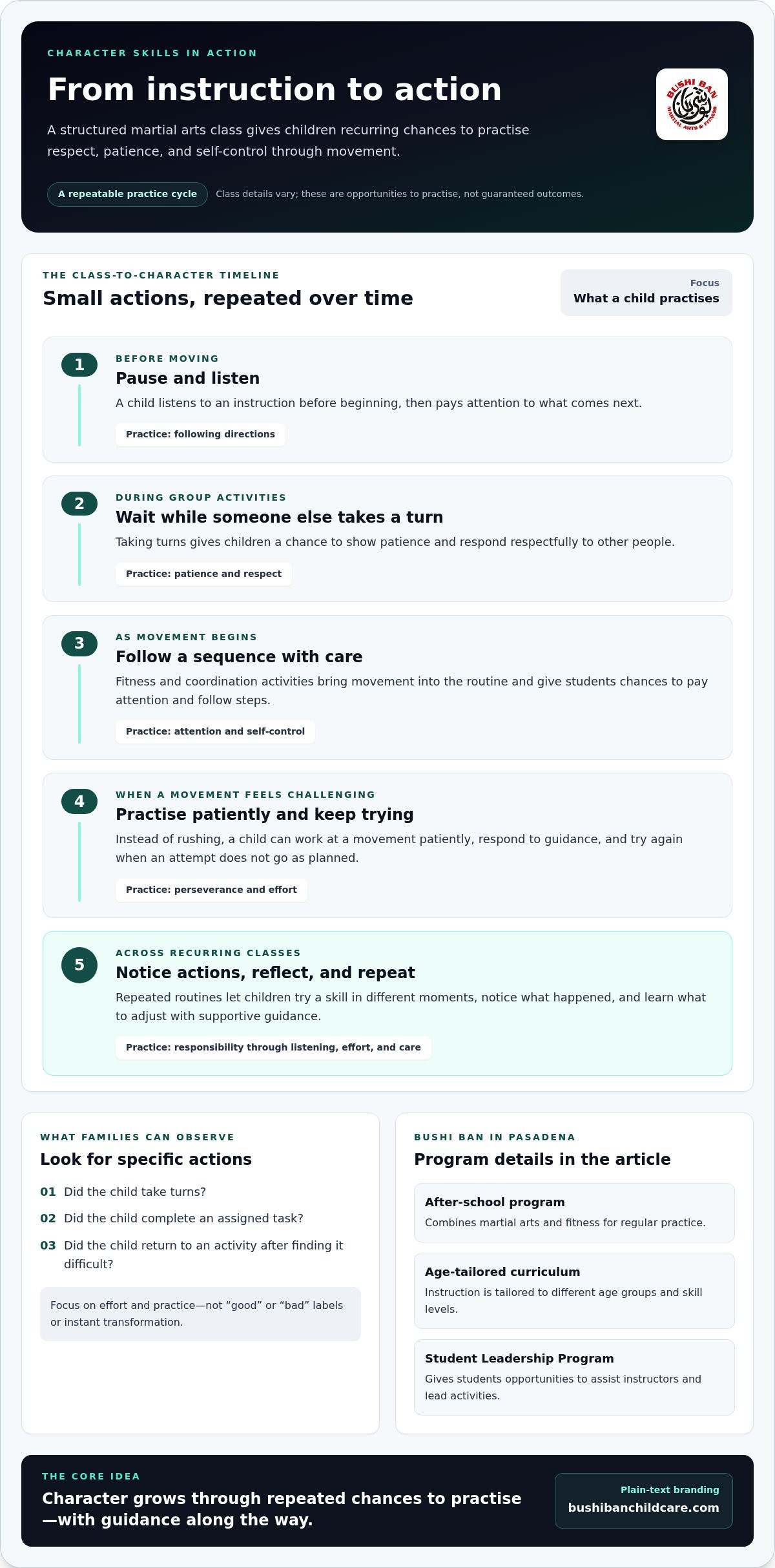
A single conversation about respect can introduce an idea. A recurring routine lets a child try it in different moments, notice what happened, and try again. For example, following directions may mean listening to a new instruction one day and remembering a familiar group routine the next. Repetition builds familiarity, while supportive guidance helps children understand what to adjust.
Clear expectations also make progress easier to notice. Parents and children can reflect on observable actions: Did the child take turns? Complete an assigned task? Return to an activity after finding it difficult? These questions focus on effort and practice rather than labels such as “good” or “bad.” They help families recognize developing habits without expecting instant transformation.
Structured martial arts and fitness classes offer one setting for active practice, with instruction and routines that give students opportunities to follow directions and show respect. At Bushi Ban, the curriculum is tailored to different age groups and skill levels. For a closer look at how martial arts connects with concentration and everyday routines, explore this martial arts focus and discipline guide. Considering what a child can practise repeatedly is a helpful first step before comparing specific programs.
How martial arts can turn character lessons into active practice
Martial arts gives children a physical setting in which to practise listening, patience, and self-control alongside movement. An instructor’s direction becomes something to act on: pause, pay attention, then try a movement with care. Character skills can feel less abstract when students encounter them as part of participating in class.
Class routines give students recurring chances to listen before acting, wait while another person takes a turn, and respond respectfully to guidance. Physical activity adds energy and challenge, while practising a movement patiently can ask a child to manage frustration and keep trying. These are opportunities to practise, not proof that every student will respond the same way or develop a skill automatically.
Consistent practice gives children repeated opportunities to demonstrate responsibility through listening, effort, and care for shared activities. For parents comparing character building programs for youth Pasadena, the connection between instruction and action can help distinguish an active practice setting from an approach focused mainly on discussion. Youth.gov offers broader resources on supporting effective youth programs, including approaches to youth development.
What can children practise during a structured martial arts class?
In class, a child might listen to an instruction before beginning, take turns during an activity, or practise a movement patiently instead of rushing through it. Fitness and coordination activities add movement to enrichment, giving children opportunities to pay attention and follow a sequence. The details vary by class, so parents can focus on what students are asked to practise, not just which skills a program names.
Movement-based experiences also connect with physical literacy, the ability and confidence to take part in physical activity. Bushi Ban’s curriculum is tailored to different age groups and skill levels, helping make instruction relevant to students at different stages. Parents interested in how movement and coordination fit together can explore this kids fitness and coordination guide.
How can responsibility grow into student leadership?
Leadership can be a further opportunity for students who are ready to take on more responsibility. It isn’t a requirement for every child, and it doesn’t need to be the starting point for character practice. At Bushi Ban, the Student Leadership Program offers opportunities to assist instructors and lead activities, with teaching, public speaking, and mentorship among its focuses. Students can practise contributing to a group while learning that leadership involves service as well as visibility.
Families in Pasadena, Deer Park, and La Porte can explore how Bushi Ban’s martial arts and fitness programs bring structured physical practice into after-school enrichment. Progress is individual. The value lies in having a consistent setting where children can keep practising and take on new challenges over time.
How Pasadena parents can compare youth character-building approaches
Programs can share goals such as respect and responsibility while offering very different ways to practise them. A classroom-based lesson may focus on discussion or group projects. Team activities bring cooperation into games and shared goals. Martial arts pairs instruction with physical practice and fitness. None is automatically right for every child. Compare what children do repeatedly, how they participate, and what kinds of responsibility the format makes possible.
This practical view can make a search for character building programs for youth Pasadena easier to navigate. Use the table as a starting point, then consider whether the format fits your child’s interests and your family’s goals.
Which program format may fit your child’s interests?
Notice what draws your child in: active movement, predictable routines, group participation, or the chance to help and mentor others. A child who enjoys movement may find martial arts engaging, while another may prefer discussion-based activities or team play. Bushi Ban’s curriculum is tailored to different age groups and skill levels, which is useful to consider when thinking about developmental fit. The best match is one your child can participate in meaningfully.
Family goals matter, too. Some parents want an active after-school enrichment option; others may prioritize shared projects or team experiences. The U.S. Department of Labor describes youth programs connected to workforce development and career exploration, offering a wider perspective on skills young people may practise over time. Its U.S. Department of Labor Youth Programs page provides information about those opportunities.
What does a character-focused program look like in practice?
Rather than relying on broad promises, look for observable features. A quick comparison checklist can include:
Children have recurring opportunities to take part and practise.
Expectations are clear enough for children to understand what participation involves.
Responsibilities are appropriate to the child’s age, experience, and role.
Bushi Ban combines martial arts training and fitness with structured after-school enrichment, giving students a consistent activity setting. Its Student Leadership Program adds opportunities to assist instructors and lead activities. For more on leadership as a distinct pathway, the youth student leadership programs guide explores how students can practise teaching, public speaking, and mentorship skills. Comparing formats this way helps families focus on the experience, not just the program label.
How to decide whether a Pasadena youth program fits your family
A strong fit is about more than a program’s name or the skills it says it values. Consider what your child enjoys, what you hope they’ll practise, and whether the activity can fit into family life. This four-step process can help families in Pasadena, Deer Park, and La Porte compare options with realistic expectations.
Identify your goals. Choose one or two skills to focus on, such as responsibility, confidence, or perseverance. A specific priority makes it easier to recognize relevant practice opportunities than a broad goal like “better character.”
Consider your child’s interests. Think about whether they’re drawn to movement, clear routines, group participation, or helping others. An active, structured experience such as martial arts may appeal to a child who enjoys learning through movement, while another child may prefer a different format.
Understand the routine. Consider how the activity fits around school, family commitments, and your child’s energy after the school day. A manageable routine can make consistent participation easier. For an after-school martial arts and fitness program, consider whether regular training is the kind of enrichment your child would look forward to.
Review progress over time. Notice specific actions rather than expecting a sudden personality change. Progress can be gradual, and a child may show a skill in class before using it confidently in other settings.
Which questions help clarify your child’s goals?
Ask your child which activities interest them, what they find challenging, and whether they enjoy structured group experiences. You might also ask which one or two skills they’d like to practise. Preferences and readiness can change as children gain experience, so treat early impressions as a starting point, not a permanent label. A good family fit leaves room to learn and adjust expectations.
How can parents recognize meaningful progress?
Look for actions you can describe: completing a practice task, following an instruction, or taking responsibility for a role in class. These moments don’t guarantee a particular outcome, but they give families something concrete to notice and discuss. Try calm, open-ended conversations: What felt rewarding today? What was difficult? What would you like to try again? Listening keeps the conversation connected to your child’s experience, not just adult expectations.
For families exploring character building programs for youth Pasadena, Bushi Ban offers structured after-school martial arts and fitness, with a curriculum tailored to different age groups and skill levels. The right choice aligns your child’s interests with the kind of practice your family values. Explore Bushi Ban’s programs to learn more about its after-school enrichment options.
Bushi Ban’s character-building martial arts program serving Pasadena
For families seeking active after-school enrichment, Bushi Ban offers structured martial arts and fitness programs serving Pasadena, Deer Park, and La Porte. Training gives students a recurring setting to practise movement, listen to instruction, and build discipline through participation. The focus is martial arts training, fitness, and discipline, with character skills practised over time rather than treated as instant results.
What can families expect from Bushi Ban’s after-school approach?
Classes combine structured martial arts instruction with fitness. As students return to practice, they have opportunities to engage with class routines and work on their skills. Repeated routines can make expectations more familiar, while instructors tailor the curriculum to different age groups and skill levels. This helps families consider whether the approach suits a child’s stage and experience without assuming every student progresses in the same way.
The program is structured after-school enrichment, not all-day child care. That distinction helps parents decide whether they’re looking for a focused activity centered on training and fitness or a different type of care arrangement. For families comparing character building programs for youth Pasadena, Bushi Ban offers an active setting where discipline is connected to practice rather than presented only as an abstract goal.
Regular participation gives students repeated opportunities to work through instruction and training. A child might focus on following a sequence, paying attention to guidance, or continuing to practise a skill. The value is in returning to the activity and engaging with it, rather than expecting one class to produce lasting change. Parents can look for small, observable signs of participation and effort while allowing each child’s development to take its own course.
When might the Student Leadership Program be a next step?
For students ready to take on additional responsibility, Bushi Ban’s Student Leadership Program offers an advanced pathway. Students have opportunities to assist instructors and lead activities, extending their participation beyond their own training. These roles let students practise contributing to a group and supporting others.
The program’s focus on teaching, public speaking, and mentorship connects leadership with action. A student who helps lead an activity, for example, has an opportunity to practise communicating with others and taking responsibility for a role. Leadership isn’t a requirement for every child, nor does participation promise a specific outcome. It’s an option for students ready to explore a different kind of challenge.
Families can consider whether the martial arts and fitness approach matches their child’s interests, after-school needs, and readiness to participate. Bushi Ban serves families across Pasadena, Deer Park, and La Porte with structured programs centered on training and fitness. Explore Bushi Ban programs to learn more about the options.
Choose a next step your child can grow into
The best next step doesn’t need to solve every developmental goal at once. Start with a simple conversation: What kind of activity would your child be excited to return to? Which challenge feels worthwhile right now? Their answers can help your family choose an experience that feels inviting while still offering room to stretch.
As you compare character building programs for youth Pasadena, look for an approach that can grow with your child’s interests. A first step might be trying a structured activity, then noticing what your child talks about afterward: a skill they enjoyed, a moment they found tough, or a role they’d like to take on. Those reflections can guide your family’s next decision without expecting instant change.
If martial arts and fitness feel like a promising fit, explore how Bushi Ban’s programs can support your child’s next stage of practice and participation. Explore Bushi Ban’s youth programs and take the next step at a pace that feels right for your family. Every meaningful journey begins with an opportunity to try.
Frequently Asked Questions
What are character-building programs for youth?
Character-building programs are organized activities that give children chances to practise positive qualities through participation. Rather than treating respect or responsibility as ideas to memorize, a program can connect them to shared tasks, group expectations, or personal goals. Parents can look for a clear link between a stated value and something a child can actually do, then talk together about what felt easy or challenging after the activity.
Can martial arts help children develop responsibility and self-discipline?
Martial arts can offer children opportunities to practise responsibility and self-discipline as they participate in training. For example, a student might focus on listening to an instructor, remembering a sequence, or taking care with shared class activities. These are practice opportunities, not guaranteed outcomes. Children develop at different paces, and skills they use in class may take time and experience to carry into other parts of life.
How do parents compare character-building programs for kids?
Compare the activities children actually do, how regularly they can participate, and what responsibilities they may take on. Ask whether your child is more engaged by movement, teamwork, discussion, or helping others. For families searching for character building programs for youth Pasadena, consider how each program fits the child’s interests and the family’s after-school routine instead of choosing by label alone.
Is martial arts a good fit for a child who is new to structured activities?
It may be a good fit if your child is curious about movement and open to learning within a group routine. A child who feels unsure at first can build familiarity over time, though each child responds differently to a new activity. Consider what helps your child feel comfortable trying something unfamiliar, and talk about what they enjoyed or found difficult afterward. An interest in martial arts can be a useful starting point.
What skills can children practise in an after-school martial arts program?
Children can practise physical skills such as coordination and fitness alongside habits that support participation, including listening, patience, and persistence. Working through a movement sequence, for instance, asks a student to pay attention and give the steps a careful try. The specific experience depends on the class and the student. These are opportunities for practice, not promises that a child will behave or perform a particular way.
How does a youth martial arts program create opportunities for leadership?
A youth martial arts program can offer leadership opportunities by giving students roles that involve helping others. At Bushi Ban, the Student Leadership Program offers opportunities to assist instructors and lead activities, with teaching, public speaking, and mentorship as areas of focus. This can be a next step for students interested in taking on more responsibility. Leadership is an opportunity to explore, not a requirement for every child.
Where can Pasadena families find youth character-building programs?
Families in Pasadena can explore city youth recreation options as well as structured after-school activities such as Bushi Ban’s martial arts and fitness programs. Bushi Ban serves families in Pasadena, Deer Park, and La Porte, Texas. To narrow the search, start with the kind of experience your child wants, such as active training or group recreation, then consider how it fits your family’s routine and goals.

Comments