
The right after-school plan starts with the right school location. Finding after-school care for a kindergartner in Deer Park means looking at which locations offer care and whether your child is eligible there.
It’s understandable to want more than a place for your child to spend the afternoon. A reassuring routine can also give young children time to move, learn, connect with peers, and build confidence after the school day.
This guide explains how to think about school location and eligibility, what children may do during the afternoon, and how to weigh activities and homework support. You’ll have a clearer picture of the questions that shape a good fit for your family and your kindergartner’s routine.
Key Takeaways
- Care options can differ by school location, so the school your child attends is a key starting point.
- Eligibility depends on the program’s grade range and the participating school, with details to explore for kindergarten through eighth grade.
- Learn what to look for in age-appropriate activities and the way afternoon routines may make room for homework.
- Bushi Ban Child Care offers an After-School Martial Arts Program for families considering movement, discipline, and skill-building after school.
Table of Contents
Program availability by school location
In Deer Park, after-school options may include school-based care and structured enrichment programs. Start by considering your child’s school, schedule, and the kind of afternoon experience your family wants.
Available Program Locations
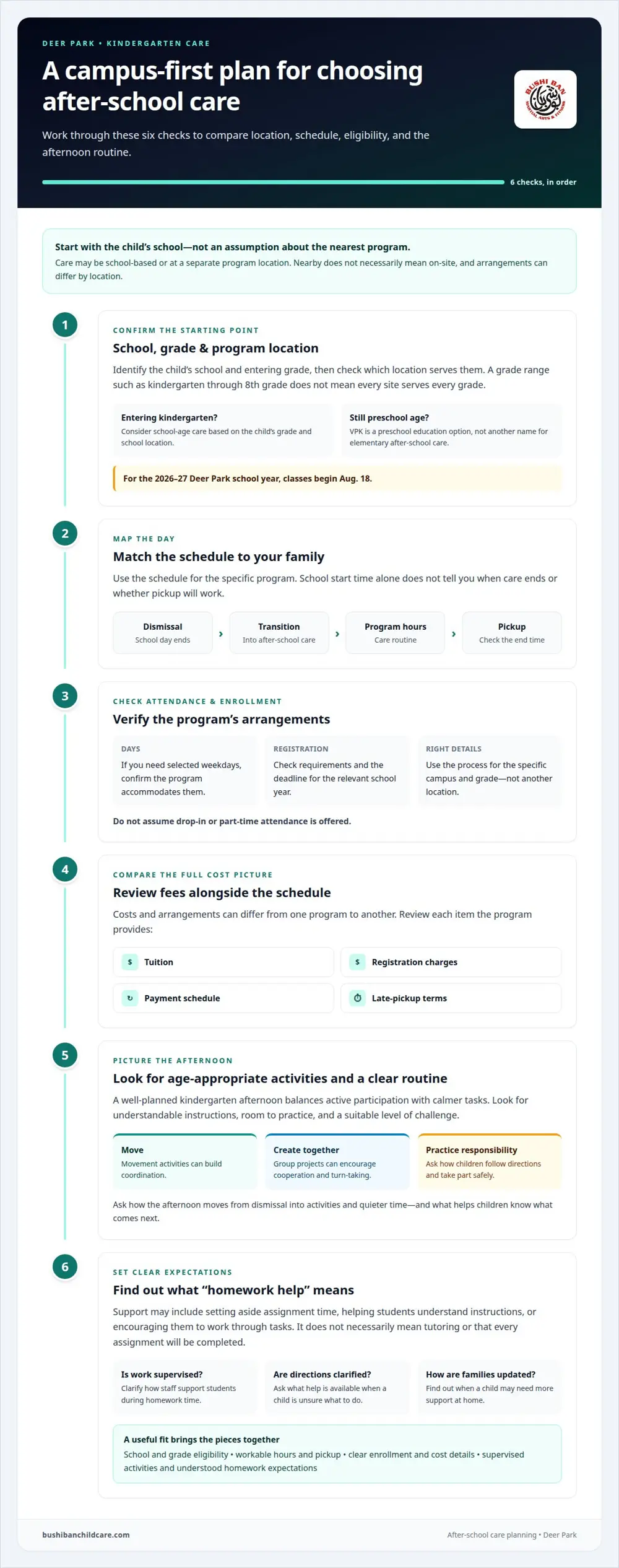
Begin with your kindergartner’s school and the hours your family needs covered. A program serving families in Deer Park may be based away from the school, while options in Pasadena or La Porte may have different arrangements. Nearby does not necessarily mean on-site, so consider whether you need care at school or can use a separate program location. This campus-first approach helps narrow the choices without assuming every school offers the same care.
After-School Program Hours
School start time alone won’t tell you the after-school schedule. Compare dismissal, the transition into care, program hours, and pickup time with your family’s daily routine. For example, a parent arranging pickup after work needs to know when the program ends, not just when the school day starts. Use the schedule for the specific program you are considering.
Attendance options depend on each program’s schedule and enrollment arrangements. If your family needs care on selected weekdays, look for an option whose routine fits those days rather than assuming every program offers drop-in or part-time attendance.
Enrollment requirements and registration deadlines also vary by program. Identify the campus and grade first, then follow the program’s registration steps and deadline for the relevant school year. This helps families avoid relying on another location’s process or timing.
Kindergarten students may participate in school-based care or other after-school programs designed for their age and needs. Consider the program’s setting, activities, and routine rather than assuming that a program serving Deer Park offers care at a particular elementary school.
When comparing programs, review the tuition, registration charges, payment schedule, and any late-pickup terms provided. Consider costs alongside the activities and schedule, since arrangements can differ from one program to another.
Age-appropriate activities and monitored homework
For kindergarten students, a well-planned afternoon balances active participation with calmer tasks. Look for a clear routine that makes room for both.
Supervised Age-Appropriate Activities
Consider whether activities give young students understandable instructions, room to practice, and a suitable level of challenge. For example, a movement activity can build coordination, while a group project can encourage cooperation and turn-taking. Supervision should help children follow directions and participate safely, rather than leaving them to manage a complicated activity alone.
Ask how the afternoon moves from dismissal into activities and quieter time. A predictable sequence can help a kindergartner understand what comes next, especially after a full school day. Look for examples of active play, creative tasks, and opportunities to practice responsibility. These details help you judge whether the routine suits your child’s age and energy.
Homework Time and Staff Support
Homework support may include setting aside time for assignments, helping students understand instructions, or encouraging them to work through tasks. It does not necessarily mean tutoring or that every assignment will be completed. Clear expectations help families understand what kind of academic support is part of the afternoon.
Before you enroll your child, consider how homework time fits into the afternoon routine. For example, a kindergartner may benefit from a short, focused work period followed by a quieter activity. Find out what “homework help” means in the program’s description, including whether staff supervise the work, clarify directions, and let families know when a child needs more support at home. Clear expectations help parents and students understand the role of after-school care.
Students who enjoy helping peers or leading group activities may also value structured leadership practice. The Student Leadership Program develops teaching and activity-leading skills.
Kindergarten through 8th-grade eligibility
Eligibility depends first on whether a child needs school-age care or preschool education. An elementary student entering kindergarten has different program needs from a preschooler preparing for school. For care spanning kindergarten through 8th grade, confirm that the program accepts the child’s grade and school location. A grade range describes who may be eligible, but it doesn’t mean every location serves every grade.
For the 2026-27 Deer Park school year, classes begin Aug. 18. Families can use the child’s entering grade and school-year start to plan enrollment timing. A kindergartner joining elementary school may need an after-school routine, while a child still in preschool may need an early-learning opportunity instead. These are different pathways, even when both support a child’s education and connections with friends.
VPK is a preschool education option, not another name for elementary after-school care. Preschool eligibility depends on a child’s age and the specific program’s enrollment criteria. Use age requirements to assess preschool options, and your child’s grade and school location to consider school-age care. This distinction helps families focus on the right type of program.
Preschool programs may have enrollment requirements that families should check before applying. Students suspected of having a disability must register with the district. Preschool Connections also requires a parent or adult to be present for the full class. These steps apply to preschool participation, not automatically to after-school care for a kindergartner or older elementary student.
Before choosing, sort the decision into three parts: your child’s current age, the grade they will enter, and the kind of program your family needs. A child entering kindergarten belongs in the school-age discussion, while a younger child may need a preschool option such as VPK or Preschool Connections. This distinction gives families a clear starting point.
After-school care for kindergarten through grade 5
Kindergarten through grade 5 spans several stages of elementary school. A kindergartner may need clear transitions and simple directions, while a fifth grader may value greater independence. For families comparing child care, the useful question is how the afternoon routine fits each child’s age, school day, and ability to participate.
Think about the shift from classroom learning to after-school time. A younger child might benefit from a familiar sequence, such as arriving, putting belongings away, and joining a guided activity. An older elementary student may be ready to take more responsibility for personal items or group tasks. Consider both the program’s grade range and its daily structure when deciding whether children will feel included.
Use these practical points to assess a program for your child:
Grade fit: Confirm the program serves your child’s grade, from kindergarten through grade 5, rather than assuming every elementary grade is included.
Age-appropriate routine: Look for a balance of guided activities, movement, and quieter time that can suit younger and older children.
Growing independence: Consider how children can practice simple responsibilities, such as following directions or preparing for the next activity.
School-day transition: Ask how the afternoon starts after dismissal and how children move into scheduled activities.
For example, siblings in kindergarten and grade 4 may attend the same program but benefit from different levels of instruction and responsibility. A thoughtful approach recognizes those differences without treating either child as too young or too old to participate. Families can also consider whether their child prefers structured group activities, active movement, or a quieter transition after school.
Choose care that aligns with the child’s grade and the kind of afternoon routine that helps them take part confidently. Explore after-school program options for a structured way to continue learning and build skills beyond the elementary school day.
Bushi Ban Child Care
Bushi Ban Child Care offers an activity-centered option for families in Deer Park, Pasadena, and La Porte. Its After-School Martial Arts Program combines martial arts training with after-school care, fitness, and structured enrichment. The Student Leadership Program helps students develop teaching and activity-leading skills, while Seasonal and Holiday Camps provide activities during school breaks.
For a kindergartner, consider whether a structured, movement-based program suits your child’s interests and routine. Bushi Ban’s after-school program combines martial arts with activities such as playtime, obstacle courses, drills, games, fitness classes, snacks, and homework time. It offers structured after-school enrichment rather than all-day child care.
Contact Bushi Ban Child Care to discuss which program may fit your child’s after-school interests.
Choose an afternoon routine that fits your family
As you choose after-school care for kindergarten in Deer Park, let your child’s interests and daily rhythm guide the decision. A supportive routine can make room for confidence, movement, and belonging, not simply fill the hours after dismissal. Consider what helps your child feel ready to participate when the school day ends.
Next, decide what kind of growth you want after school. Bushi Ban Child Care offers an After-School Martial Arts Program, Seasonal and Holiday Camps, and Martial Arts & Fitness Classes. These options bring structured movement and skill-building into after-school and school-break routines.
Think about which activities your child would look forward to, then connect that preference with your family’s routine. A conversation can help you explore the options that fit your child’s interests. Contact Bushi Ban Child Care to take the next step with confidence.
Frequently Asked Questions
Who Can Participate?
For families in Deer Park, Pasadena, and La Porte, start with your child’s school and grade when considering after-school care. Kindergarten after-school programs serve a different need from preschool education, so use your child’s current stage to guide the choice. Bushi Ban’s after-school program combines martial arts training, fitness, and structured activities.
Which Deer Park schools offer on-site after-school care for kindergarteners?
The right arrangement depends on what your family needs after school. Bushi Ban Child Care offers a structured after-school program that combines martial arts training, fitness, playtime, and homework time. Families in Deer Park can consider whether this activity-based routine suits their child and pickup schedule.
What are the hours and pickup times for kindergarten after-school care in Deer Park?
When comparing after-school options, focus on the actual schedule and how it fits your family’s day. Consider the transition from school, the program’s activities, and your pickup routine. Bushi Ban’s after-school program adds martial arts and fitness to a structured afternoon, offering an enrichment-focused alternative to all-day child care.
How much does after-school care cost in Deer Park, including registration and late-pickup fees?
Costs depend on the program and its enrollment arrangement, and no reliable amount should be assumed across Deer Park options. Registration charges and any late-pickup terms are separate from tuition, so compare each item in the program’s stated payment information. Avoid using another school’s fee as a substitute: schedules, included activities, and registration terms can differ between programs.
What activities, snacks, and homework support do Deer Park after-school programs provide?
Bushi Ban’s after-school offering combines martial arts training with playtime, obstacle courses, drills, games, fitness classes, snacks, and homework time. These activities give families concrete examples of movement and structured enrichment. Homework time provides academic support, but does not promise tutoring or completed assignments, so children may still need help with unfinished work at home.
What staff-to-child ratios, licensing, and safety policies apply to Deer Park after-school care?
Ratios, licensing, and safety policies depend on the program and the rules that apply to its setting; one figure or policy shouldn’t be assumed for every Deer Park option. Bushi Ban’s program includes supervised martial arts instruction and structured activities, but no specific staff-to-child ratio or licensing detail is established here. Keep those operational details distinct from the program’s activities when assessing care.