
After-school care costs in Texas vary by program type, schedule, and the child’s age. The after school program cost in Pasadena, TX, depends on the care a family needs and the options available for school-age children.
It makes sense to look closely at cost: families need a dependable plan for the hours after school, and the right fit should work for both a child’s routine and a household’s budget. But a rate alone doesn’t show how a program’s schedule or activities match your needs.
This guide explains how Texas rates relate to school-district and private programs, what age ranges and availability can mean for your search, and which factors shape the overall cost of care. You’ll also learn how an after-school martial arts program can offer a structured alternative centered on movement, discipline, and growth.
Key Takeaways
- Compare school-district and private care by schedule and program type to understand what drives Texas rates.
- Use a child’s age and the program’s age range to narrow down suitable school-age options.
- Factor in availability and the school-year schedule when estimating what care may mean for your family budget in Pasadena.
- Explore whether an after-school martial arts program, with movement, discipline, and opportunities to build leadership, fits your child’s routine.
Table of Contents
How much does after-school care cost in Texas?
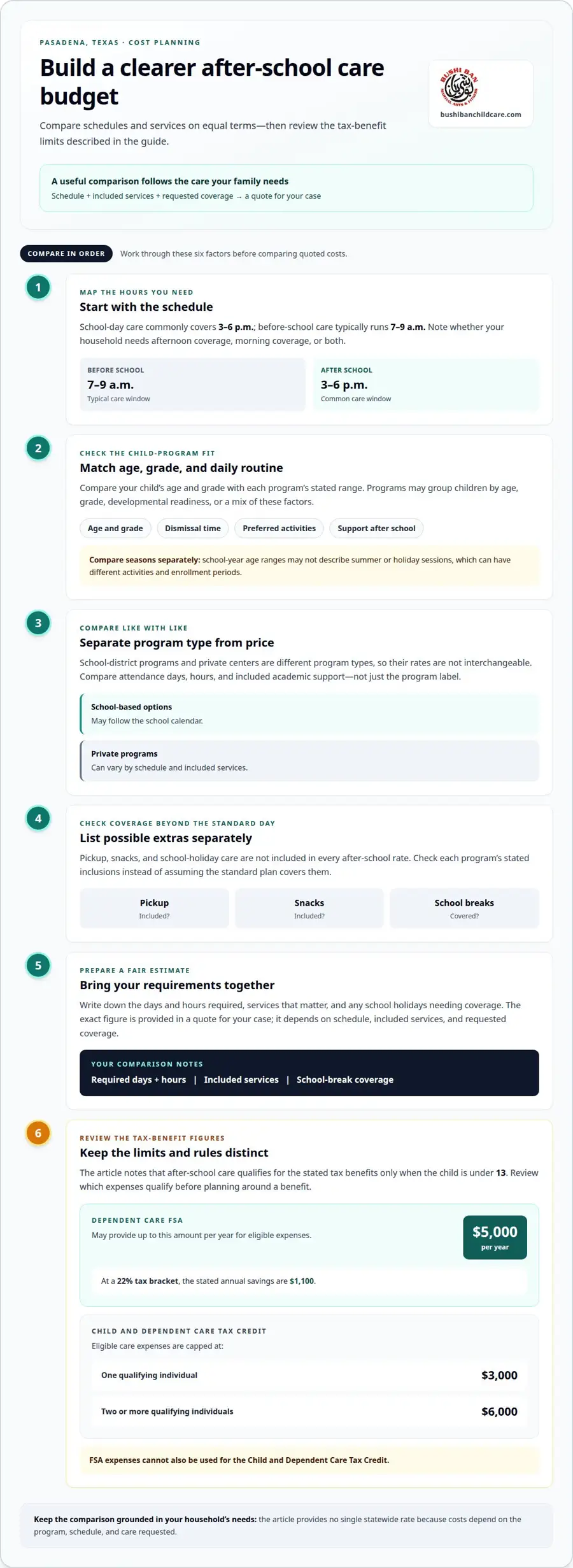
Texas after-school costs depend on program type, schedule, and included learning support. School-day care commonly covers 3-6 p.m.; before-school care typically runs 7-9 a.m.
Care Options for Elementary and School-Age Children
For local elementary students, school-age care can cover the hours before classes, after dismissal, or both. The schedule matters: a family needing only afternoon coverage has different needs from one needing morning and afternoon care. Compare the days covered, pickup arrangements, and whether learning activities are part of the program. The Internal Revenue Service says after-school care qualifies for the stated tax benefits only when the child is under 13.
Costs by Program Type
Texas school-district programs and private centers are different program types, so their rates aren’t interchangeable. School-based options may follow the school calendar, while private programs can vary by schedule and included services. Before-school coverage can also affect a family’s total care budget. For financial planning, separate the costs of morning care, afternoon care, and school-break coverage. A Dependent Care FSA can provide up to $5,000 per year for eligible expenses; at a 22% tax bracket, the stated annual savings are $1,100. FSA expenses can’t also be used for the Child and Dependent Care Tax Credit.
Pasadena Program Cost Comparisons
In Pasadena, private after-school programs and tutoring centers may charge differently depending on attendance days, hours, and whether academic support is included. Compare programs using the same schedule and services, not just their labels. Check how school holidays affect the calendar and whether morning care is part of the schedule. The after school program cost in Pasadena, TX, depends on the care your family needs, not simply on a statewide category.
Financial assistance can change what eligible families pay. For the Child and Dependent Care Tax Credit, the Internal Revenue Service sets eligible care expenses at no more than $3,000 (for one qualifying individual) or $6,000 (for two or more qualifying individuals). Review which expenses qualify before planning how to use tax benefits.
Program age range
Age eligibility helps determine which after-school programs may suit your child. In Pasadena, compare your child’s age and grade with each program’s stated range, then consider whether the schedule and activities fit their school stage. A kindergartener and an older elementary student may need different levels of structure after dismissal.
Make a short comparison list with your child’s age, grade, dismissal time, and preferred activities. A student who enjoys active group activities may gravitate toward movement-based programming, while a child who wants quiet study time may prefer a learning-focused setting. These details help narrow the options without assuming every program serves the same ages.
Programs may group children by age, grade, developmental readiness, or a mix of these factors. Review how each program describes its groups and daily routine. A child ready for more independence may enjoy activities that build responsibility, while a younger student may benefit from clear transitions between school and afternoon activities.
Summer schedules deserve a separate comparison. A program’s school-year age range may not describe its summer or holiday sessions, which can have different activities and enrollment periods. Treat each season as its own decision: compare age eligibility, daily structure, and the child’s interests before choosing. This keeps the plan aligned with the child’s changing routine.
For Pasadena families, the best next step is to create a short age-and-needs profile before comparing programs. Include the child’s grade, preferred activities, and the support that helps them settle after school. Then use those details to assess fit alongside cost and availability. A clear profile makes the search more focused and helps identify programs that support both care needs and healthy growth.
School-age childcare rates
For Pasadena families, the cost of school-age care reflects more than the hours after dismissal. Compare the schedule, included services, and school-break arrangements together.
School-Age Care Rate Details
Start by matching the schedule to the care your household needs. A child attending on selected days may need a different arrangement from one attending throughout the school week. Check whether the rate covers a set schedule or varies with attendance, then compare activities and academic support to understand what each program offers.
For a practical comparison, list the days and hours required, then note what each program includes. This makes differences easier to see without relying on the program label alone. The exact figure is provided in a quote for your case; it depends on the schedule, included services, and requested coverage.
Pickup, Snacks, and Holiday Coverage
Pickup, snacks, and school-holiday care are not included in every after-school rate. Review each program’s stated inclusions separately. If your family needs pickup or care during school breaks, compare those needs with the program’s schedule rather than assuming the standard plan covers them.
In Pasadena, note whether your family needs pickup, snacks, or care during school breaks, then compare those needs with each program’s description. This shows how well the schedule fits your routine, including days when the school calendar changes.
School-age childcare rates can also depend on how consistently a child attends and which activities are included. A family seeking a steady after-school routine may prioritize predictable coverage, while another may need a plan that accounts for changing school-week commitments. These needs shape the quote and help explain differences between program options.
Before choosing, organize the decision around three practical points: the required schedule, the services that matter, and any school holidays needing coverage. This keeps the comparison focused on your child’s routine. It also helps distinguish the base after-school plan from any additional coverage your family may need.
What is the average cost of after-school programs in Pasadena, TX?
A statewide average is not a guaranteed rate for Pasadena. School-district programs, private programs, and tutoring centers may offer different schedules and services, so their costs are not directly comparable. Start by identifying the type of program and coverage your household needs.
Program format matters. School-district programs may follow the school calendar, private centers may structure schedules and activities differently, and tutoring centers may focus primarily on academics. Compare what each option provides, rather than relying on its category.
Attendance patterns also matter. A child attending on selected weekdays needs different coverage from one attending every school day. Write down the days and hours you need, along with whether academic support or other structured activities are a priority. Use the same criteria to compare programs in Pasadena.
A program’s activities and services are another point of comparison. A schedule with additional activities differs from one focused on supervision and study time. Check how school-calendar changes are handled, and consider regular school-day care separately from holiday plans. These details make budgeting more practical.
The exact figure for a particular program depends on the schedule, program format, and included activities, and is given in a quote for your case after a quote request. For a clear comparison, prepare the child’s grade, attendance pattern, and preferred activities. This helps align the estimate with the routine the family actually needs.
Treat a Pasadena average as a point of comparison, not a rate that applies to every program. A school-based option and a private tutoring center may serve different needs, even if both cover after-school hours. Compare similar schedules first, then consider each program’s learning focus and activities. This helps you make a practical decision without treating different services as equivalent.
Program format, schedule, attendance, and included activities all shape the cost. When comparing programs, consider your child’s grade, the days and hours you need, and the activities your family values.
Bushi Ban Child Care: After-School Martial Arts Program
Bushi Ban Child Care offers an After-School Martial Arts Program for families seeking structured, active after-school care. The program combines martial arts training with playtime, obstacle courses, drills, games, snacks, homework time, and fitness classes. The Student Leadership Program gives students opportunities to lead activities and teach under instructor supervision.
This program may suit families who want martial arts, movement, confidence-building, and personal growth as part of after-school care. Seasonal and Holiday Camps provide a related option during school breaks, while Martial Arts & Fitness Classes support participation beyond the after-school routine.
Consider whether martial arts and leadership activities match your child’s interests and your family’s schedule. Contact Bushi Ban Child Care to learn about its after-school program in Pasadena, Deer Park, and La Porte.
Choose an After-School Routine That Helps Your Child Grow
Your next step is to match your family’s schedule with an after-school experience your child will enjoy. A purposeful routine can make room for movement, focus, and confidence-building, not just care after dismissal. As you consider the after school program cost in Pasadena, TX, weigh your child’s interests and what they’ll gain from an active afternoon.
Bushi Ban Child Care’s After-School Martial Arts Program brings martial arts into the after-school routine. Seasonal and Holiday Camps offer an option during school breaks, while Martial Arts & Fitness Classes provide additional opportunities for physical activity. Contact Bushi Ban Child Care to find the program that best fits your child’s interests and your family’s needs.
Connect with Bushi Ban Child Care to discuss an after-school option for your family. A thoughtful choice today can help make each afternoon a chance to build skills and enjoy progress.
Frequently Asked Questions
Are sibling discounts or financial aid available for after-school programs in Pasadena, TX?
Texas Child Care and Development Fund assistance may be available to eligible families. Sibling discounts, if offered by a program, are separate from public assistance. For budgeting, include a sibling discount only when the program’s terms explicitly provide one.