
Confidence grows through practice, not pressure. Confidence-building activities for kids in Pasadena can include sharing family compliments on colored paper, rehearsing unfamiliar situations, keeping a list of wins, and taking on helpful responsibilities at home. Together, these simple activities give children ways to practice friendship, independence, and resilience.
It’s natural to want your child to feel comfortable making connections and trying new things, even when they’re unsure. Small, encouraging steps can make new experiences feel more manageable and help children recognize their own effort.
Here are practical ideas for building social skills and teamwork, preparing for new situations, valuing progress over perfection, and giving children age-appropriate responsibilities. Choose an activity that fits your child’s interests, then make time to recognize each attempt and what they learn along the way.
Key Takeaways
- Help children practice friendship and teamwork by creating low-pressure chances to listen, cooperate, and notice what others do well.
- Use role-play to rehearse an unfamiliar situation and consider different ways your child could respond.
- Celebrate effort and small steps forward, and help children see “I can’t do it yet” as room to keep learning.
- Offer responsibilities suited to your child’s age, from putting away toys to helping prepare a simple meal, so they can experience contributing to family life.
Table of Contents
1. Social skills, teamwork, and friendship
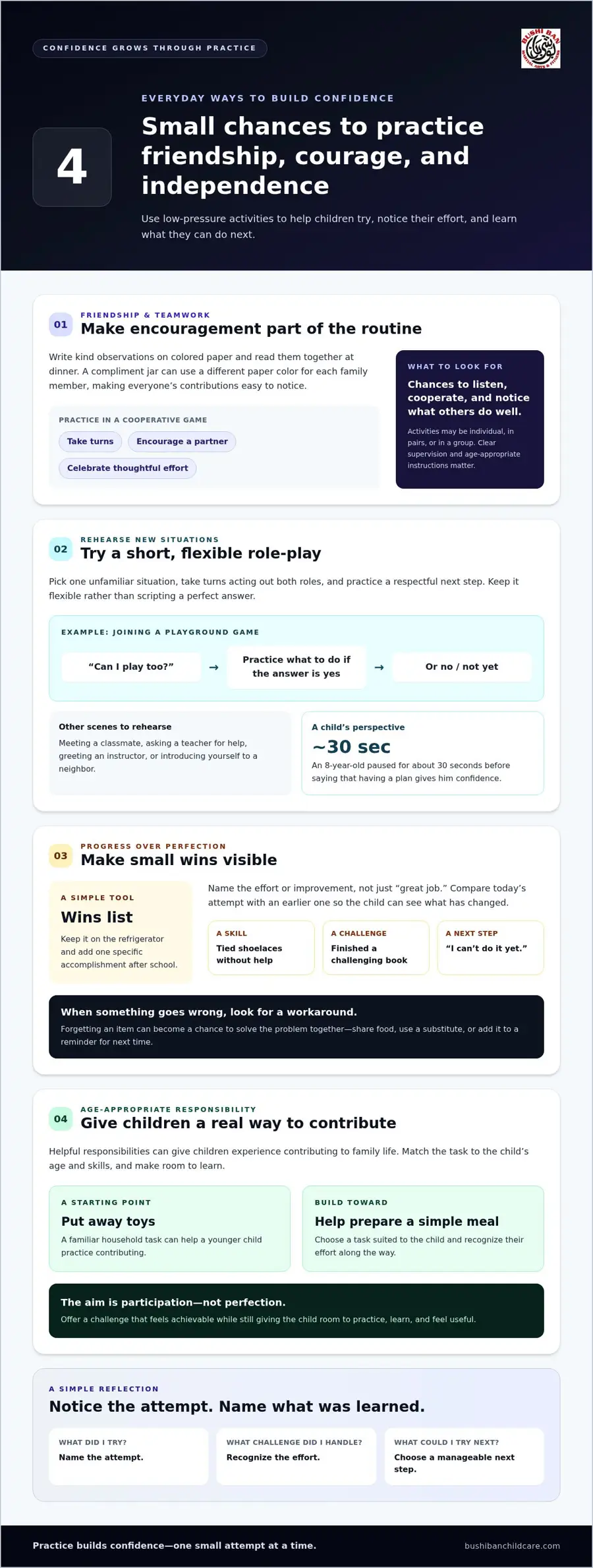
Friendship skills grow through small, repeated actions: listening, taking turns, inviting someone to join, and offering encouragement. Try a family compliment activity by writing kind observations on colored paper and reading the notes together at dinner. A child might praise a sibling for sharing a game or helping tidy up. In a compliment jar, use a different paper color for each family member so everyone’s contributions are easy to notice.
Confidence and self-esteem can strengthen when children feel capable in an area they value. A cooperative game gives them practice without making winning the only measure of success. In golf, for instance, children can take turns, encourage a partner after a missed shot, and celebrate a thoughtful effort. A golf and life-skills curriculum can connect those moments to patience, courtesy, and teamwork, rather than focusing only on the score.
Pasadena activities vary by activity, class size, and format. Compare whether children work individually, in pairs, or as a group, and look for chances to practice conversation and cooperation.
Safety rules, staff qualifications, and parent participation depend on the specific activity and setting. Before choosing, look for clear supervision, age-appropriate instructions, and defined expectations for adults and children.
Compliment sharing at home and cooperative games with everyday materials are accessible ways to practice encouragement. Families can build these activities into their routine without relying on a paid class as the only option.
Adapt activities by changing the task to fit your child’s skills. Younger children can practice taking turns, while older kids can lead a group game or help a teammate. Choose challenges that feel achievable while still offering room to learn.
A home activity can fit naturally into dinner or another familiar routine. For group activities, consider your child’s interests, opportunities to participate, supportive feedback, and what works for your family’s schedule in Pasadena, Deer Park, or La Porte.
2. Role-playing possible outcomes of new situations
A short role-play can help a child rehearse what to say in an unfamiliar situation. Choose one scenario, such as joining a playground game, meeting a classmate, or asking a teacher for help. Take turns acting out both roles. Your child could start with, “Can I play too?” Then switch roles and practice responding warmly when someone approaches.
Keep the practice flexible, not scripted. For a first day in a new activity, act out arriving, greeting the instructor, and asking where to put a backpack. Invite your child to imagine more than one outcome: the instructor may answer right away, or the child may need to ask again. Planning simple responses can help a young person feel prepared. One 8-year-old said having a plan gives him confidence, after pausing for about 30 seconds before answering what helps him feel confident.
At home, role-play forgetting an item, disagreeing during a game, or introducing yourself to a new neighbor. At a Pasadena-area park, practice asking another child to play catch. Rehearse what to do if they say yes, no, or not yet. Keep the focus on trying a respectful next step, not controlling the other person’s response.
After each scene, ask your child to name a strength they used, such as speaking clearly, listening, or trying again. They can also draw a simple plan: what might happen, what they could say, and who could help. Keep it easy to remember, then revisit it after the real situation and talk about what worked.
For practice beyond home, a child who enjoys guiding others can try leading a brief activity with family or peers. Explore student leadership opportunities as another way to practice speaking up and taking initiative.
When a child says they cannot do something, adding “yet” can make room for future learning and shift the focus to what they might be able to do with practice.
3. Emphasizing progress over perfection
Children build confidence by noticing what they can do now, not only what remains difficult. Keep a “wins list” on the refrigerator and add one specific accomplishment after school. It could include learning to tie shoes, finishing a challenging book, or earning A’s and B’s in math. These examples help children see effort and improvement as meaningful achievements.
Make each entry specific. Instead of writing “great job,” note, “You practiced your shoelaces and tied them without help.” If a child is learning a skill, compare today’s attempt with an earlier one. A teacher can also point out a step the student has mastered, such as showing their work in math or joining a group activity. Specific feedback makes progress easier to see.
Mistakes can provide useful information. If a child forgets something while packing for a picnic, talk through what happened and find a workaround together. They might share food, use a substitute, or add the item to a packing reminder for next time. The goal is to practice problem-solving, not label the outing a failure.
When children say, “I can’t do this,” add one small word: “yet.” For example, “I can’t ride a bike yet” leaves room for practice. Help your child choose a next step, such as balancing with support or trying again on a quiet path. Notice the attempt, then let your child decide what to practice next.
Scholarships, financial aid, and trial classes are distinct ways programs may address cost or help families experience an activity before committing. For any opportunity, compare its practical terms with your family’s needs.
A simple weekly reflection can help children keep track of progress. Ask your child to name something they tried, a challenge they handled, and a next step. A short note gives them a record of effort to revisit when a new task feels difficult. Encourage honest answers rather than perfect performance. “I asked for help” can be a meaningful accomplishment.
4. Taking on responsibilities
A useful responsibility gives a child a clear role and a chance to contribute. Start with one manageable task, explain what “finished” looks like, then let your child complete it before offering help. Putting away books, setting out napkins, or checking a school backpack can make everyday routines opportunities to develop independence. Thank your child for a specific contribution, such as remembering the napkins or returning every book to its shelf.
Match chores to your child’s age and abilities. Preschool children ages 2-4 can put away toys and books, set the table, or water plants with assistance. Children ages 5-7 can make their beds, sort laundry, and tidy their play areas. For ages 8-10, try folding clothes, helping prepare simple meals, or sweeping with supervision. Preteens ages 11-12 can do laundry with guidance, assist with cooking under supervision, or help with grocery shopping.
These tasks help children experience being trusted and contributing to family life. Make the expectation specific: “Put your clean clothes in this drawer” is easier to follow than “Help with laundry.” If the task feels too difficult, demonstrate one step, then invite your child to try the next. Gradually reduce reminders as the routine becomes familiar.
Planning a picnic is another practical responsibility. Ask your child to choose a simple menu, make a packing list, and gather the items with your support. If something is forgotten, discuss a workaround together rather than taking over. Older children can take responsibility for a household errand or pet care, with guidance suited to the task and their experience.
Choose one responsibility your child can practice consistently, then recognize their follow-through. Explore activities that encourage responsibility and leadership as a next step for practicing initiative beyond home.
Age-appropriate chores can help children feel trusted and recognize their contribution to family life. Give them a meaningful role in shared routines, with support suited to the task.
The responsibility lesson resource includes 15-minute mini-lessons and activities about how students can be responsible. Letting a child plan and pack a picnic can also give them an opportunity to exercise independence, turning preparation into a chance to make choices and take ownership.
Bushi Ban Child Care: After-School Martial Arts Program
Bushi Ban Child Care offers an After-School Martial Arts Program for families seeking a structured activity after school. Martial arts and fitness classes give children a setting to practice movement, discipline, and persistence as they learn new skills.
For children ready to take on more responsibility, Bushi Ban’s Student Leadership Program offers opportunities to develop teaching and activity-leading skills under instructor supervision. Seasonal and Holiday Camps provide organized activities during school breaks. Consider which format best fits your child’s interests and your family’s routine.
These programs can complement at-home activities, giving children additional opportunities to practice effort and leadership. Visit bushibanchildcare.com to learn more about Bushi Ban Child Care’s programs in the Pasadena, Deer Park, and La Porte area.
Choose a small step your child can own
Confidence develops through experiences children can revisit: trying, reflecting, and choosing what to practice next. Pick an upcoming moment that matters to your child, then agree on a manageable action they can take. It might be greeting a classmate, asking for help, or accepting a new responsibility. Afterward, invite your child to describe what felt comfortable and what they might try differently next time.
For families exploring confidence-building activities for kids in Pasadena, choose a next step that fits your child’s interests and supports steady participation. Bushi Ban Child Care offers an After-School Martial Arts Program, Martial Arts & Fitness Classes, and Seasonal and Holiday Camps. These programs give children in Pasadena, Deer Park, and La Porte structured opportunities to keep practicing beyond home.
Consider which kind of activity feels like a natural fit for your child’s next challenge. Contact Bushi Ban Child Care to explore a supportive next step, and keep celebrating the effort your child brings to it.
Frequently Asked Questions
What confidence-building activities are available for kids in Pasadena, Texas?
Families can build confidence with activities that let children make choices and contribute. Try a cooperative puzzle, invite your child to teach the family a simple game, or let them choose and explain a route on a neighborhood walk. In Pasadena, Texas, families can also explore community activities that match a child’s interests and offer welcoming ways to participate with others.
Which Pasadena organizations offer confidence-building classes or programs for children?
Bushi Ban Child Care offers children’s programs focused on martial arts, fitness, and leadership in Pasadena, Deer Park, and La Porte, Texas. Its Student Leadership Program gives students opportunities to develop teaching and activity-leading skills under instructor supervision. Families in these communities can consider whether structured movement or leadership practice fits their child’s interests and goals.