
Essential Leadership Skills for Elementary Kids: A Complete Parent Checklist
True leadership for young children has almost nothing to do with commanding others; it begins with mastering personal self-discipline. If you've ever watched your child hesitate to speak up in class, or worried they're acting overly bossy on the playground, you aren't alone. Most parents find themselves wondering what foundational leadership skills for elementary kids actually look like, especially when standard school curriculums rarely provide structured character development.
It's completely natural to worry about how your child handles peer pressure, expresses their ideas, or manages frustration. You want them to grow into confident, compassionate individuals, but translating abstract concepts like integrity and teamwork into daily lessons for a young child can feel daunting. Fortunately, genuine leadership isn't an innate trait reserved for natural extroverts. It's a set of practical, daily habits that any child can develop with intentional guidance.
This comprehensive checklist outlines the core leadership skills your child needs right now, actionable methods to cultivate self-discipline and empathy at home, and guidance on selecting structured after-school programs that reinforce strong character for life.
Table of Contents
What Leadership Skills for Elementary Kids Really Mean: Reframing Early Leadership
The Elementary Youth Leadership Skills Checklist: 6 Core Competencies
Assessing Your Child’s Strengths: The Everyday Leadership Observation Guide
Cultivating Leadership Beyond the Classroom: Structured Environments That Work
Practical Strategies to Foster Leadership Skills at Home: Your Action Plan
What Leadership Skills for Elementary Kids Really Mean: Reframing Early Leadership
When adults think about leadership, boardrooms, public speeches, and commanding figures often come to mind. For a seven- or nine-year-old, true leadership looks entirely different. It isn't about directing classmates, winning class elections, or speaking the loudest. Developing authentic leadership skills for elementary kids begins with self-mastery, personal accountability, and compassionate communication. It means learning to govern one's own impulses before attempting to influence others.
Many parents worry that an introverted child lacks the raw material for leadership. That concern stems from a common misconception that equates leadership with extroversion. In reality, leadership is an active practice of responsibility rather than a personality type. As modern research into youth leadership demonstrates, early developmental models focus on internal agency and character rather than social authority. When children transition from waiting for adult instructions to proactively making good choices, they take their first real steps as leaders.
The Crucial Difference Between Leadership and Dominance in Childhood
Parents often witness playground dynamics and wonder where the boundary lies between taking initiative and acting bossy. Bossiness relies on control, demanding compliance through exclusion or sheer volume. Authentic young leadership, however, inspires collaboration. A true leader notices the classmate left standing on the sidelines and invites them into the game. When children guide others through empathy and active listening, they earn genuine respect from peers and teachers without needing to demand it.
Why Ages 6 to 11 Represent the Critical Window for Leadership Development
Between the ages of six and eleven, children experience pivotal cognitive growth. They move beyond early childhood egocentrism and develop the capacity for genuine perspective-taking. This shift creates a prime developmental window to anchor foundational values:
Proactive accountability: Children learn to own their mistakes rather than blaming siblings or classmates.
Peer pressure resistance: Practicing independent decision-making now shields children from toxic conformity in middle school.
Self-discipline habits: Learning to finish homework or practice an activity before playtime cements lifelong personal confidence.
Instilling these habits before adolescence ensures that self-worth is rooted in competence and character rather than outside validation.
The Elementary Youth Leadership Skills Checklist: 6 Core Competencies
Abstract theories about leadership rarely help when you are trying to guide a seven-year-old through daily routines. To build concrete leadership skills for elementary kids, parents need clear, observable behaviors they can track at home and in the classroom. Real growth happens across six core competencies split between internal self-mastery and external interpersonal habits.
Educational experts examining how to raise a leader emphasize that personal agency precedes public success. The following checklist bridges everyday actions with lifelong character development.
Self-Regulation and Personal Discipline: The Internal Leadership Foundation
Before children can guide others, they must learn to control their own reactions. Self-regulation forms the bedrock of character:
Frustration tolerance: Staying calm when a game is lost or a math problem proves difficult, avoiding explosive tantrums or abrupt quitting.
Autonomous routine completion: Finishing morning routines and schoolwork without requiring multiple reminders.
Impulse control: Pausing before reacting to irritation, understanding that immediate feelings do not have to dictate behavior.
Physical disciplines provide an ideal setting for sharpening this focus. Many families find that enrolling in an after-school martial arts program helps translate these abstract emotional concepts into physical habits of respect, perseverance, and daily discipline.
Active Communication: Public Speaking, Clear Articulation, and Respectful Listening
Clear communication allows children to express their thoughts without slipping into timid silence or aggressive outbursts:
Vocal clarity: Speaking loud enough for a group to hear, making polite eye contact, and phrasing questions directly.
Assertive posture: Standing tall with open body language when introducing themselves to new peers or adults.
Reflective listening: Waiting patiently for someone else to finish speaking and summarizing their thoughts before responding.
Social Responsibility: Team Collaboration, Inclusion, and Moral Courage
External leadership reveals itself in how a child treats others when adults aren't actively supervising:
Proactive inclusion: Spotting peers left out on the playground and inviting them to join group games.
Constructive resolution: Proposing fair compromises during disagreements rather than arguing or spreading rumors.
Moral backbone: Calmly defending a peer who is being mistreated, showing that kindness requires genuine bravery.
When children practice these six competencies consistently, leadership transforms from an elusive concept into a daily habit of quiet confidence.
Assessing Your Child’s Strengths: The Everyday Leadership Observation Guide
Evaluating your child's social progress requires looking far beyond surface-level confidence. Many parents mistake quiet obedience for maturity, or loud demands for natural charisma. In reality, young behavior during group activities generally falls into three distinct categories: passive compliance, aggressive dominance, or authentic guidance. Recognizing these patterns helps you identify emerging leadership skills for elementary kids while viewing inevitable social missteps as valuable teaching moments rather than personal flaws.
When assessing how your child handles family routines, collaborative school projects, or youth sports, look for these defining behavioral patterns:
Passive Compliance: Follows instructions silently out of fear of making mistakes, rarely voices personal opinions, and withdraws into the background whenever group dynamics shift.
Aggressive Dominance: Demands control over game rules, interrupts classmates, hoards praise after team wins, and reacts with anger or sulking when challenged.
Authentic Leadership: Offers clear ideas while inviting others to participate, shares credit generously, and maintains emotional composure when unexpected obstacles arise.
Spotting the Quiet Leader: Why Introverts Make Outstanding Role Models
Does your child prefer observant silence over commanding attention in a crowded room? High-decibel energy isn't a prerequisite for effective influence. Quiet leaders guide others through steady, thoughtful example. They demonstrate deep empathy, make careful decisions during disagreements, and complete responsibilities reliably without supervision. Classmates naturally gravitate toward these children because their consistency, fairness, and quiet integrity cultivate lasting peer loyalty.
Playground and Classroom Dynamics: Decoding Behavior in Group Settings
Observing your child during unstructured play reveals how they handle spontaneous social challenges. Notice how they establish boundaries during recess games. An emerging leader calmly says, "That tag wasn't fair, let's reset," rather than yelling or storming away. During academic group work, true leaders celebrate their teammates' efforts rather than demanding the spotlight. When a referee's call alters a game on the sports field, they adapt and encourage their peers instead of pointing fingers. Every misstep in these moments simply highlights where gentle, intentional coaching can happen next.
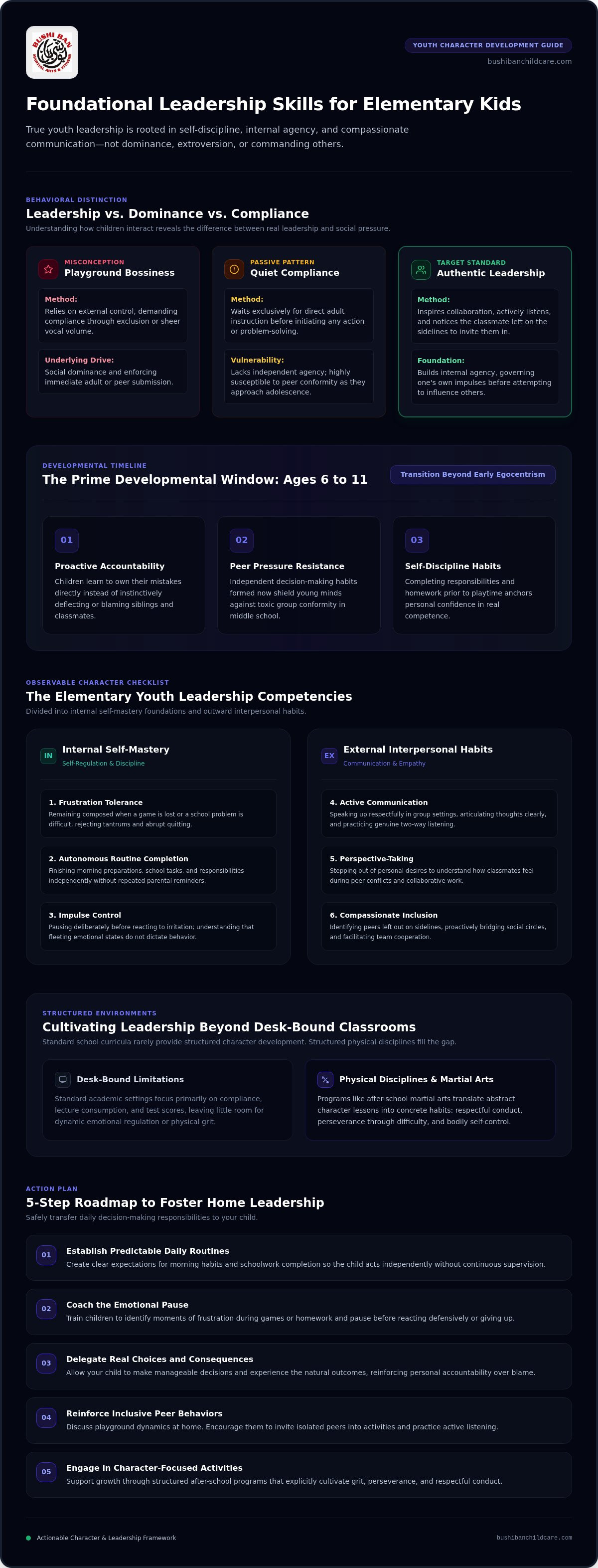
Cultivating Leadership Beyond the Classroom: Structured Environments That Work
Standard elementary classrooms provide essential academic foundations, but they rarely offer daily opportunities for dynamic initiative. Sitting quietly at a desk for six hours teaches children how to follow instructions, yet authentic leadership requires proactive decision-making, physical poise, and active problem-solving. Structured athletic environments bridge this developmental gap by turning abstract ideas into practical grit and resilience. Cultivating strong leadership skills for elementary kids requires an environment where students can test boundaries, overcome physical challenges, and build authentic self-esteem.
The Dojo as an Incubator: Translating Martial Arts Training into Life Skills
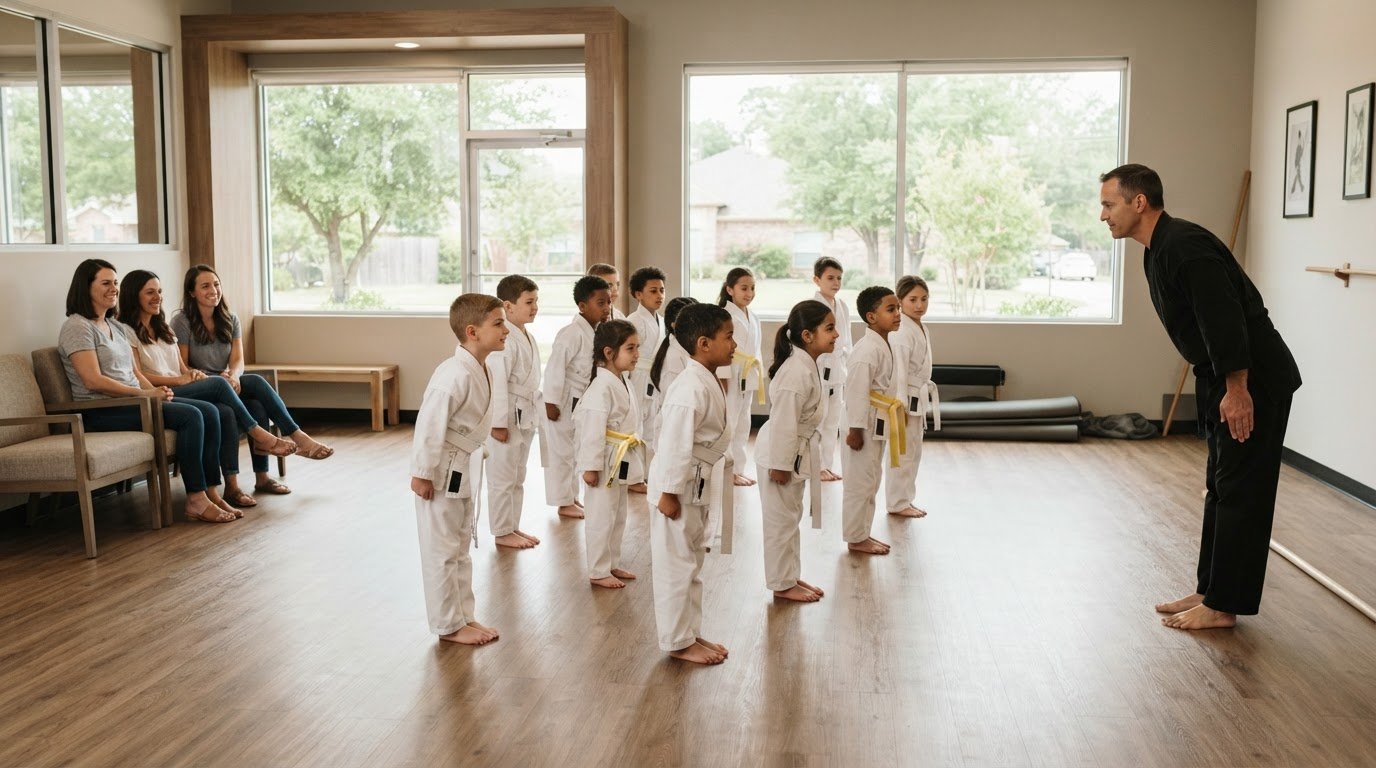
Few environments reinforce character as systematically as traditional martial arts. Dojo etiquette is rooted in mutual respect: students bow upon entering, listen attentively to instructors, and treat training partners with dignity. Learning physical defense techniques doesn't foster aggression; instead, it eliminates the insecurity and fear that often drive playground conflicts. Pushing through rigorous physical drills develops the exact mental endurance children need to persist through challenging academic tasks. Progressive belt promotions also teach an invaluable life lesson: mastery requires steady effort, patience, and personal accountability.
Peer Mentorship and Junior Leadership: Stepping Up to Help Others
A child's leadership capability expands dramatically when they transition from learner to mentor. In a structured setting, advanced elementary students often guide newer peers through basic stances and forms:
Vocal instruction: Older students practice public speaking by giving clear, respectful directions to small groups.
Constructive encouragement: Mentors learn to celebrate a peer's progress rather than pointing out flaws.
Mature accountability: Guiding others encourages children to hold themselves to higher standards of behavior both on and off the mat.
When children experience the satisfaction of helping a teammate succeed, their understanding of leadership shifts from personal achievement to collective growth. To help your child cultivate these foundational life habits in a structured setting, explore the Student Leadership Program at Bushi Ban, where peer mentorship and character education are built directly into every after-school class.
Practical Strategies to Foster Leadership Skills at Home: Your Action Plan
Character development doesn't require complex curriculums or rigid schedules. Transforming home routines into an incubator for authentic responsibility begins with small, intentional adjustments. When parents provide steady guidance instead of micromanaging every decision, children discover their own competence. You can cultivate foundational leadership skills for elementary kids right at the family dinner table and during morning departures through a straightforward five-step framework.
Transfer low-stakes decisions: Let your child choose between two healthy lunch options or plan the family Saturday walk.
Praise grit over results: Commend persistence when a puzzle proves difficult, reinforcing that effort builds mastery.
Implement communal contributions: Assign household jobs that directly support everyone, not just individual bedroom tidiness.
Hold weekly family councils: Create a consistent space where every family member shares ideas and solves challenges together.
Roleplay social scripts: Practice responding calmly to playground exclusion or disagreements before they happen.
Implementing Autonomy and Accountability in Daily Household Routines
Real accountability grows when children realize their actions directly impact the household. Instead of assigning isolated tasks like making their bed, give them ownership of communal responsibilities, such as feeding the pets, preparing the dinner salad, or sorting the recycling. Step back and let natural consequences do the teaching. If your child forgets to pack their water bottle after packing their own backpack, resist the urge to rush to school. Navigating minor setbacks without an immediate rescue builds problem-solving resilience.
Active Dialogue: Teaching Kids to Express Needs and Solve Conflicts
Family discussions teach children how to express opinions assertively and listen without interrupting. Use regular family meetings to discuss upcoming plans, review household expectations, and tackle minor squabbles. If your child struggles with peer disagreements, run quick roleplaying exercises in the living room. Practice saying, "I'm still using this ball, but you can have it in five minutes," using steady eye contact and a clear voice. Normalizing constructive conversations about frustration helps children handle unexpected social friction with composure.
Partnering with Community Programs in Pasadena, Deer Park, and La Porte
Home habits provide the blueprint, but structured community environments put those lessons into practice. When evaluating local youth activities across Pasadena, Deer Park, and La Porte, look for programs that prioritize character education alongside physical activity. The dedicated Student Leadership Program at Bushi Ban offers motivated elementary students a clear pathway to hone their public speaking, assist instructors, and practice peer mentorship in an inspiring, supportive environment.
Inspiring the Next Generation of Confident Young Leaders
Nurturing genuine leadership skills for elementary kids is a steady, rewarding journey. It doesn't happen through lectures on authority. Instead, it takes root when children practice daily self-discipline, extend quiet empathy to their peers, and learn to navigate unexpected setbacks with emotional composure. By shifting the focus from playground dominance to personal accountability, you equip your child with the inner strength needed to thrive through middle school and beyond.
While home habits establish the blueprint, structured programs help reinforce these values in the real world. For over four decades, Bushi Ban has helped families across Pasadena, Deer Park, and La Porte connect physical fitness with lasting character education and academic focus. If you're ready to see your child step forward with poise and purpose, discover how the Bushi Ban Student Leadership Program inspires young leaders to mentor others, speak with clarity, and lead by positive example.
Frequently Asked Questions
How do I know if my elementary school child has leadership potential?
Every child possesses leadership potential, which typically surfaces through everyday reliability, empathy, and initiative rather than loud charisma. Look for subtle signs like comforting an upset classmate, completing routines without prompting, or proposing fair compromises during play. Developing foundational leadership skills for elementary kids starts with these quiet displays of personal responsibility, emotional self-regulation, and genuine consideration for others rather than seeking attention.
Can an introverted child learn effective leadership skills in elementary school?
Yes, introverted children often make exceptional leaders because they naturally excel at active listening, careful observation, and empathetic decision-making. Leadership doesn't require an outgoing or commanding personality. Introverted kids often lead by steady personal example, following through on their commitments and demonstrating integrity. Classmates trust them because they remain calm under pressure, listen respectfully, and treat their peers with fairness.
What is the difference between an assertive young leader and a bossy child?
An assertive young leader inspires collaboration and welcomes input, whereas a bossy child attempts to control others through demands and exclusion. Bossy behavior usually stems from insecurity or a rigid desire for control, which sparks conflict on the playground. Assertive leaders express their boundaries clearly, invite teammates to contribute ideas, and focus on group problem-solving rather than personal dominance.
How do martial arts classes help children develop leadership skills?
Martial arts classes teach children self-regulation, respect, and physical perseverance within a disciplined, highly structured environment. Rather than promoting aggression, traditional training instills emotional composure and humble confidence. As students advance through belt ranks, they practice mentoring newer classmates and standing tall during group exercises. This physical journey reinforces vital leadership skills for elementary kids by connecting sustained effort with personal accountability.
At what age should kids start learning leadership and public speaking skills?
Children can begin learning foundational leadership and public speaking habits as early as age six or seven. Around first or second grade, elementary students develop the cognitive maturity needed to understand another person's perspective. Introducing clear articulation drills, eye contact habits, and group sharing at this age normalizes confident communication well before the social pressures of middle school take hold.
What can parents do at home if their child is easily swayed by peer pressure?
Parents can build peer resistance by roleplaying common social dilemmas and allowing children to make meaningful everyday choices at home. Practice assertive verbal scripts around the dinner table so your child knows exactly how to respond when classmates suggest poor choices. When kids experience healthy autonomy and praise for standing by family values, they develop the courage to resist playground conformity.
What makes a structured student leadership program different from typical after-school care?
A structured student leadership program focuses on intentional character coaching, public speaking, and peer mentorship rather than passive supervision. While standard after-school options merely monitor free time, specialized programs like the Bushi Ban Student Leadership Program in Pasadena, Deer Park, and La Porte combine physical fitness, homework support, and junior instructor training. Students learn real-world accountability by assisting teachers and encouraging younger peers.


Comments