
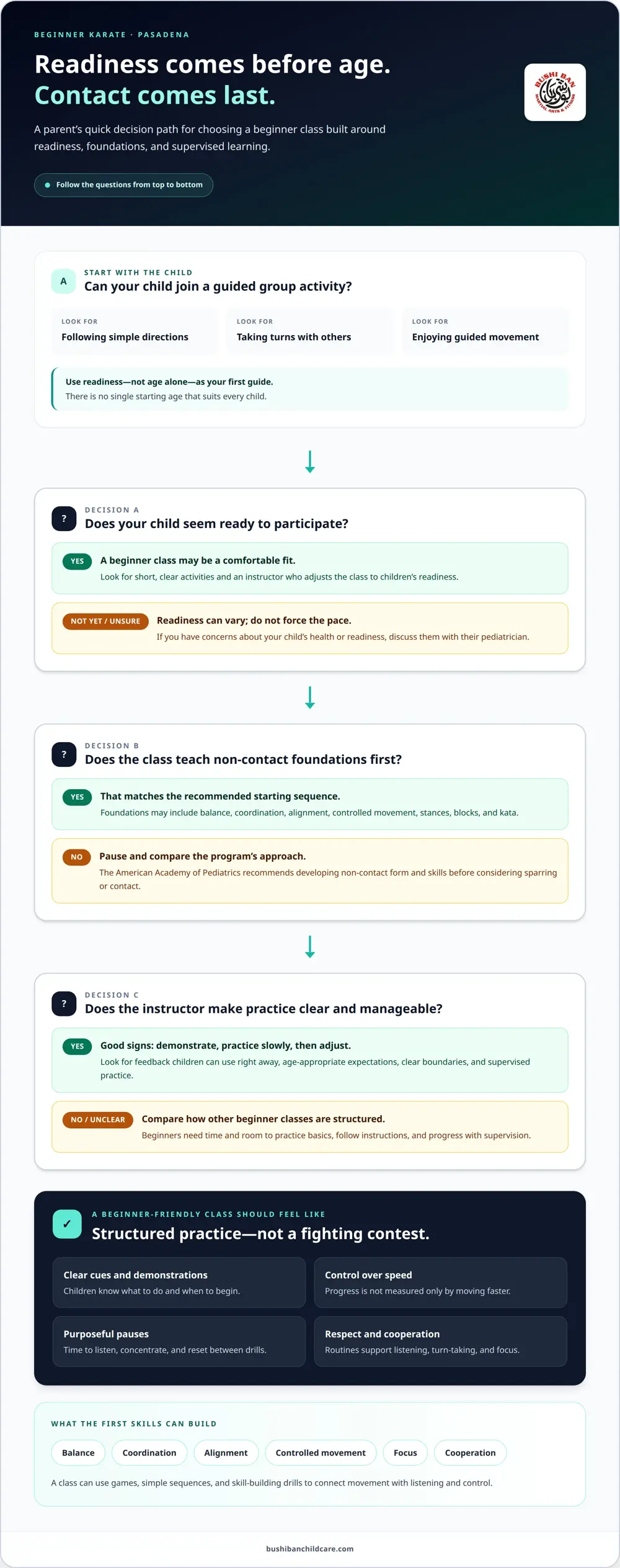
A child’s first karate class should build skills before it introduces contact. For parents considering beginner karate for kids in Pasadena, the right starting point is a class that matches a child’s readiness and focuses on foundations such as balance, coordination, stances, and blocks. The American Academy of Pediatrics recommends developing non-contact form and skills before considering sparring or contact.
It’s natural to wonder whether your child is old enough, and to want classes to feel safe as well as engaging. A child’s ability to follow simple directions, take part in a group, and enjoy guided movement can help indicate whether a beginner class is a comfortable fit.
This guide explains what foundational karate practice can develop, why non-contact learning comes first, and what to look for in an instructor serving Pasadena. You’ll also learn how a structured class can introduce focus, respect, and steady progress, so you can make a more confident choice for your child.
Key Takeaways
- Look for a beginner class that fits your child’s readiness to follow simple instructions and participate with others, rather than relying on age alone.
- Foundational practice can develop balance, coordination, alignment, and controlled movement through skills such as stances and blocks.
- Choose an instructor who teaches respect, listening, and focus alongside martial arts skills, with progress introduced in a supportive, structured way.
- Explore how Bushi Ban Child Care’s martial arts, fitness, and leadership programs may suit your family’s goals.
Table of Contents
What age can kids start martial arts?
Children can start when they’re ready to follow simple instructions, take turns, and join a structured activity. There’s no single starting age that suits every child. The American Academy of Pediatrics recommends developing non-contact form and skills before considering sparring or contact. If you have concerns about your child’s health or readiness, discuss them with their pediatrician.
Preschool classes can introduce movement through short, clear activities. In Pasadena, the Mighty Tigers class teaches balance, coordination, alignment, stances, blocks, and a short kata. Children also practice working together and following simple instructions. Age-specific groups let instructors adjust class structure and skill progression to children’s readiness, rather than expecting every beginner to move at the same pace. Families looking for karate for beginners kids Pasadena can look for these age-appropriate foundations.
Class sizes and schedules vary among Pasadena schools, as do beginner programs and age groupings. Compare how each class is structured: beginners need room to practice basics, follow instructions, and progress with supervision. Trial classes and introductory lessons also vary by school, so check each program’s own terms.
Children’s karate programs can teach different styles and terminology. Asai-Ryu is a dynamic, Shotokan-based style associated with Master Tetsuhiko Asai. The Mighty Tigers class introduces early Kenpo Karate vocabulary and patterns. If you’re considering karate for beginner kids in Pasadena, look at what the program teaches in practice: students may first learn controlled stances, blocks, and kata rather than contact techniques.
There’s no single weekly schedule that suits every child. How often to start depends on the program, your child’s routine, and how comfortably they manage classes alongside school and rest. For a first class, comfortable clothes that allow free movement are practical; bring water and follow the school’s directions about uniforms or equipment. These simple preparations help children focus on learning their first skills.
Coordination, strength, flexibility, and fitness
Children’s martial arts classes combine movement with listening to instructions. Look for lessons that give beginners clear techniques to practice and time to control each movement.
Fitness and Coordination Development
A simple sequence, such as stepping forward, settling into a stance, and returning to ready position, asks a child to coordinate several actions. Repeating it while paying attention to posture engages balance and controlled movement. A well-paced class gives children opportunities to practice without making speed the only measure of progress.
Strength and flexibility develop through a class’s range of movements, such as holding a stable stance or reaching through a controlled technique. Training should suit children’s abilities rather than copy adult classes. Notice whether instructors demonstrate movements, offer manageable adjustments, and leave time for concentration between active drills.
Games and Skill-Building Drills
Games give children a lively way to respond to directions while moving. For example, an instructor might ask students to move to a marker, stop in a balanced position, and listen for the next cue. This combines movement, attention, and following instructions without making competition the focus.
Skill-building drills break techniques into clear steps. A teacher can demonstrate a movement, guide students through it slowly, then invite them to repeat it with control. Look for feedback children can use immediately, such as adjusting a stance before trying the sequence again. This structure makes practice easier to follow.
School routines also involve listening, waiting, and shifting attention between activities. Martial arts practice brings those habits into movement: a child listens to a cue, performs a technique, then resets for the next turn. When evaluating a class, notice whether active games have clear boundaries and purposeful pauses. These details show how fitness, coordination, and concentration fit together in a beginner-friendly lesson.
Instructor experience and teaching approach
For beginners in Pasadena, Deer Park, and La Porte, look for classes that teach foundational skills through clear demonstrations and age-appropriate practice. Karate can develop focus and cooperation, while contact brings different considerations. The American Academy of Pediatrics recommends non-contact form and skill development before sparring or contact.
Beginner-Friendly Instruction
A beginner-friendly instructor breaks each lesson into visible, manageable steps. For example, they might demonstrate a movement, let children practice slowly, then offer a specific adjustment. This approach helps students understand what to do without expecting them to master a technique immediately. Parents can look for explanations children can follow, constructive feedback, and opportunities for everyone to participate at their own pace.
Safety and Age-Appropriate Teaching
Age-appropriate teaching matches activities and expectations to children’s readiness. An instructor can begin with controlled movement and non-contact techniques, then build skills under supervision. The American Academy of Pediatrics advises focusing on non-contact form and skill development before sparring or contact. Notice whether lessons have clear boundaries, organized practice, and instruction that emphasizes control rather than treating class as a fighting contest.
Cooperation and Following Instructions
Classes can teach respect for classmates, teachers, the training space, and themselves through repeated routines. Children practice when to speak, when to listen, and how to focus while an instructor explains a task. For instance, students might wait for a cue before beginning a drill, then take turns practicing. These habits make cooperation part of every lesson, not just a separate topic.
Self-defense teaching should include judgment, not just physical techniques. The Pasadena Mighty Tigers program teaches children that their voices are their first form of self-defense. This gives instructors a way to discuss speaking up and listening to directions. A thoughtful approach connects physical skills with respect, attention, and choices children can understand.
Pasadena service area
For families in Pasadena, Texas, consider the class address, schedule, and route from home or school. Locations and hours vary by program, so there’s no single timetable for the area. Families in Deer Park and La Porte can use the same practical approach: consider where your child will travel from and when class begins.
A city name alone won’t tell you how manageable a trip feels after school. Compare the route from your child’s school to the class location with the route home. Traffic, pickup timing, and the transition between school and practice all affect whether the schedule fits an ordinary weekday.
Plan in a few steps: identify your starting point in Pasadena, Deer Park, or La Porte; compare class time with school pickup; then consider the return trip and evening routine. A class that fits those steps can make regular attendance easier. Younger students may especially benefit from a predictable transition from the school day into lessons.
Location can also shape the family’s experience around class. A convenient route gives parents more room to arrive without rushing, while students have time to settle before learning begins. Find out how the program organizes beginner lessons and builds respect among classmates. Those details help you assess the class itself, not just its address.
For families comparing options in Pasadena, Deer Park, and La Porte, weigh location and schedule together. Consider the actual route at the time your child would travel, then see whether class hours work with school and home routines. A suitable local class should make both participation and the journey practical for your family.
Schedules and beginner lesson arrangements vary by program, so compare class times with school pickup and your family’s evening routine, and ask how beginner lessons are organized. The section provides no basis for comparing class sizes.
Beginner class locations and hours vary by program in Pasadena. Compare each class location with your child’s school and home routes, then see whether the hours fit pickup and your evening routine.
Bushi Ban Child Care
Bushi Ban Child Care offers structured martial arts and fitness learning for children through its After-School Martial Arts Program and Martial Arts & Fitness Classes. Families looking to build skills beyond foundational practice can also explore the Student Leadership Program, where students develop teaching and activity-leading skills.
Seasonal and Holiday Camps offer another option for children who want martial arts and fitness activities during school breaks. The right next step depends on your family’s goals, whether that’s regular practice, broader fitness, or developing leadership skills. Explore Bushi Ban’s programs to find the one that best fits your child’s interests and routine.
For information about Bushi Ban Child Care’s programs, contact Bushi Ban Child Care.
Make the First Step Feel Right
A child’s first martial arts experience can shape how they approach new challenges. Let your child’s curiosity guide the next step: notice which activities they enjoy, what helps them stay engaged, and whether they feel ready to learn alongside others. For families considering karate for beginners kids Pasadena, a thoughtful match between the child’s interests and the class environment matters more than rushing toward advanced skills.
Before choosing a program, talk together about what your child hopes to try, whether that’s learning movement, building confidence, or finding a positive after-school activity. Their perspective can make the decision feel shared and give them a reason to return to practice.
Bushi Ban Child Care offers programs for children interested in martial arts and fitness, with opportunities to keep learning through structured activities. Contact Bushi Ban Child Care to discuss your child’s next step.
A steady beginning gives young students room to grow, one lesson at a time.
Frequently Asked Questions
What days are the classes?
Class days depend on the school and program schedule. For an after-school class, consider how weekday timing fits your child’s pickup and evening routine; seasonal and holiday programs follow a different school-break schedule. Bushi Ban Child Care offers after-school martial arts and seasonal and holiday camps. Use the schedule for the specific program when planning regular attendance.
What ages do Pasadena karate schools accept for beginner children's classes?
Schools in Pasadena set their own age ranges, so there’s no single starting age across the city. Beginner programs may group students by age, readiness, or experience, and a younger child’s ability to follow directions and join group activities can affect whether a class is a good fit. Look for instruction and expectations suited to your child’s developmental stage, rather than choosing by age alone.
What safety measures and instructor qualifications should parents look for in kids' karate classes?
Look for instructors who teach children with clear demonstrations, supervised practice, and a clear distinction between non-contact skills and sparring. The American Academy of Pediatrics recommends non-contact form and skill development before children consider sparring or contact. Notice whether the instructor explains directions in child-friendly language, manages turn-taking, and corrects technique calmly. You can also ask about experience teaching children and how lessons progress for beginners.
What are the best beginner karate classes for kids in Pasadena, California?
The Mighty Tigers class in Pasadena teaches balance, coordination, alignment, stances, blocks, and a short kata. Its approach emphasizes non-contact foundations and age-appropriate instruction.