
Kids Martial Arts Classes in La Porte for Skills and Safety
Kids’ martial arts classes in La Porte give children a structured way to practice movement, focus, and self-discipline while learning age-appropriate personal safety skills. Programs may include guided drills, fitness activities, and lessons in respect and confidence. The right fit depends on a child’s age, interests, and readiness to learn in a group.
Parents often want more than an activity to fill the afternoon. They want their child to feel capable, stay active, and learn how to respond thoughtfully in everyday situations. Martial arts can support those goals through steady practice, clear routines, and encouragement to keep improving.
This guide explains the skills children can develop, how classes can support personal safety, and what to consider when comparing age ranges and schedules in La Porte, Texas. You’ll also learn how local programs may differ and how Bushi Ban Child Care’s martial arts and fitness offerings connect with children’s growth and after-school routines.
Table of Contents
Children's karate and martial arts programs
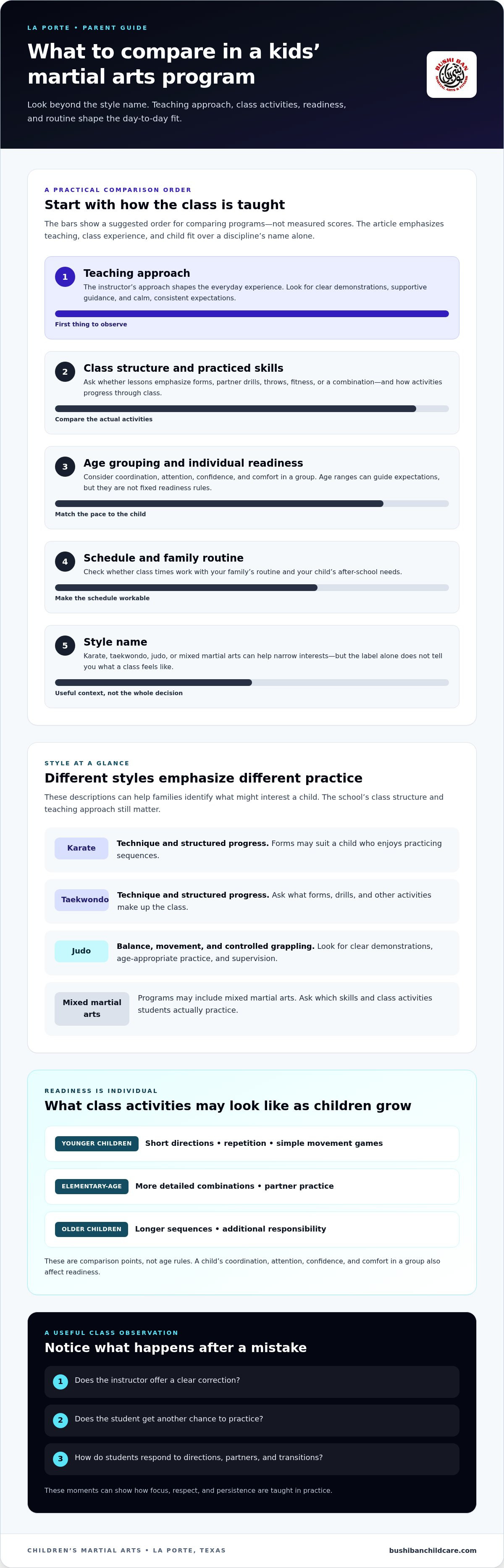
Children’s martial arts programs can teach karate, taekwondo, judo, or mixed martial arts, depending on the school. To compare styles in La Porte, look at class structure, age groupings, and the skills students practice. Ask whether instruction emphasizes forms, partner drills, throws, fitness, or a combination.
Karate and taekwondo commonly organize practice around technique and structured progress. Judo focuses on balance, movement, and controlled grappling. Those descriptions can help families identify a style that interests a child, but the instructor’s teaching approach shapes the day-to-day experience. For example, a child who enjoys practicing sequences may respond well to forms, while another may prefer movement-based partner drills.
Age groupings can influence the pace and activities. Programs for younger children may use short directions, repetition, and simple movement games. Elementary-age students may be ready for more detailed combinations and partner practice. Older children may enjoy learning longer sequences or taking on additional responsibility. These are useful comparison points, not fixed age rules: coordination, attention, confidence, and comfort in a group all affect readiness.
ATA Tigers is a program name parents may encounter when comparing classes for younger children. Check how the class introduces basic movement, listening, and turn-taking, and how instructors adapt activities for beginner students. Dragon Tots students can earn colored belt ranks at the end of a session. That gives parents a concrete example of how one program may mark progress, though advancement systems differ across schools.
Judo can also suit children interested in balance and controlled partner practice. Its throws and grappling techniques make instruction and supervision important parts of the learning environment. Parents can look for clear demonstrations, age-appropriate practice, and a steady progression from basic movement to partner work. Adults may be able to participate in an Adult Assistant Martial Arts class without prior martial arts experience, offering a way to share practice with children.
To enroll, compare the school’s style, class grouping, and schedule, then follow its registration process for the selected program. Before choosing, write down what your child hopes to gain, such as fitness, structured practice, or learning a particular style. This simple step helps families compare programs by fit rather than by labels alone.
Discipline, confidence, focus, and leadership skills
Martial arts practice gives children opportunities to work on attention, respect, and self-control. Look for clear routines and supportive instruction that help students learn through practice.
Building Focus and Confidence
A class may ask students to listen to an instruction, repeat a movement, then practice it with a partner. That sequence gives children a practical way to focus on one task at a time. Confidence can grow through small, visible steps, such as completing a movement they found difficult earlier. Look for instructors who give specific feedback, like “keep your balance,” rather than vague praise alone.
Developing Discipline and Respect
Discipline is easier to understand when students practice it through everyday class habits. For example, children can line up when asked, wait their turn, and return equipment after a drill. Respect also appears in how partners listen and take turns during practice. Families can notice whether instructors explain these expectations calmly and apply them consistently, so children know what respectful participation looks like.
Life Skills and Mental Toughness
Self-discipline includes continuing a task after a mistake, then trying again with a correction. A child learning a new sequence might forget a step, pause, listen, and restart. That process can encourage patience and problem-solving without framing mistakes as failure. Mental toughness in a children’s class should mean persistence and emotional control, not pressure to ignore discomfort or compete at any cost.
Leadership skills can develop through small responsibilities. An instructor might invite a student to demonstrate a familiar movement, help organize a line, or welcome a newer classmate. These tasks let children practice speaking clearly and supporting others. A Student Leadership Program offers a more structured setting for developing teaching and activity-leading skills. Families can consider whether their child enjoys helping peers or would benefit from guided opportunities to do so.
To assess a program’s approach, observe a class and note what happens after an error. Does the instructor offer a clear correction? Do students get another chance to practice? Also notice how children respond to directions, partners, and transitions between activities. These examples reveal how discipline and respect are taught in practice, beyond words on a schedule or a school’s description.
Families looking for a structured way to combine movement with personal development can explore martial arts and fitness classes as one option.
Self-defense and personal safety
Children’s self-defense teaching should begin with awareness, communication, and choosing a safe response. A class might practice noticing a blocked exit, using a clear voice, moving toward a trusted adult, and asking for help. Physical techniques can be part of instruction, but they shouldn’t replace prevention or imply that a child is responsible for stopping bullying or abuse.
For bullying situations, families can look for teaching that distinguishes conflict from repeated intimidation. A practical lesson might help a student rehearse saying, “Stop, I don’t like that,” then leaving and telling a teacher or caregiver. Instructors can also explain how a bystander can seek help rather than join in. These examples keep the focus on boundaries, support, and reporting, not on encouraging children to fight.
Ask how partner drills are introduced during a session. A well-organized lesson can demonstrate a movement slowly, explain where students may make contact, and let children practice at a controlled pace. Instructors can adapt an exercise when a child feels unsure. Parents can observe whether directions are clear, students respect each other’s space, and practice stops when the instructor calls for it. Those details help families understand how safety is addressed in teaching.
Mental preparation matters, too. Children can practice pausing, creating distance, using a strong voice, and finding a trusted adult. For example, a role-play might involve a classmate pressuring someone to hand over a personal item. The useful response is not a guaranteed outcome or a complex move. It’s rehearsing a simple decision, leaving when possible, and telling a responsible adult promptly.
Women’s self-defense is a related but distinct topic. Adult instruction may address scenarios, communication, and physical techniques suited to adult participants. That content shouldn’t automatically be treated as appropriate for children. Parents comparing programs can ask what lessons are designed for young students, how scenarios match their age, and how instructors explain boundaries without frightening them. A child’s class should keep its examples relevant to school, friendships, and everyday routines.
Martial arts can teach movement and responses, but no class can make every situation predictable. Families can reinforce lessons at home by naming trusted adults, practicing how to ask for help, and discussing safe routes in familiar places. Keep conversations calm and specific. For instance, agree on what a child should do if separated from a caregiver in a public setting. This complements practice without suggesting that children must manage danger alone.
When reviewing a program, consider whether its personal-safety teaching combines awareness, clear boundaries, supervised practice, and help-seeking. That balance makes self-defense part of a broader safety conversation, rather than a promise that physical skills alone can prevent harm.
Class schedule and age ranges
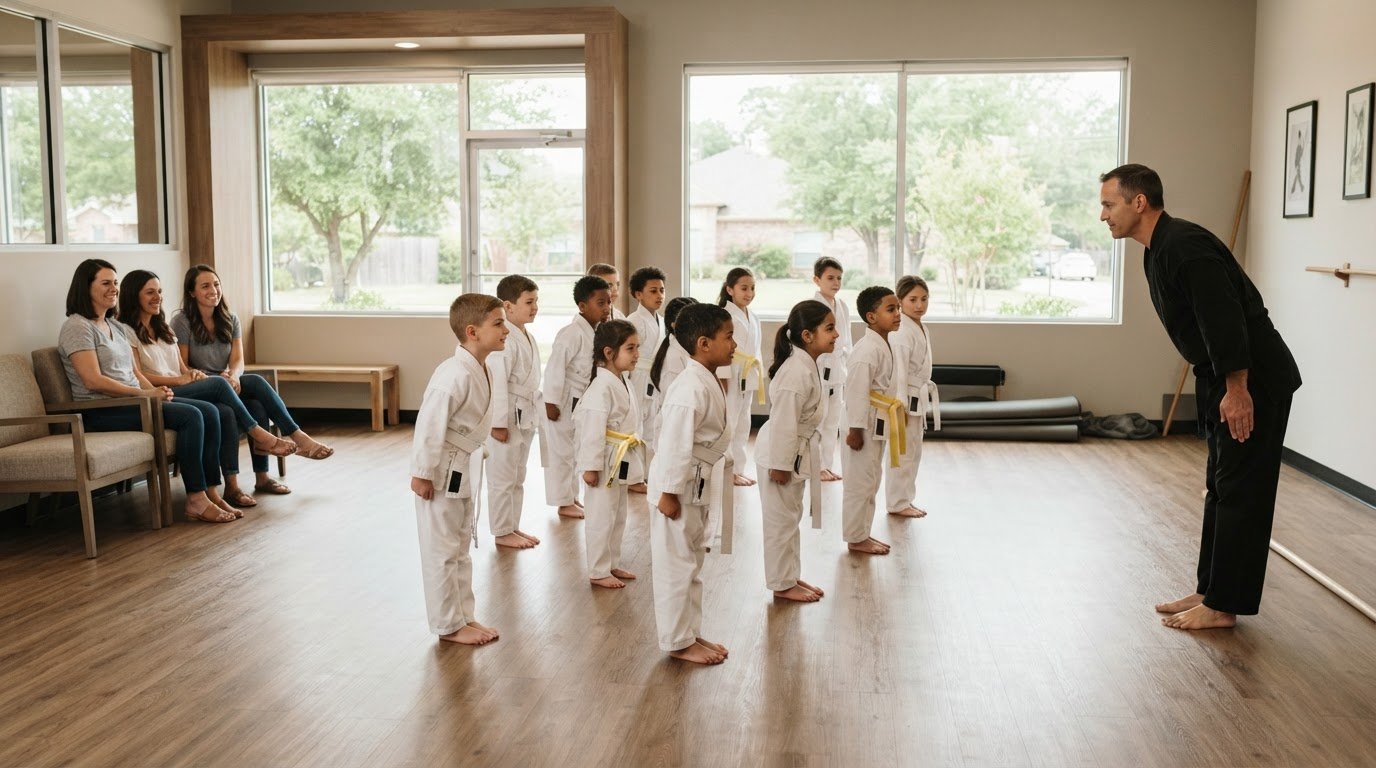
A child’s readiness depends on more than a birthday. Consider attention, coordination, comfort following group directions, and interest in practicing with others. For example, a child who can wait briefly for a turn may find a structured class easier to join. Age groupings help organize teaching, while individual readiness helps families judge the fit.
Programs can divide students by age, experience, or both. A younger beginner may need short demonstrations and frequent changes between activities. An older beginner may be ready to follow a longer sequence or practice with a partner. Ask how instructors group new students and adapt activities when children have different skill levels. Those details reveal more than an age label alone.
Some programs offer named groups for younger children. ATA Tigers is one example parents may encounter while comparing classes. Dragon Tots students can earn colored belt ranks at the end of a session. These program examples show that class names and progress markers vary. Families can compare what a child practices during each session, and how instructors explain progress.
Judo is an option for children ages 5 and older. Parents considering it can look for a progression from basic movement to supervised partner practice. A child who is new to group activities may benefit from understanding how turns, demonstrations, and practice partners work. Readiness also includes comfort listening to instructions and stopping when asked.
Scheduling is a practical part of choosing a class. Compare class times with school dismissal, travel, homework, meals, and your family’s evening routine. Map the trip from school to class and allow time for your child to get settled. A realistic weekly plan can help them arrive ready to take part.
Before enrolling, write down the days your family can attend consistently. Then compare those days with the program’s published schedule and note any conflicts with school activities or family commitments. Ask how make-up sessions are handled only if the program explains that option. A predictable routine can make attendance easier to maintain.
Use a first visit to assess the pace and setting. Notice whether the instructor gives directions children can follow, whether students have room to practice, and how transitions happen between activities. If fitness is a priority, observe how movement fits alongside instruction. Afterward, ask your child which activity felt enjoyable or challenging. Their response can help you decide whether the age grouping, class pace, and schedule suit your family.
Kids martial arts schools in LaPorte, Indiana
For families in La Porte, Texas, compare children’s martial arts schools by teaching style, class structure, and convenience. The heading’s Indiana reference does not describe the local area covered here. A family may prioritize taekwondo forms and movement, while another may seek fitness or a structured after-school activity like Bushi Ban Child Care. Compare what each school teaches, how it groups students, and whether its classes fit your routine.
Look beyond the style name. A taekwondo class may emphasize forms, kicks, and coordinated sequences, while another program may teach different techniques. Ask what a beginner practices during a typical class at Bushi Ban Child Care. For example, find out whether a session includes warm-ups, demonstrations, individual practice, and supervised partner activities. That outline makes programs easier to compare.
Teaching approach matters as much as curriculum. During a visit to Bushi Ban Child Care, notice whether instructors explain movements clearly, give children time to practice, and manage transitions calmly. Watch how students respond when someone loses focus or needs help. A school’s approach to corrections can show whether its environment supports learning without relying on embarrassment or pressure.
Use a short comparison list before choosing:
Write down your child’s main goal, such as fitness, confidence, or taekwondo.
Compare class groupings and how beginners are introduced.
Review the schedule against school, travel, and family commitments.
Observe how instructors organize practice and respond to questions.
These steps keep the decision focused on your child’s experience, not promotional language.
Do La Porte martial arts schools offer free trials or introductory classes for kids? Programs like Bushi Ban Child Care often provide options to explore. Review what a first visit includes and whether it gives your child a chance to experience the class format before you decide.
Compare the details that shape a child’s first weeks. A beginner who feels uncertain in groups may benefit from a clear introduction to class routines. A child excited about taekwondo may want to understand how lessons build from basic movements. Match those needs with the class structure, pace, and teaching style you observe at Bushi Ban Child Care.
Travel and timing also affect whether attendance becomes part of a family routine. Map the route from school or home to Bushi Ban Child Care, then compare class time with homework, meals, and other activities. If a class creates a tight transition, consider how that may affect your child’s energy and readiness. A realistic schedule is easier to sustain than one built around ideal conditions.
After visiting a program in the La Porte, Texas, area, note what students practiced, how the instructor guided the class, and how your child felt afterward. Those observations can help you decide whether the teaching, environment, and schedule at Bushi Ban Child Care meet your child’s needs.
Bushi Ban Child Care: After-School Martial Arts Program
Bushi Ban Child Care offers an After-School Martial Arts Program that combines martial arts training with after-school care, playtime, obstacle courses, drills, games, snacks, and homework time. Its Martial Arts & Fitness Classes focus on movement and fitness, while the Student Leadership Program gives students opportunities to take leadership roles and assist instructors. Seasonal and Holiday Camps are available during school breaks.
These programs can suit families looking for an organized way to include martial arts, fitness, and leadership opportunities in a child’s routine. Seasonal and Holiday Camps offer another option during school breaks.
To learn more about these programs, visit Bushi Ban Child Care online.
Choose a Next Step That Fits Your Family
For families comparing kids martial arts classes in La Porte, start by identifying what your child hopes to gain. Is the priority an after-school activity, martial arts and fitness, or something structured during school breaks? Naming that goal can help you weigh the options.
Bushi Ban Child Care offers an After-School Martial Arts Program, Seasonal and Holiday Camps, and Martial Arts & Fitness Classes. Consider which format best fits your child’s interests and your family’s routine, then explore the details together. A child who helps choose an activity may feel more ready to take part and make it their own.
Contact Bushi Ban Child Care to discuss a suitable next step. A thoughtful choice can give your child room to learn, practice, and enjoy the journey.
Frequently Asked Questions
What kids martial arts classes are available in La Porte, Texas?
Children’s options may include karate, taekwondo, judo, and broader martial arts and fitness classes. Families in La Porte, Texas, can compare lesson activities with a child’s interests. One child may enjoy learning forms, while another prefers movement drills. Before choosing, note which activities your child is eager to try and use those preferences to guide your comparison.
Which martial arts schools in La Porte offer programs for children?
Bushi Ban Child Care offers an After-School Martial Arts Program and Martial Arts & Fitness Classes, as well as Seasonal and Holiday Camps. These options can suit La Porte families looking for structured martial arts after school or during school breaks. Consider which program format best fits your child’s interests and your family’s routine.
What ages can start kids martial arts classes in La Porte?
Starting ages vary by program and class grouping. Judo is an option for children ages 5 and older, while programs for younger children use their own groupings. Readiness also depends on practical factors, such as following group directions, taking turns, and feeling comfortable practicing with other students. These signs can help parents assess class fit alongside a child’s age.
What are the class schedules and locations for kids martial arts in La Porte?
Class times depend on the program, and Bushi Ban Child Care serves the Houston area, including La Porte, Texas. To plan a workable week, compare class times with school dismissal, travel, homework, and family routines. For example, map the trip from school to class and consider whether your child has time to arrive ready to participate.
What should parents look for when choosing a martial arts school for children?
Compare lesson structure, beginner instruction, age groupings, and how instructors communicate with students. Notice whether children understand directions and know what to do next. Consider your child’s goals: a student interested in leadership may value opportunities to help others, while a beginner may appreciate clear demonstrations and a comfortable pace.
What safety rules and instructor qualifications do La Porte kids martial arts schools have?
Safety practices and instructor qualifications vary by school and program. Look for clear boundaries during partner activities, active supervision, and instructors who explain how drills begin and stop. Qualifications should match the activities taught, while class rules should be understandable to children. For example, students should know how to pause a practice drill and follow the instructor’s direction before continuing.


Comments