
Choosing a school holiday camp in La Porte means considering practical details that help your child feel prepared for the day.
It’s natural to want to know what happens after registration, especially when meals, dietary needs, packing, and health support are part of your decision. A little preparation can make a new camp routine more comfortable for your child and more reassuring for you.
This guide explains how to approach session registration, what to consider when planning food and packing essentials, and how to understand the camp’s safety and health support. With the key details in view, you can make a thoughtful choice and help your child arrive ready to take part, learn and enjoy their time at camp.
Key Takeaways
- Plan session choices with the registration steps and considerations for attending multiple sessions in mind.
- Learn how to prepare for meal arrangements and communicate your child’s dietary needs.
- Use the packing guidance to distinguish everyday essentials from items the camp includes.
- Understand what to look for in camp safety procedures and health support before your child attends.
Table of Contents
Registration and attending multiple sessions
Start registration planning with the session dates, age range, and enrollment method. These details help you choose a schedule that suits your child for your school holiday camp La Porte needs.
Registration and Session Enrollment
La Porte camp registration with Bushi Ban Child Care is available by phone at 281-471-1002. Have your preferred sessions in mind before enrolling, especially if your child may attend multiple sessions. Confirm each session separately in your schedule, since dates and enrollment arrangements can vary by camp. Financial assistance, discounts, and drop-in care are separate from multi-session enrollment; consider them only when the individual camp offers those options. This keeps your plans tied to the session you select.
Age and Residency Eligibility
Our holiday camp program at Bushi Ban Child Care is open to children from prekindergarten age 4 through age 13. That age range gives families a concrete starting point when considering eligibility. The range is described by age, rather than by elementary, middle, or high school grade. Use your child’s age when comparing this camp with school-grade schedules, and avoid assuming every grade band is included. Residency requirements should be considered separately from age eligibility when selecting a La Porte program.
Camp Dates and Hours
La Porte’s listed camp and event dates vary throughout the year. Summer Strength & Conditioning Camp runs June 1 through July 16. Special family activity nights and holiday sessions are scheduled throughout the season. School’s Out Hangout is scheduled for teacher workdays and holidays, and includes structured activities and offsite field trips. These dates identify scheduled offerings, not daily opening or closing hours, so plan around each session’s actual schedule.
Our local programs take place at our dedicated Bushi Ban Child Care facility in La Porte, Texas. Venue locations do not establish transportation arrangements for other camps or offsite field trips unless explicitly noted. Treat travel as a separate part of enrollment, and plan around the specific session and location. If your child may attend several sessions, organize their dates and locations together before settling into a routine. This makes scheduling conflicts easier to spot.
Meals and dietary accommodations
Activities and meal arrangements vary by La Porte camp session. Check the schedule to see what children will do and whether food is included, rather than assuming every camp offers the same activities, lunch, or snacks. An offsite field trip, for example, can change the day’s routine, so plan meals around the outing.
Before the first day, note your child’s dietary needs clearly and practically. Include foods to avoid, suitable alternatives, and relevant allergy information. A concise note keeps details organized when you prepare meals or share instructions during enrollment. If your child follows a particular eating routine, note the foods and timing that help make the day manageable.
Use a simple meal checklist: identify which meals are included, decide what your child needs to bring, and label packed food with their name. If lunch isn’t part of the session’s arrangements, for instance, plan a familiar meal and any snacks your child usually eats. Keep food choices straightforward, especially if unfamiliar options are harder to manage on a busy camp day.
Dietary accommodations need clear communication, not guesswork. Describe the need specifically, such as “no dairy” or “avoid peanuts,” and distinguish an allergy from a preference. Share the information through the enrollment process, and explain it to your child in age-appropriate terms. Knowing which foods to avoid can help your child follow the plan during activities.
For each session, match food planning to its schedule and activities. A day with physical activity may call for different familiar foods than a shorter event. Keep the plan consistent across multiple sessions, while accounting for changes in location or timing. Reviewing camp session planning can help you organize these details alongside the day’s activities.
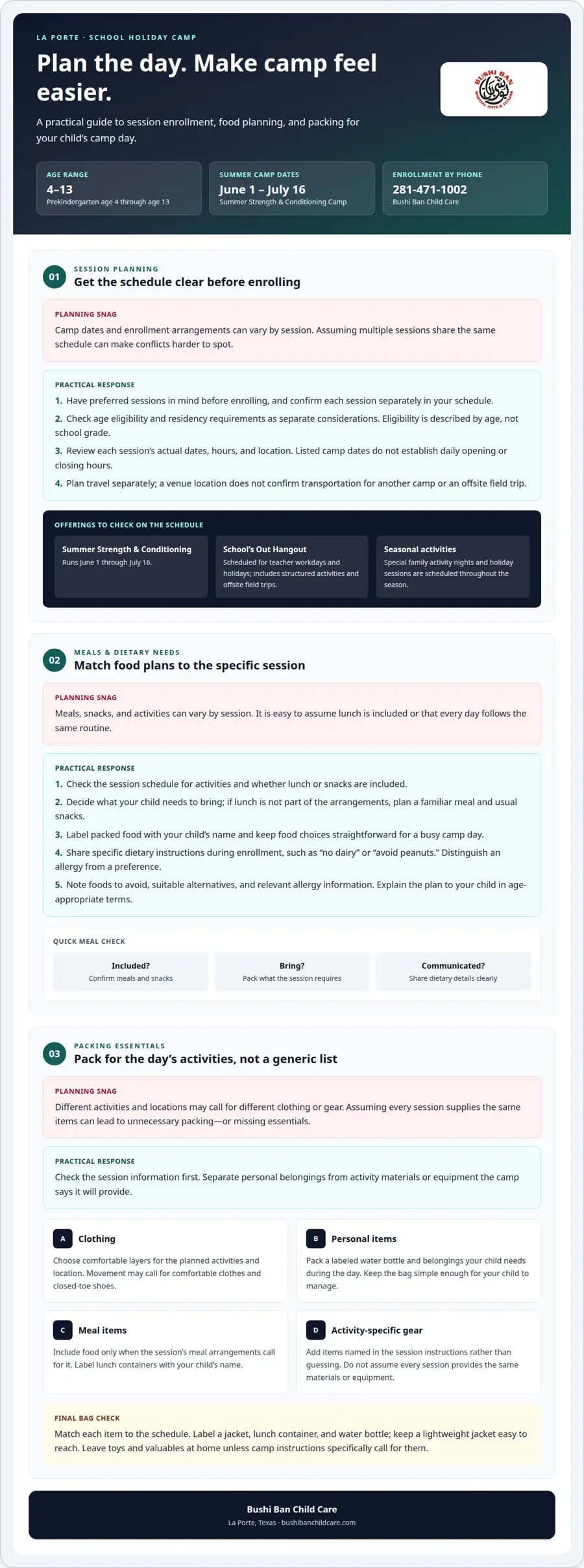
Activities and meals vary by session. Check the schedule to see what children will do and whether lunch or snacks are included.
Packing essentials and included items
Build your camp bag around the day’s activities, not a generic checklist. A session with movement may call for comfortable clothes and closed-toe shoes; a field trip may require different items from an indoor activity. Check the schedule, then pack what supports that day.
Separate personal essentials from items supplied for activities. Use the session information to identify what camp provides, such as activity materials or equipment, and what your child should bring. Don’t assume every session includes the same items. A labeled water bottle, for example, is personal, while shared materials may be provided for a scheduled activity.
For a practical packing routine, prepare these categories:
Clothing: choose comfortable layers suited to the planned activities and location.
Personal items: pack a labeled water bottle and any belongings your child needs during the day.
Meal items: include food only when the session’s meal arrangements call for it.
Activity-specific gear: add items named in the session instructions, rather than guessing.
Labels make belongings easier to identify. Write your child’s name inside a jacket and on their lunch container and water bottle. Keep the bag simple enough for your child to manage independently. For example, place a lightweight jacket in an easy-to-reach pocket rather than burying it beneath other items.
Before leaving, match each packed item to the schedule. If an activity takes place away from the usual location, consider whether your child needs a different layer or footwear. Leave toys and valuables at home unless the camp instructions specifically call for them. A quick review with your child can also help them recognize their bag and belongings.
Pack for comfort and participation, and let the session determine the details. This avoids unnecessary items and keeps belongings organized. For activities requiring special equipment or materials, follow the camp’s instructions so your child arrives prepared without bringing items already supplied for the session.
Safety procedures and health support
Safety planning starts with understanding how a camp handles everyday transitions and unexpected needs. For a La Porte session, consider arrival, activity changes, pickup, and health information as connected parts of the day. Clear steps help children know where to go and whom to approach.
Look for clear arrival and dismissal procedures. A practical plan explains who receives children, how attendance is tracked, and how pickup changes are handled. For example, a late-arriving child should have a clear way to join the group without interrupting an activity. Provide accurate emergency contacts and pickup instructions during enrollment.
Health support starts with useful, specific information. Share relevant allergies, medical needs, and signs that your child may need help. “Avoid peanuts” is more informative than “food allergy,” while a note about an inhaler identifies an important health item. Include your child’s usual response to discomfort or symptoms so adults can recognize when their behavior changes.
Medication needs require careful planning. Provide clear instructions about the medication, timing, and storage through the camp’s established process. Don’t assume your child can carry or take medication independently. For a child who uses an inhaler, for example, agree on a plan for access during activities and transitions.
For active sessions: identify how staff respond to minor injuries and pause participation.
For outdoor activities: consider shade, water breaks, and weather-related changes.
For offsite trips: understand how attendance and group movement are managed.
For illness: share symptoms or care needs that affect your child’s participation.
Before camp begins, talk through one simple example with your child: tell an adult if they feel unwell or get separated. Then provide health and contact details through the enrollment process. To connect your child with a structured camp experience, explore seasonal camp options.
Bushi Ban Child Care: Seasonal and Holiday Camps
Bushi Ban Child Care offers Seasonal and Holiday Camps for families seeking engaging activities during school breaks. These camps provide a structured option that combines movement, learning, and opportunities to build confidence.
Bushi Ban’s Martial Arts & Fitness Classes and Student Leadership Program also support children’s physical development and growing sense of responsibility. Families considering a school holiday camp in La Porte can use the registration, meal, packing, and safety details above to decide what best suits their child and routine.
For an active camp experience that supports personal growth, contact Bushi Ban Child Care to discuss your child’s needs.
Choose a camp experience that fits your child’s next step
When considering a school holiday camp in La Porte, think beyond filling a school break. Your child’s interests, confidence, and preferred ways of learning can help guide a meaningful choice. Camp can be an opportunity to try an activity, practice persistence, and return to school with fresh momentum.
Bushi Ban Child Care offers Seasonal and Holiday Camps, an After-School Martial Arts Program, and Martial Arts & Fitness Classes. These programs give families different ways to include movement and skill-building in a child’s routine, during school breaks and beyond.
Choose the next step that best suits your family’s priorities. Contact Bushi Ban Child Care today to discuss its programs and find an encouraging path forward for your child.
A smoother camp experience starts with clear plans: registration for La Porte camp sessions is available by phone at 219-326-9600.
Frequently Asked Questions
What school holiday camps are available in La Porte, Texas?
La Porte options include Summer Strength & Conditioning Camp, Mission Camp with Champions, and School’s Out Hangout. La Porte ISD also schedules Planetarium Nights at Pemberton Planetarium. Mission Camp with Champions is open to children from prekindergarten age 4 through age 13. Bushi Ban Child Care offers Seasonal and Holiday Camps with a martial arts focus.
How do parents register for a La Porte school holiday camp, and what are the deadlines?
Registration for La Porte camp sessions is available by phone at 219-326-9600. There isn’t one shared deadline for every program in the information provided, so use the selected camp’s session date to plan your registration. Before calling, note the session you’re considering and any scheduling needs, such as attending more than one camp or coordinating with school breaks.
What supervision, safety, and pickup rules do La Porte holiday camps have?
Supervision and pickup procedures depend on the individual camp, so no single set of rules applies across La Porte. Bushi Ban’s Student Leadership Program lets students take leadership roles under instructor supervision, but that doesn’t define camp pickup procedures. For a specific session, review its arrival and dismissal instructions, authorized pickup process, emergency contacts, and how staff handle changes to a child’s pickup plan.
What activities and meals are included at La Porte holiday camps?
School’s Out Hangout includes an offsite field trip, and Planetarium Nights takes place at Pemberton Planetarium. Activities and meal arrangements vary by session, so check the schedule to see whether lunch or snacks are included.