
Leadership doesn’t have to begin with a speech or a major responsibility. For leadership activities for middle schoolers in Deer Park, an adapted Oh Deer game can combine social-emotional learning with practical roles: one or two students serve as spotters while another records the data. These roles give students a clear way to observe, communicate, and contribute to a shared activity.
Middle schoolers are still finding their voices, and structured opportunities can help them practise listening, cooperation, and thoughtful decision-making. Make leadership active and inclusive, so students learn by taking turns instead of watching from the sidelines. Social-emotional learning can shape these experiences, while rotating spotter and recorder roles helps students practise responsibility and build confidence.
Key Takeaways
- Choose activities with a shared goal and clear responsibilities so students can practise cooperation, communication, and thoughtful decision-making.
- Plan the setting and timing around the activity’s purpose, available space, and the support students need to participate confidently.
- Match activities to student age and readiness: the Deer Yards in Your Town challenge is designed for grades 5-6, while forest lessons are intended for grades 6 through 8.
- To launch a club or service project, begin with a meaningful goal, agree on manageable tasks, and give students chances to reflect on what they learn.
Table of Contents
3. What leadership activities are suitable for middle school students?
3. Where and when are leadership activities for Deer Park middle school students held?
4. What age or grade requirements apply to local leadership programs
4. How can middle school students start a leadership club or service project in Deer Park?
3. What leadership activities are suitable for middle school students?
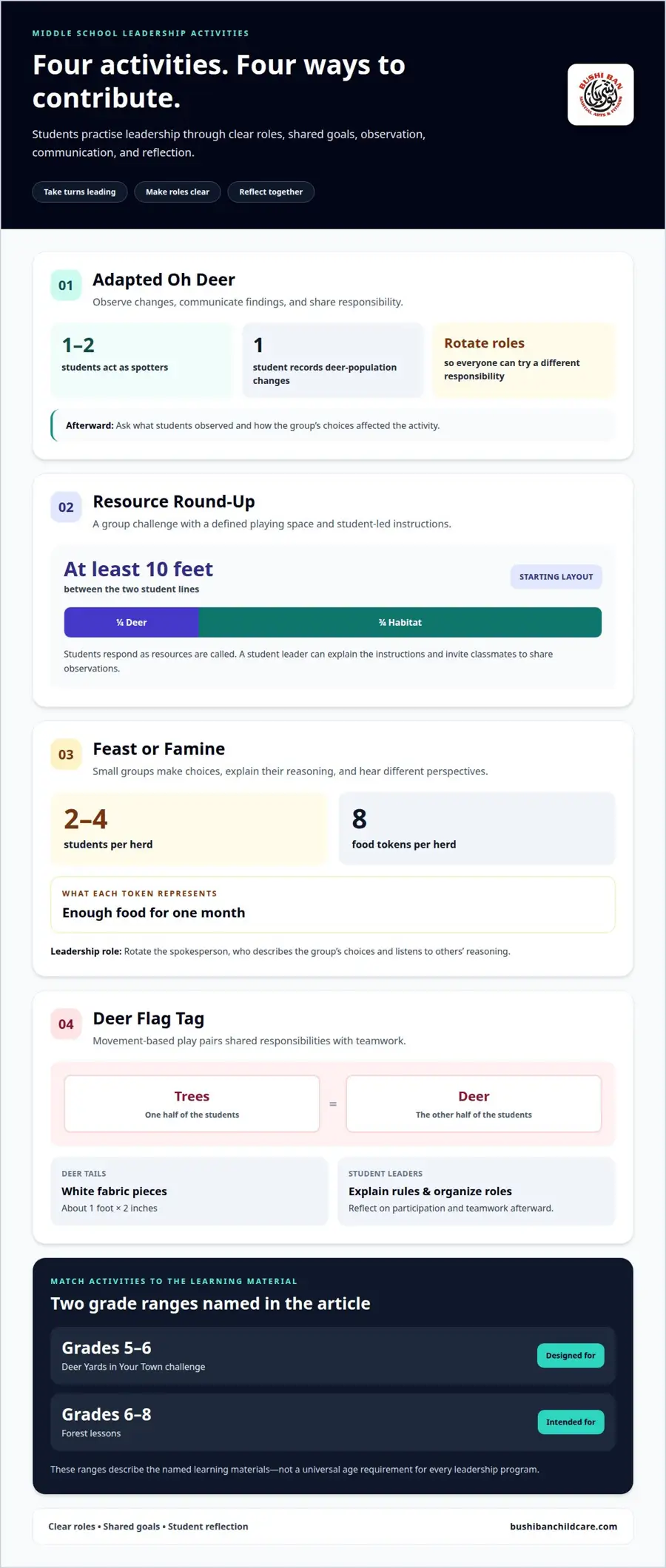
An adapted Oh Deer game helps students practise observation, communication, and responsibility. Assign one or two students as spotters and another as the recorder. Spotters watch each round while the recorder tracks changes in the deer population. Rotate the roles so everyone can try a different responsibility. Afterward, ask students what they observed and how the group’s choices affected the activity.
Resource Round-Up offers another group challenge. Set two student lines at least ten feet apart, with one-quarter of the students representing deer and three-quarters representing habitat. Students respond as resources are called, then discuss how the round unfolded. A student leader can explain the instructions and invite classmates to share observations. Families comparing leadership activities for middle schoolers in Deer Park can look for activities with clear roles and a shared goal.
Feast or Famine gives small groups a chance to make and explain decisions. Form herds of two to four students and give each herd eight food tokens. Explain that each token represents enough food for one month. A rotating spokesperson can describe the group’s choices and listen to others’ reasoning. This role helps middle schoolers practise speaking clearly while making room for different perspectives.
Deer Flag Tag combines movement with shared responsibilities. Divide students equally into trees and deer, using white fabric pieces about one foot by two inches as deer tails. Before play, student leaders can explain the rules and organize roles. Afterward, invite the group to reflect on participation and teamwork. Strong leadership activities for middle schoolers in Deer Park give students different ways to contribute, from guiding peers to noticing details and sharing what they learned.
The two lines in Resource Round-Up, set at least ten feet apart, create a defined space where student leaders can explain the activity and coordinate classmates’ participation.
3. Where and when are leadership activities for Deer Park middle school students held?
Choose a setting based on the activity’s materials, movement, and supervision needs. A classroom suits a small-group planning challenge, a discussion, or a recorder reviewing results. For movement-based activities, use an open area where students have room to move. Before starting, mark boundaries and gathering points, and choose a place for materials such as paper, tokens, or role cards.
Outdoor activities call for a suitable space and a plan for changing conditions. For example, a teacher leading a habitat simulation can mark starting positions, explain where students may move, and set a meeting point for the debrief. If students need to observe or record information, prepare a clipboard or recording sheet before the activity begins. These steps keep the focus on teamwork and student responsibility.
Timing should follow the activity’s purpose and the available school schedule. Forest lessons are intended for students in grades 6 through 8 and are generally designed for one to two class periods. That gives a class time to introduce a topic, complete an activity, and discuss what the observations mean. A shorter leadership exercise can also fit into an advisory period or a club meeting when its goal and roles are clearly defined.
For a Deer Park student planning an ongoing club, start by choosing a regular meeting time that works for members and an adult supervisor. Then select a location suited to the project, such as a classroom for planning or an outdoor area for a nature-focused task. Families seeking a structured setting for continued leadership practice can explore after-school activities. The best fit is the one that gives students room to participate, take responsibility, and reflect together.
4. What age or grade requirements apply to local leadership programs
Grade ranges depend on the specific activity, not on one universal middle-school rule. The Deer Yards in Your Town challenge is designed for grades 5-6. Forest lessons are intended for students in grades 6 through 8. These ranges help families identify activities aligned with a student’s school stage. They describe those learning materials, rather than setting an age requirement for every leadership program in Deer Park.
Grade is a useful starting point, but activity demands matter too. A student leading a discussion needs to follow the topic, listen to classmates, and explain ideas clearly. A student recording observations needs to write down results accurately and keep information organized. For example, a forest lesson for grades 6 through 8 can involve group observation and a shared explanation. Those tasks give students practical ways to contribute while developing responsibility.
For grades 5-6, a challenge such as Deer Yards in Your Town can offer an age-aligned entry point. An adult can explain the goal, clarify each role, and invite students to share their observations. For students in grades 6 through 8, forest lessons provide a different context for learning and collaboration. Within either range, assign responsibilities that suit the activity, then rotate roles so participation isn’t limited to the most confident students.
Before choosing an activity, match its instructions and responsibilities to the student’s grade and readiness. Check whether the student can understand the task, follow its sequence, and work with a group. A younger middle-school student might begin with a defined observation role, while an older student could help explain the results. These are ways to adapt participation, not additional eligibility rules. For local families comparing leadership activities, the key distinction is clear: the named forest materials target grades 6 through 8, while the Deer Yards in Your Town challenge targets grades 5-6.
4. How can middle school students start a leadership club or service project in Deer Park?
Start with a specific need students can explain. For example, a group might want to make a school garden easier to care for or organize a campus cleanup. Ask classmates what they notice, then choose one realistic goal. A focused purpose helps students explain why the project matters and decide what actions to take. It gives members a shared reason to participate and turns the club’s name into a plan.
Next, find a supportive adult and a suitable meeting place. A teacher or school staff member can help students shape the idea, plan meetings, and identify applicable school procedures. Bring a brief proposal that describes the goal, intended participants, activities, and resources needed. For a garden project, for instance, outline the planting tasks and how students will care for the space. The adult can help turn the proposal into a workable plan.
Give each member a meaningful responsibility. Students can take turns facilitating meetings, taking notes, preparing materials, or sharing updates with classmates. Agree on how the group will make decisions, handle differing opinions, and keep members informed. A simple agenda can cover the project goal, current tasks, obstacles, and next steps. Rotating responsibilities lets students practise leadership without leaving every decision to one confident speaker.
Start with a manageable first effort, then review what happened. A cleanup group could begin by identifying a specific area, planning what supplies it needs, and agreeing how to document completed work. After the activity, discuss what went smoothly and what the group should change next time. This reflection turns service into a learning experience and helps students set a clear next goal. For structured opportunities to practise responsibility and peer leadership, explore leadership development.
Bushi Ban Child Care: After-School Martial Arts Program
Bushi Ban Child Care’s After-School Martial Arts Program combines martial arts training with after-school care, playtime, obstacle courses, drills, games, snacks, homework time, and fitness classes. Its Student Leadership Program gives students opportunities to develop teaching and activity-leading skills, making it a relevant option for middle schoolers ready to practise responsibility with peers. Martial arts and fitness classes also support physical skill development alongside discipline. Seasonal and Holiday Camps offer structured activities during school breaks.
Consider these programs when your child would benefit from guided opportunities to participate, practise leadership, and stay active after school or during seasonal breaks. The best fit depends on the kind of experience your family is seeking, whether that’s martial arts, fitness, or student leadership. For details, visit Bushi Ban Child Care.
Help Your Child Take the Next Step
Leadership grows through practice, reflection, and meaningful opportunities to contribute. As your child takes on new responsibilities, notice what helps them participate: guiding a group, listening to a teammate, or sharing an idea with confidence. These moments can help your family choose experiences that match your child’s interests and support their growth.
For families seeking leadership activities for middle schoolers in Deer Park, look for an environment where students learn by doing and can develop skills at a comfortable pace. Bushi Ban Child Care offers programs that connect physical activity with personal development, giving families a local option as they plan their child’s next step.
Contact Bushi Ban Child Care today to explore its programs. With encouragement and room to grow, your child can keep discovering the leader they’re becoming.
Frequently Asked Questions
What leadership programs are available for middle schoolers in Deer Park?
Bushi Ban Child Care’s Student Leadership Program gives students guided leadership practice. Participants take on teaching roles under instructor supervision, including leading exercises and reading aloud. It can suit a middle schooler who enjoys helping peers and wants a structured setting to practise. Families can also consider how martial arts training fits their child’s interest in responsibility and mentorship.
What youth leadership programs are available near Deer Park, Texas?
Families in Deer Park, Pasadena, and La Porte can explore Bushi Ban Child Care’s Student Leadership Program as a youth leadership option. Its supervised roles let students practise explaining activities and supporting instruction. Other program options include after-school martial arts, fitness classes, and seasonal or holiday camps. Consider which setting best matches your child’s interests, from mentoring and physical activity to school-break enrichment.
What are low-cost leadership activities for middle schoolers in Deer Park?
Try activities that use materials already available at home or school. A student can organize a peer read-aloud, lead a group discussion, or coordinate a classroom tidy-up with clear shared tasks. Invite them to plan the steps, ask classmates for input, and reflect afterward on what worked. These simple projects build communication and responsibility without specialized equipment or a formal club.