
Martial arts belt tests assess what a student knows and can demonstrate. A test may lead to a stripe on the current belt or promotion to a new belt color. How do martial arts belt tests work in practice? Students demonstrate the techniques and skills expected at their level, and instructors assess their individual progress.
A belt test does not represent the same milestone in every martial arts system. The ranks before black belt, the skills required at each level, and the pace of advancement can vary. A student’s progress is best understood within their own system.
Whether you’re preparing for a first test, supporting a child through the process, or comparing martial arts programs, knowing what to expect can make the experience feel more encouraging and less uncertain. This guide explains what students may be asked to do, how often tests happen, what a stripe means, and why belt ranks differ across styles.
Key Takeaways
- Prepare for a test that may take place in a group, while each student’s progress is assessed individually.
- Expect advancement timing to depend on the student’s level and the requirements of their martial arts system.
- Look beyond physical technique: testing can also assess what students know about their practice.
- View black belt as a milestone, not always the end of training, since some systems include further degrees.
Table of Contents
What Happens in a Belt Test?
A belt test checks whether a student is ready to demonstrate the skills expected at the next level. The result may be a stripe on the current belt or promotion to a new belt color.
Belt and Stripe Promotions
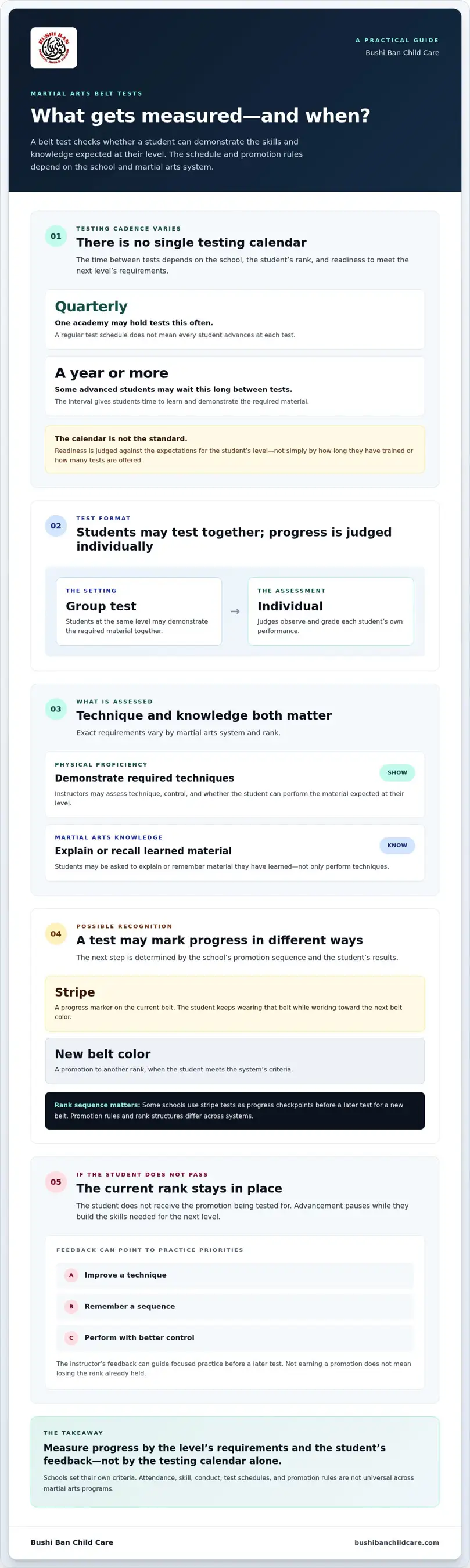
A promotion recognizes a student’s progress by awarding a stripe or a new belt after a test. Students at the same level may test for the next rank and receive a stripe rather than a different belt color. A stripe marks progress toward the next level and signals that the student is working toward promotion to the next belt color.
For example, a student who earns a stripe keeps wearing the current belt while working toward the next color. Some schools use monthly stripe tests as progress checkpoints, but schedules vary. A monthly test might assess readiness for a stripe, while a later test considers advancement to another belt. Understanding the difference helps families know what each test recognizes.
Required Tests and Skipped Ranks
Whether a student must pass a formal test before promotion depends on the rules of their martial arts system. Where testing is required at each level, it provides a structured way to assess readiness before awarding a stripe or belt. Simply attending classes or practicing techniques may not meet the system’s promotion criteria.
Skipping ranks also depends on the system’s promotion rules. Students generally progress through the ranks their system recognizes rather than choosing a belt color independently. If the next step is a stripe, for instance, earning it may come before testing for a new belt color. Knowing the sequence helps students set a clear goal for their next test.
Failing a Belt Test
If a student doesn’t pass, they don’t receive the promotion being tested for and remain at their current rank. The result points to skills that need more practice before the next attempt. A student might need to improve a technique, remember a sequence, or perform with better control. The specific focus depends on the test requirements and the student’s performance.
The practical next step is to use instructor feedback to guide training. A student can focus on techniques or knowledge they found difficult, then demonstrate their progress at a later test. Not earning a stripe or belt that day doesn’t mean losing an existing rank. It simply pauses advancement while the student builds the skills needed for the next level.
How Often Do Belt Tests Occur?
There isn’t one testing calendar across martial arts schools. One academy may hold belt tests quarterly, while advanced students in some martial arts may wait a year or more between tests. The interval is about more than the calendar: students need time to learn and demonstrate the material required for their next rank.
A test measures progress against a level’s expectations, not just how long someone has trained. An instructor may consider whether a student can perform required techniques with control and recall what they’ve learned. A student who hasn’t reached the next level’s standard can keep practicing before testing again.
To understand a student’s pace, look at the criteria and progress feedback, not just how many tests are held each year. A quarterly schedule makes tests available at regular intervals, but it doesn’t mean every student advances each quarter. Rank, readiness, and the skills being assessed all shape when a student is prepared to test.
Some schools use evaluation forms to track progress between tests. A form might record skills practiced, strengths demonstrated, or areas needing more work. Families can use this feedback to set a concrete practice goal, such as improving a technique or remembering a sequence. The form supports a conversation about progress; it is not itself a promotion.
Ask what the next test evaluates and how feedback is shared. Those details help a student connect everyday practice with a clear goal. For children building a consistent routine around martial arts, after-school martial arts practice can provide a structured setting for continued learning.
How Does Martial Arts Belt Testing Work?
A belt test assesses martial arts knowledge and physical proficiency. The format varies, but students demonstrate required techniques while instructors evaluate their progress at facilities like Bushi Ban Child Care.
Skills and Knowledge Assessed
Testing measures whether students can perform the techniques and demonstrate the knowledge expected at their level. A promotion reflects more than simply attending classes. During a group test, an instructor administers the assessment while judges observe and grade students’ techniques. Each student is assessed individually, so their own performance matters.
Students may need to demonstrate techniques and explain or recall material they’ve learned. Exact requirements depend on the martial arts system and rank being tested.
Practice and Test Readiness
To prepare, students practice the required techniques and review the knowledge expected for the next rank. Attendance, skill, and conduct requirements aren’t universal; each school sets its own criteria. Readiness is judged against the relevant standards, including demonstrated physical proficiency and knowledge.
Testing schedules can help students plan, but a scheduled date doesn’t automatically mean every student is ready. Focus practice on the techniques and material being assessed rather than treating attendance at the test as the only measure of progress.
The Testing Process
The testing process moves from the school’s registration arrangements to demonstrating the required material and receiving a result. Students test with others at the same level, but judges assess each performance individually. The instructor administers the test, and judges grade the demonstrated techniques.
A student who meets the promotion criteria may receive a new belt or other rank recognition. Belt-test fees in the United States vary by school, test format, and what the fee covers; there’s no single standard amount.
Advanced and Instructor Testing
In systems that award multiple black-belt degrees, testing can continue after a student earns a black belt. This means a black belt can mark continued training, not its endpoint. In some systems, students who reach fourth-degree black belt may choose to test as a master instructor.
That path adds a distinct milestone to rank progression. The student’s next test depends on the system’s degrees and requirements, while instructor testing represents a separate option after fourth-degree black belt.
Variation in belt ranks across martial arts systems
Belt colors don’t represent an identical rank structure across every martial arts system. The number of ranks before black belt varies by style and system. One practitioner’s training has included systems with as few as 5 ranks before black belt and others with as many as 14. That difference changes how many steps students pass through, not simply the belt colors they wear.
Compare progress within the same system rather than counting belts across different schools. A student wearing a green belt in one system, for example, may have passed through a different number of ranks than a green-belt student elsewhere. Rank names and colors make more sense alongside that system’s own sequence and requirements.
Many students begin training in a white belt, but that shared starting point doesn’t mean their paths will match. One school may use stripes as intermediate milestones, while another recognizes progress through a different number of belt ranks. Ask what the next rank represents within the student’s system, then use that as the meaningful reference point.
Black belt also doesn’t necessarily mark the final stage. Some systems award multiple degrees of black belt, and the 9th-degree black belt is the highest rank a martial artist can achieve in most cases. This helps explain why earning a black belt can be a major achievement and still leave room for continued training.
The takeaway is simple: a belt color alone can’t show how two students’ training compares. Look at the rank sequence, the skills expected at each step, and what advancement means within that specific system. To explore the foundations of martial arts training, continue learning about martial arts practice.
Bushi Ban Child Care: After-School Martial Arts Program
Bushi Ban Child Care’s After-School Martial Arts Program helps families connect a child’s interest in belt progress with regular martial arts practice. Its structured routine combines martial arts training with playtime, obstacle courses, drills, games, snacks, homework time, and fitness classes. This gives students opportunities to develop skills between tests.
Families can also explore the Student Leadership Program, where students develop teaching and activity-leading skills, or Seasonal and Holiday Camps during school breaks. These programs bring martial arts learning together with opportunities to build confidence, fitness, and leadership. Families in Pasadena, Deer Park, and La Porte can explore the option that best fits their child’s interests and routine.
To learn more, visit Bushi Ban Child Care.
Make the Next Step About Growth
Understanding how martial arts belt tests work can help families focus on a child’s learning, not just belt color. A useful next step is to talk with your child about what they enjoy practicing and which skill they’d like to develop. That personal goal can make each class feel purposeful, whether they’re building confidence, improving fitness, or learning to lead.
Bushi Ban Child Care offers an After-School Martial Arts Program, Martial Arts & Fitness Classes, and Seasonal and Holiday Camps. These options connect martial arts learning with a child’s routine and interests. Explore Bushi Ban’s programs in Pasadena, Deer Park, and La Porte to find a fitting next step for your family.
Contact Bushi Ban Child Care to explore the available programs and help your child keep growing through practice.
Frequently Asked Questions
How Many Belts Are There?
There’s no universal number of belts because each martial arts style or system sets its own ranks. Before black belt, systems may have as few as 5 ranks or as many as 14. Students often begin with a white belt, but that shared starting point doesn’t make later rank sequences identical. In most cases, the 9th-degree black belt is the highest rank a martial artist can achieve.
What happens during a martial arts belt test?
A belt test asks students to demonstrate the material required for the level they’re pursuing. An instructor administers the assessment, and judges may observe and grade techniques. For example, students might be asked to show a required technique when called, then continue with other test material. The goal is to evaluate each student against the expectations for that rank.
What skills and techniques are tested at each belt rank?
Students are assessed on the techniques and knowledge required by their rank and martial arts system. The level’s curriculum determines what they need to demonstrate, so there isn’t one checklist for every belt. To prepare, review the material taught for the current rank and identify which techniques or knowledge the upcoming assessment covers.
How long do students usually train before testing for the next belt?
There’s no single training period for every student or rank. Timing depends on the system’s expectations and whether the student can demonstrate the required proficiency. Advanced students in some martial arts may wait a year or more between tests. Rather than counting class attendance alone, consider whether the student has developed the skills and knowledge expected at the next level.
How often do martial arts schools hold belt tests?
Testing schedules vary by school and rank. One martial arts academy holds tests quarterly, while students pursuing advanced belts in some martial arts may wait a year or more. These examples show why a school’s schedule doesn’t necessarily determine each student’s promotion pace. A test date offers an opportunity to demonstrate progress; readiness and rank requirements shape when an individual advances.
How do belt tests differ between karate, taekwondo, judo, and Brazilian jiu-jitsu?
The rank sequence and curriculum can differ among karate, taekwondo, judo, and Brazilian jiu-jitsu, so belt colors aren’t direct equivalents across those arts. The useful comparison is what each system expects students to demonstrate at a particular rank. For families in Pasadena, Deer Park, and La Porte, comparing a student’s progress within their own system gives a clearer picture than comparing belt colors alone.