
Six is a suitable age to begin martial arts when the class is designed for young children. A six-year-old can learn foundational movements and class routines at a pace that fits their age. For families exploring martial arts for 6 year olds in Deer Park, the focus should be on a supportive start, not on rushing toward advanced techniques.
It’s natural to wonder whether your child is ready to listen, join in, and feel comfortable in a structured class. Children develop at different rates, so a program designed for young beginners can make those first steps more welcoming and manageable.
This guide explains when children can start martial arts, how instruction differs across ages, and what a beginner class may involve in Deer Park, Texas. You’ll also learn what to look for in a program that balances movement, focus, and personal growth, helping you decide whether martial arts suits your child.
Key Takeaways
- A six-year-old can begin when the class is structured for young children and introduces foundational skills at a comfortable pace.
- Age-specific instruction helps families look beyond the age label and consider how lessons fit a child’s stage and learning style.
- Class routines can give children practical opportunities to practice listening, patience, and respect alongside movement.
- Consider how the training location and class format fit your family’s routine when deciding what to explore next.
Table of Contents
AT WHAT AGE DO CHILDREN START CLASSES?
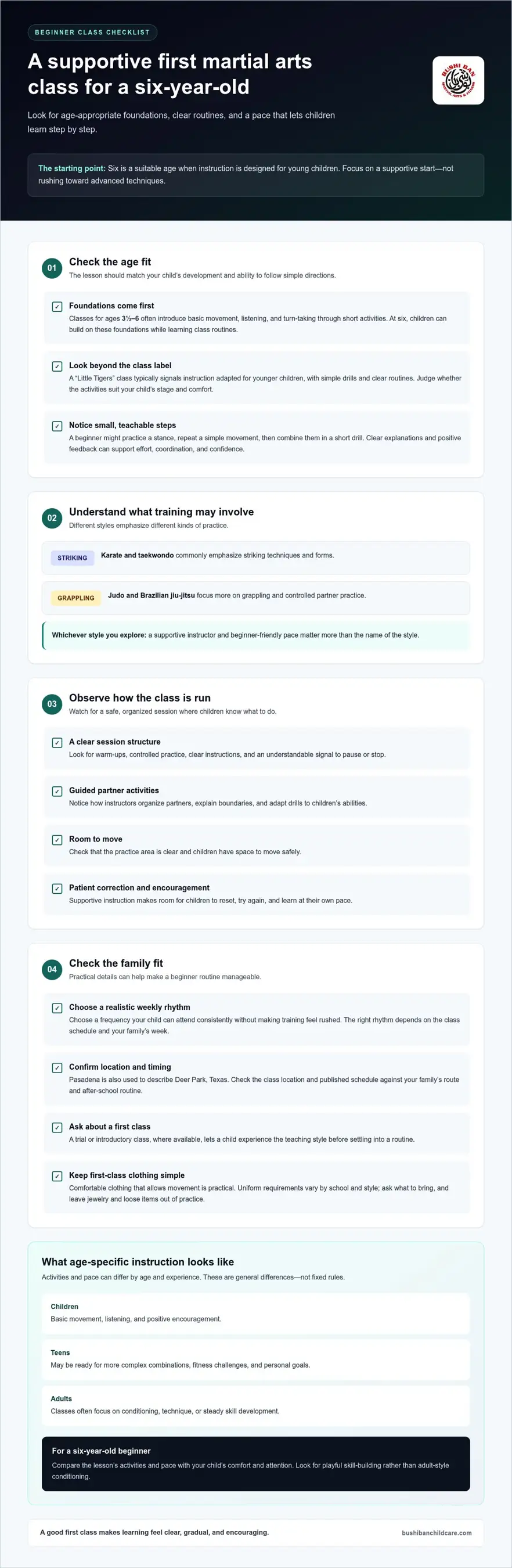
Children can begin when lessons match their development and ability to follow simple directions. Classes for ages 3½-6 often introduce basic movement, listening, and turn-taking through short activities. At six, a child can build on those foundations while learning class routines. In Pasadena, Deer Park, Texas, look for beginner training that helps children develop skills gradually.
Karate, taekwondo, judo, and Brazilian jiu-jitsu can all suit young beginners. Karate and taekwondo commonly emphasize striking techniques and forms, while judo and Brazilian jiu-jitsu focus more on grappling and controlled partner practice. Whatever the style, a supportive instructor and beginner-friendly pace matter more than the name.
A “Little Tigers” class typically signals instruction adapted for younger children, with simple drills and clear routines. Ask what your six-year-old will practice, such as balance, basic stances, or following an instructor’s directions. Look for positive feedback that encourages effort, respect, and participation.
As you observe a class, notice how instructors organize partner activities, explain boundaries, and adapt drills to children’s abilities. A well-run session includes warm-ups, controlled practice, and clear instructions to pause or stop. Check that the practice area is clear and children have room to move.
Choose a weekly frequency your child can attend consistently without making training feel rushed. Regular attendance helps children remember routines and build skills step by step; the right rhythm depends on the class schedule and your family’s week. A trial or introductory class, where available, lets a child experience the teaching style before settling into a routine.
Schedules and locations depend on each school’s timetable. In this area, Pasadena is also used to describe Deer Park, Texas, so check that the class location fits your family’s route. A school’s published schedule can show which sessions suit a six-year-old’s after-school routine.
Comfortable clothing that allows movement is a practical choice for a first class. Uniform requirements vary by school and style, and some classes may use training equipment later. Ask what to bring, and leave jewelry and loose items out of practice.
Age-specific programs for kids, teens, and adults
Age-specific programs match training to children’s goals and experience. For a six-year-old beginner, look for playful skill-building rather than adult-style conditioning.
Programs by Age Group
Children’s classes can emphasize basic movement, listening, and positive encouragement. Teens may be ready for more complex combinations, fitness challenges, and personal goals. Adult classes often focus on conditioning, technique, or steady skill development. These are general differences, not fixed rules: compare the lesson’s activities and pace with your child’s comfort and attention.
Kids Martial Arts Program
A kids’ martial arts program should make progress visible through small, teachable steps. Beginners might practice a stance, repeat a simple movement, then combine them in a short drill. Age-appropriate instruction, fun activities, and positive feedback help children learn. Look for instructors who explain skills clearly and offer encouraging corrections as children develop coordination and confidence.
Preschool programs, sometimes informally called “cubs” classes, typically keep learning active and simple. A child might follow an instructor’s movements, pause on a signal, and take turns in a group drill. The key is whether each activity suits the child’s developmental stage, not whether the class label sounds appealing.
Fitness activities can develop balance, coordination, and stamina through controlled movement. For a young beginner, a warm-up followed by basic footwork and a game-like drill can make activity feel purposeful. Notice how instructors adapt exercises while a child is learning a movement.
As skills improve, instruction can add detail gradually: first a movement, then a sequence, then practice with a partner under clear guidance. Families can compare age-group descriptions and class formats through martial arts and fitness classes while considering which structure best suits their child’s coming school routine.
Discipline and respect
For a six-year-old, discipline starts with simple, repeatable class habits. An instructor might ask students to line up, listen, and then begin a drill. Repeating that sequence helps children understand expectations and take turns. Respect becomes concrete when each child waits for a partner, follows directions, and shares space carefully.
Focus develops through short tasks with clear goals. A child might watch an instructor demonstrate a stance, copy it, and hold the position until the next cue. This links attention with coordination: children need to notice directions while controlling their movements. Clear instructions and brief practice rounds give beginners chances to reset and try again.
Discipline isn’t the same as demanding perfection. In a supportive class, an instructor can calmly correct a movement and show the student how to adjust it. A child who steps out of line can return to the mark and restart the drill. This practical response teaches accountability without making a small mistake feel like failure.
Confidence can grow through achievable goals. A student might first remember a sequence, then perform it with steadier balance, and later demonstrate it for the group. Instructors can recognize effort and progress, not just polished technique. Children can see what they’ve practiced and choose a skill to work on next.
As a parent, look for three signs during class: instructors give clear directions, students treat partners respectfully, and children get chances to practice at their own pace. Notice how the group responds when someone loses focus or forgets a step. Patient redirection, a fresh demonstration, and another turn make discipline part of learning, not punishment. These routines help young students grow more comfortable participating with others.
Location in Deer Park, Texas
For families in Deer Park, Pasadena, and La Porte, Texas, the practical question is how training fits into everyday routines. Consider the drive from home, school, or after-school activities, then compare it with the class timetable. A manageable route can make consistent attendance and a familiar routine easier.
When looking for local classes, keep Deer Park, Pasadena, and La Porte in mind. Map the route from your child’s usual pickup point and consider whether there’s enough time to arrive calmly. These details help you decide whether a location works for your family.
A family testimonial describes boys attending martial arts classes in Pasadena, Deer Park, for 5+ years, with one boy earning a black belt. That example offers a glimpse of a long-term training journey, not a promise about any child’s progress. Each student’s experience develops through their own participation and goals.
Shihan Jerry Minerva has taught martial arts for 39 years and holds a 5th degree black belt in Goshin Jiu-Jitsu. For parents in Deer Park, Pasadena, or La Porte, these details can add context when considering local instruction. Focus on how beginner lessons introduce movement, strength, and defense concepts at a pace suited to young students.
A first visit can also help your child become familiar with the setting. Notice how the instructor gives directions, how students move through the practice space, and how beginners join activities. A comfortable route and clear class routine may make it easier for your child to arrive ready to participate.
Compare your family’s route and schedule with the available martial arts class options for the Deer Park, Pasadena, and La Porte area.
Bushi Ban Child Care: After-School Martial Arts Program
Bushi Ban Child Care offers an After-School Martial Arts Program for families seeking structured after-school care and training. The program combines martial arts with activities such as playtime, obstacle courses, drills, games, snacks, and homework time. It can fit families in Deer Park, Pasadena, and La Porte looking to add movement and structure to the after-school routine.
For other ways to stay active, Martial Arts & Fitness Classes combine martial arts training with fitness. Seasonal and Holiday Camps provide activities during school breaks, while the Student Leadership Program helps students develop leadership skills by taking on supervised roles. Choose the option that best matches your child’s interests and routine.
To explore the options, contact Bushi Ban Child Care or visit bushibanchildcare.com.
Give Your Child a Confident Next Step
Choosing martial arts for six-year-olds in Deer Park is less about setting a distant belt goal and more about helping your child enjoy the next class. Talk with your child about what they’d like to practice, then connect that interest to a steady routine. Small goals, such as remembering a movement or joining a group drill, give children something meaningful to work toward.
Bushi Ban Child Care offers an After-School Martial Arts Program, Seasonal and Holiday Camps, and Martial Arts & Fitness Classes. These options suit different family routines and interests, from after-school training to activities during school breaks. Consider which format fits your child’s week and enthusiasm for movement.
Explore the available options and take the next step at Bushi Ban Child Care. A positive start can help your child approach each class with curiosity, growing confidence, and pride in their progress.
Frequently Asked Questions
HOW MUCH DO CLASSES COST?
Tuition depends on the program and enrollment details, and is provided after a quote request. For a useful comparison, identify whether you’re considering after-school training, regular martial arts classes, or a seasonal camp. Then consider which format fits your child’s routine and goals. Contact Bushi Ban Child Care for pricing based on the option you’re considering.
What martial arts schools in Deer Park offer classes for 6-year-olds?
Bushi Ban Child Care offers children’s martial arts programs serving Pasadena, Deer Park, and La Porte, Texas. Families seeking martial arts for 6 year olds in Deer Park can start by matching the class location with their regular school-day route. Compare the trip from school with pickup plans, then choose a program format that fits your child’s after-school routine.
What are the age requirements for kids' martial arts classes in Deer Park?
Children’s programs are the relevant starting point for a six-year-old. For families considering martial arts for 6 year olds in Deer Park, Bushi Ban Child Care offers an After-School Martial Arts Program and Martial Arts & Fitness Classes for children. Consider whether your child can join a group activity, follow basic instructions, and enjoy practicing new movements. These readiness cues can help guide your choice.
How much do children's martial arts classes cost in Deer Park?
Children’s class tuition depends on the program and enrollment details, and is provided after a quote request. The option may be a regular class, after-school program, or seasonal camp, so identify the format you’re considering first. Then describe your child’s schedule and interests when requesting a quote from Bushi Ban Child Care.
What safety measures and instructor qualifications should a children's martial arts program have?
Look for instructors who demonstrate movements clearly, supervise practice, and give children straightforward directions for partner activities. During a visit, notice whether the practice space is organized and students have room to move. Observe how instructors guide beginners through drills and explain class expectations. These details can help you assess whether the learning environment suits your child.