
Martial Arts for Focus & Discipline: Parent's Guide
What if the secret to your child's success in the classroom isn't found in a textbook, but on a training mat? As a parent, it's incredibly tough to hear reports of distractibility from teachers or to feel the exhaustion of a child who won't follow simple instructions at home. You want them to excel, yet traditional after-school supervision often lacks the structure needed to channel their energy effectively. Many families find that martial arts for focus and discipline provides the vital bridge between restless energy and academic achievement. You already know that your child has immense potential; you're simply looking for the right environment to unlock it.
In this guide, you'll discover how structured martial arts training transforms a child's concentration, behavior, and academic performance through the science of discipline. We'll explore why this moving meditation is so effective at training the brain's executive function. You'll learn how these skills translate into better grades, increased initiative at home, and a profound sense of self-confidence. From the first bow to the specialized Student Leadership Program, we'll show you how a commitment to character development creates a foundation for lifelong success.
Table of Contents
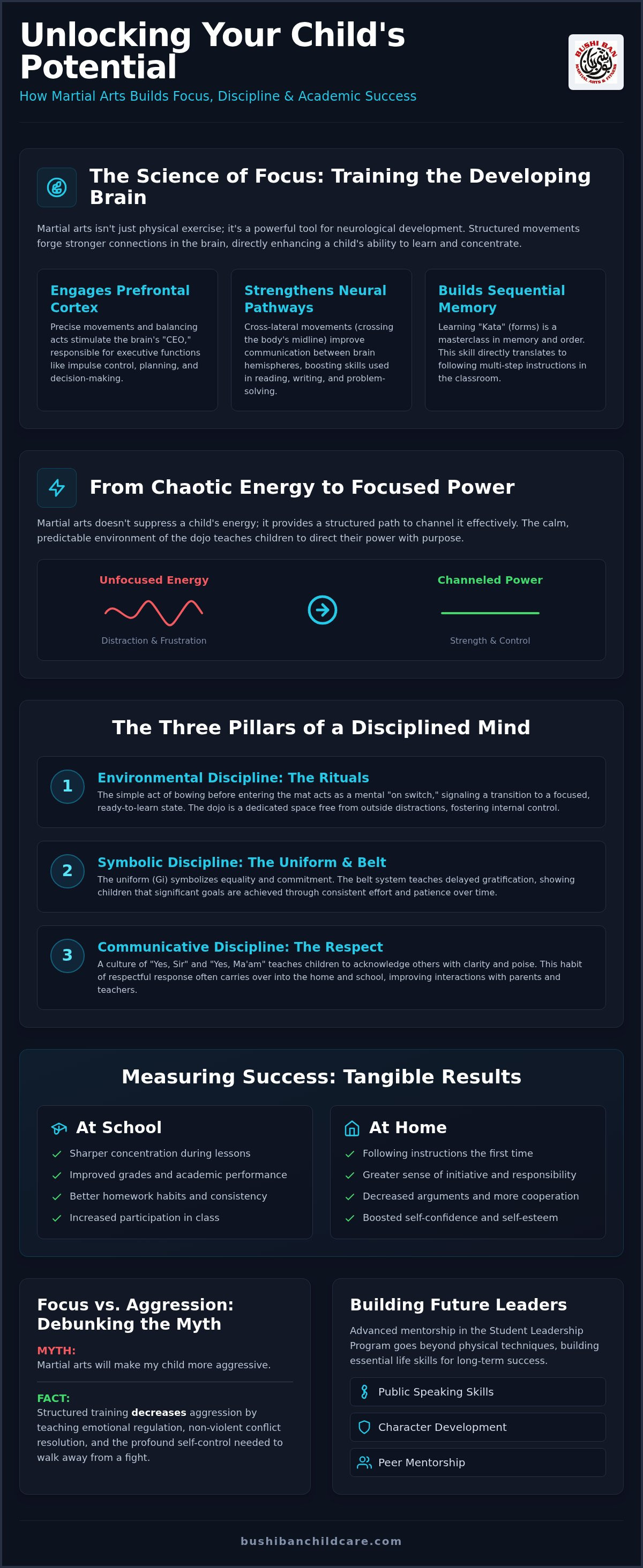
The Science of Focus: How Martial Arts Trains the Developing Brain
In the dojo, we often speak of "Zanshin." This ancient concept translates to a state of total awareness or a "lingering mind." While many children today struggle with constant digital distractions, martial arts for focus and discipline teaches them to remain entirely present. This isn't a passive state; it's an active, sharp engagement with their surroundings. When a child balances on one leg or executes a precise strike, they aren't just moving muscles. They're engaging the prefrontal cortex, which is the part of the brain responsible for executive function, impulse control, and complex planning.
Scientific research into Martial Arts Therapy highlights how these structured movements support neurological development. Specifically, cross-lateral movements, which involve crossing the body's midline, require the left and right hemispheres of the brain to communicate more effectively. This "cross-talk" strengthens the neural pathways that children use for reading, writing, and problem-solving. Cognitive discipline is the byproduct of intentional, repetitive physical practice.
From Hyperactivity to Controlled Energy
High-energy children often feel out of place in a standard classroom or a chaotic playground. In those environments, energy is often either suppressed or allowed to turn into noisy distraction. Martial arts offers a third path: channeling. We don't ask a child to stop being energetic. Instead, we teach them how to direct that power with purpose. The dojo provides a predictable, calm structure that contrasts sharply with the noise of a typical childcare setting. This helps children learn that energy, when controlled, becomes a strength rather than a source of frustration.
Building Executive Function Through Kata
Learning a Kata, or a series of choreographed movements, is a masterclass in sequential memory. A child must remember the order, the direction, and the specific technique of dozens of different moves. This builds a mental "muscle memory" that is directly applicable to the classroom. If a child can memorize a complex form, they can follow a multi-step set of instructions from a teacher without getting lost. During this process, instructors provide immediate, supportive feedback. This helps the student recognize when their focus has drifted and teaches them how to pull it back instantly. This constant cycle of action and correction is what makes martial arts for focus and discipline so effective for long-term academic and social success.
The Three Pillars of Discipline in a Structured Dojo
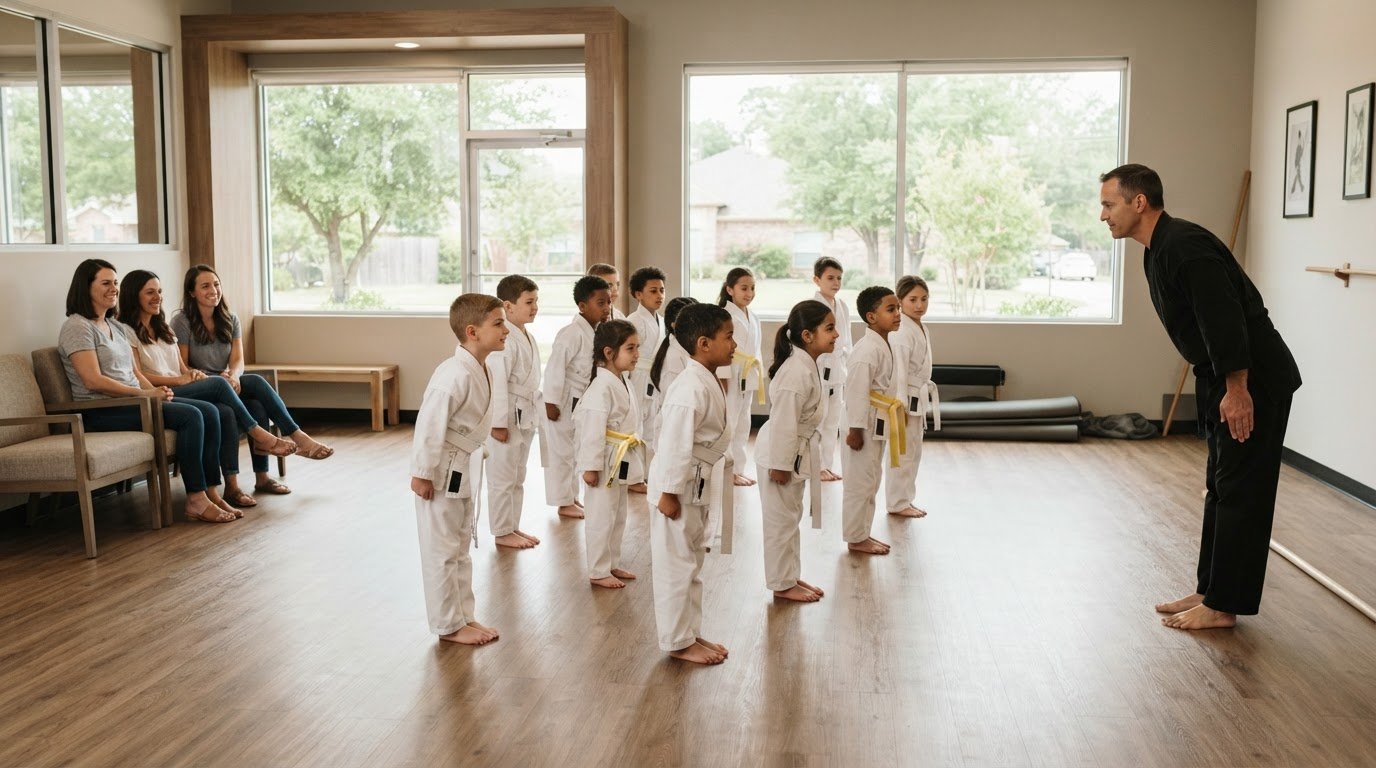
Discipline in a martial arts setting is far more than just following orders. It's a structured framework that helps children build internal strength and clarity. One of the first things a child learns is the ritual of the bow. This simple act isn't just a tradition; it serves as a mental "on switch." By bowing before entering the mat, a student signals they're entering a "ready state" for learning and leaving outside distractions behind. This transition is essential for children who spend their day in high-stimulation school environments.
The uniform, or Gi, reinforces this commitment to the group. It serves as a symbol of equality, showing students that everyone is working toward the same standard of excellence regardless of their background. When a child puts on their uniform, they step into a role defined by effort and character. This is where martial arts for focus and discipline truly shines. The belt system further supports this by teaching delayed gratification. In a world of instant rewards, earning a new belt requires months of persistent effort. It shows children that big goals are achieved through small, consistent steps and unwavering patience.
Respectful communication is the final piece of this foundational puzzle. We cultivate a "Yes, Sir" and "Yes, Ma'am" culture that isn't about blind obedience. Instead, it's about teaching children to acknowledge others with clarity and poise. This habit of respectful response often carries over into the home, where parents notice their children taking more initiative without being asked multiple times.
Pillar 1: Environmental Discipline
The dojo mat is a dedicated space where the rules of the outside world pause. By removing toys, screens, and chaotic play, we create an environment where children can practice internal control. This "sacred space" triggers a focused mindset the moment their feet touch the mat. For many local families, the transition from the school bus to our after-school martial arts program provides a necessary mental reset. It allows them to shed the stresses of the classroom and refocus their energy on personal growth.
Pillar 2: Peer-to-Peer Accountability
Training in a group setting teaches children to respect physical boundaries and personal space. They learn that their actions affect those around them. This is often modeled by our Senior Students, who take pride in mentoring younger practitioners. By watching older kids demonstrate poise, new students see a living example of what they can become. They learn the value of waiting their turn and showing respect, which builds the foundation for emotional regulation both at home and in the classroom.
Focus vs. Aggression: Debunking Common Martial Arts Myths
Many parents hesitate to enroll their children in training because they fear it might encourage fighting at school. It's understandable to wonder if teaching combat skills leads to aggressive behavior. However, the structured environment of a dojo actually produces the opposite effect. Martial arts for focus and discipline emphasizes that physical techniques are strictly for self-defense. We teach children that true strength lies in the ability to avoid a confrontation whenever possible. By prioritizing non-violent resolution, we help students understand that self-defense is always a last resort.
Because these children feel physically capable, they no longer feel the need to use aggressive posturing or bullying to gain status. Research into youth development suggests that martial arts students are statistically less likely to initiate conflict because they possess the self-assurance to remain calm when challenged. They don't have anything to prove to their peers. This sense of security allows them to focus on their own progress rather than seeking validation through dominance.
The Confidence-Focus Connection
A child who feels truly capable is much less likely to act out for attention. When a student spends weeks mastering a difficult kick, they develop a sense of "inner quiet" that stays with them long after they leave the mat. This quiet confidence is the foundation of assertive leadership rather than aggressive energy. Instead of reacting impulsively to a peer's comment, a focused student has the mental space to choose a productive response. This shift from reactive to proactive behavior is a hallmark of martial arts for focus and discipline.
Emotional Regulation Under Pressure
Controlled sparring sessions are one of the most effective ways to teach emotional regulation. Under the watchful eye of an instructor, children learn to stay calm while facing a direct physical challenge. They practice specific techniques for breathing through frustration when a move is difficult to learn or when they face a setback. These dojo breathing techniques are highly transferable skills. A child who can keep their heart rate steady during a match can apply those same methods to manage test-taking anxiety in the classroom. This ability to regulate emotions under pressure is a vital life skill that serves them well in every area of life.
Measuring Success: How to See Focus Improvements at Home and School
How do you know if the training is actually sticking? While a new belt is a wonderful celebration of effort, the real evidence of martial arts for focus and discipline appears in the quiet moments between classes. You'll likely notice your child making more consistent eye contact when you speak. They might start following instructions the very first time you give them, rather than requiring several reminders. Perhaps most impressively, you may see them self-correct their behavior before you even have to intervene. This internal awareness is a direct result of the structured environment they experience on the mat.
This newfound clarity often creates what we call the "Homework Habit." The same mental stamina required to hold a difficult stance or memorize a form is exactly what's needed to sit through a math assignment. Discipline isn't a switch that only turns on in the dojo; it's a character trait that travels with them. We encourage parents in Pasadena and Deer Park to keep an open line of communication with their child's teachers. Ask if they've seen a shift in classroom engagement or a reduction in distractibility. Often, the teacher is the first to notice that a student is now finishing what they start with a new sense of grit. If you're ready to see these changes in your own home, explore our after-school martial arts programs today.
The 30-Day Focus Milestone
Within the first month, most parents report a visible improvement in listening skills and physical coordination. You can reinforce these dojo lessons at home by using "martial arts language." Try asking your child to "show me your focus stance" when it's time to listen to important news. This simple phrase acts as a physical anchor for their concentration. As you track school grade improvements alongside their belt promotions, you'll see a clear correlation between martial arts for focus and discipline and their success in the classroom.
Social Skills and Leadership
Focus isn't just about individual tasks; it's also about how a child interacts with others. Better concentration leads to better listening in social circles, which naturally improves friendships. You may notice your child shifting from a "follower" who simply goes along with the crowd to a "leader" who sets a positive example for group activities. This transition is a key part of our Student Leadership Program, where focus evolves into genuine mentorship and public speaking skills. When a child learns to command their own mind, they're finally ready to lead others with integrity and confidence.
Bushi Ban: Leadership in Pasadena, Deer Park & La Porte
Choosing an after-school program is one of the most important decisions a parent makes. It’s the bridge between the structured school day and the peace of home. At Bushi Ban, we believe this time shouldn't just be spent waiting; it should be used for growth. Founded circa 1980 by Grandmaster Zulfi Ahmed, the "Bushi Ban Way" is a philosophy that has guided thousands of Texas families toward higher standards of character. Our approach to martial arts for focus and discipline isn't just about physical movement. It's about a legacy of excellence that transforms children into leaders.
We invite you to see the difference between simple supervision and true structured enrichment. In many traditional settings, children are merely watched until their parents arrive. At our facilities, every minute is intentional. From the moment they arrive, students are immersed in an environment that prizes respect and effort. Our Student Leadership Program stands as the pinnacle of this journey. It’s designed for those who have mastered the basics of focus and are ready to develop public speaking, mentorship, and advanced character traits. This program ensures that the discipline learned on the mat becomes a permanent part of their identity.
Beyond After-School: A Community of Mentors
Our instructors are far more than martial arts coaches. They serve as mentors who are deeply invested in your child's academic success and emotional well-being. We understand the unique needs of families in the Pasadena, Deer Park, and La Porte areas. Our local facilities provide a safe, familiar environment where kids can thrive among peers who share their values. This transition from the school bus to our dojo is the most productive part of a child's day. It’s a place where they feel seen, supported, and challenged to be their very best.
Join the Bushi Ban Family Today
Enrolling your child in our After-School Martial Arts Program is a straightforward process designed for busy parents. We've spent decades refining our methods to ensure we remain the premier choice for character development in Texas. We don't just teach kicks and punches; we build the foundational martial arts for focus and discipline that leads to better grades and a more harmonious home life. If you’re ready to see your child take initiative and lead with confidence, we’re here to partner with you. Schedule a tour of our Pasadena, Deer Park, or La Porte locations to experience the Bushi Ban difference firsthand.
Empower Your Child’s Future Today
The journey from the classroom to the dojo represents more than just a change of scenery. It's a fundamental shift in how your child engages with the world around them. By choosing martial arts for focus and discipline, you provide them with the vital tools to master their own concentration and navigate academic challenges with poise. We've seen how the structured environment of the mat translates into better grades, respectful communication, and a resilient spirit that lasts a lifetime.
Serving the Houston area since 1980, Bushi Ban provides the ideal bridge between school and home for busy families. With dedicated transportation from local elementary schools and our specialized Student Leadership Program, we offer a foundation for advanced character growth rather than simple supervision. It's time to unlock the immense potential you already see in your child every day. We invite you to Enroll Your Child in Our Structured After-School Program Today and watch them grow into the confident, capable leader they were meant to be. We're honored to partner with you in this rewarding journey of personal achievement.
Frequently Asked Questions
How long does it take to see focus improvements in my child?
Most parents notice a difference in their child’s listening skills and eye contact within the first 30 days of training. While every child is unique, the consistent routine of martial arts for focus and discipline creates visible behavioral shifts relatively quickly. You'll likely see them following instructions at home with less resistance. Over time, these small changes grow into significant improvements in academic performance and self-regulation as they progress through their belt ranks.
Will martial arts make my child more violent or aggressive at school?
Martial arts training actually reduces aggression by giving children the confidence to avoid conflict. We teach students that physical techniques are strictly for self-defense and should be used only as a last resort. By fostering a sense of "inner quiet" and security, we remove the need for children to act out or use aggressive posturing to impress their peers. Our students learn to resolve disagreements through assertive leadership and calm communication instead of violence.
My child has ADHD; is martial arts a good fit for them?
Yes, martial arts is an excellent fit for children with ADHD because it provides a high-energy outlet within a very structured environment. The repetitive nature of the movements and the immediate feedback from instructors help train the brain to maintain attention. Unlike a chaotic playground, the dojo environment minimizes external distractions. This allows children to practice internal control and cognitive discipline in a way that often carries over into their schoolwork and home life.
What is the difference between your program and a standard daycare?
The primary difference is our focus on structured enrichment rather than just supervision. While a standard facility might provide a safe place to wait, our After-School Martial Arts Program uses every minute to build character and physical fitness. We don't offer all-day child care; instead, we provide a goal-oriented curriculum. Students participate in daily classes and have the opportunity to join our Student Leadership Program to develop mentorship and public speaking skills.
Do you provide transportation from local schools in Deer Park and Pasadena?
We provide dedicated transportation from many local elementary schools in Pasadena, Deer Park, and La Porte to ensure a seamless transition for your family. This service allows your child to move directly from their classroom to our facility without you needing to leave work early. It turns the gap between school and home into a productive time for growth. Please contact your local Bushi Ban location to verify if we serve your child’s specific school.
What age is best to start martial arts for discipline?
Children can begin benefiting from martial arts as early as four or five years old, but the elementary years are an ideal time to start. During this stage of development, kids are building the foundational social and cognitive skills they'll use for the rest of their lives. Starting early helps instill a sense of respect and goal-setting. Our programs are tailored to be age-appropriate, ensuring that every student feels supported while they learn the value of persistence.
How many days a week should my child attend for the best results?
Daily attendance in our after-school program helps solidify the benefits of martial arts for focus and discipline. Consistency is the most important factor in building new habits of focus and discipline. By participating several times a week, children stay immersed in the dojo’s culture of respect. This regular practice ensures that the lessons they learn on the mat become a natural part of their daily routine both at school and at home.


Comments