
Martial Arts for Girls in La Porte: A Parent's 2026 Guide
What if the best martial arts fit for your daughter isn’t the one with the flashiest moves, but the one where she feels encouraged to keep learning? Choosing martial arts for girls La Porte families can feel challenging when you’re weighing class atmosphere, beginner readiness, and opportunities to grow beyond technique.
It’s reasonable to want more than a workout. A welcoming class gives your daughter room to learn at an age-appropriate pace, with clear instruction and encouragement as she takes on new challenges. The right fit depends on her age, experience, interests, and comfort in the room.
This guide compares La Porte-area options, including La Porte TaeKwonDo, the City of La Porte’s Space City Martial Arts program, and Bushi Ban Child Care. You’ll find practical ways to compare instruction, class structure, and mentorship, plus what to watch for during an introductory class. Bushi Ban Child Care’s curriculum is tailored to age groups and skill levels, and its Student Leadership Program gives students opportunities to assist instructors. Use these details to find a program that fits your daughter’s interests and your family’s routine.
Key Takeaways
When comparing martial arts for girls La Porte programs, look beyond labels to teaching style, class culture, and your daughter’s readiness.
Constructive feedback and age-appropriate responsibility can complement physical training, while every child’s growth remains personal.
Compare instruction, age and skill grouping, leadership opportunities, and schedule fit.
During an introductory class, observe how instructors communicate, include students, and support beginners. Then ask your daughter what she thought.
Bushi Ban’s tailored training and Student Leadership Program connect martial arts practice with opportunities to assist instructors and develop leadership skills.
Table of Contents
Girls' Martial Arts in La Porte: What Parents Should Seek
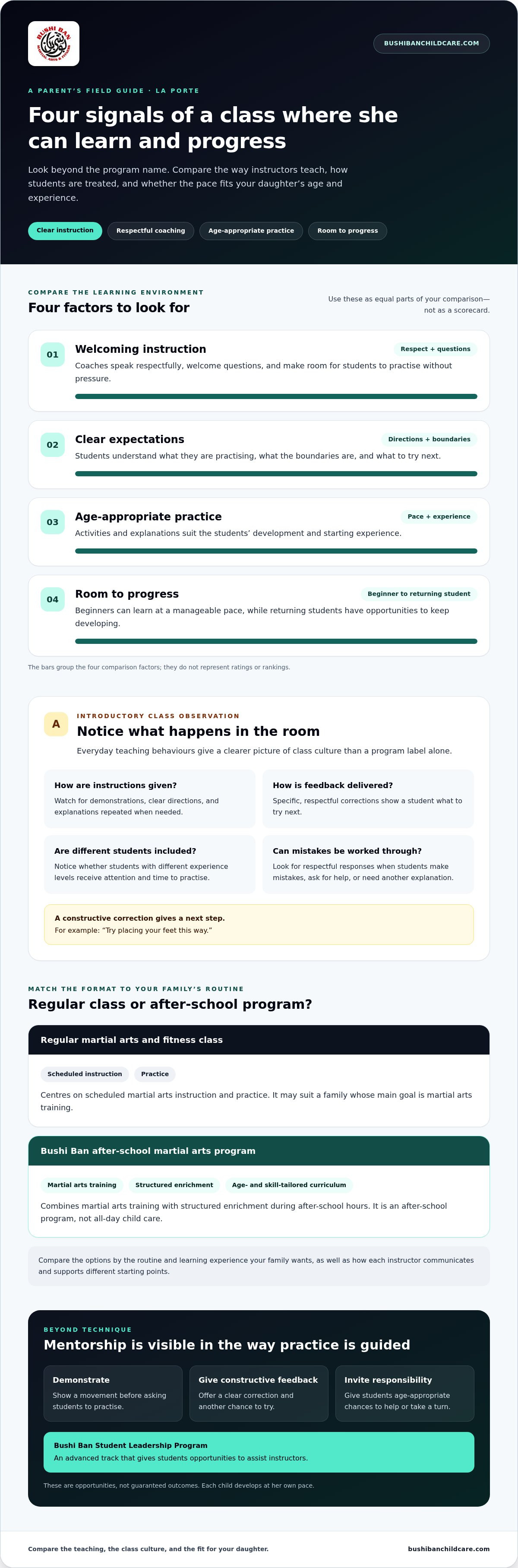
Choose a program by looking beyond the name on the schedule. Compare how instructors teach, how students treat one another, and whether the pace and expectations suit your daughter’s age and experience. A class is easier for a beginner to navigate when directions are clear and she has room to ask questions and practise.
Girls don’t need a separate standard for learning martial arts. They need instruction that respects them as individuals and supports them as they practise new movements. Martial arts include a range of traditions and approaches, as the general overview of Martial arts explains. Focus on the teaching and learning environment rather than assumptions about what girls should enjoy or achieve.
As you compare martial arts for girls La Porte options, use this checklist:
Welcoming instruction: Coaches speak respectfully and make space for questions.
Clear expectations: Students understand directions, boundaries, and what they’re practising.
Age-appropriate practice: Activities and explanations suit the students’ development and experience.
Room to progress: Beginners can learn at a manageable pace, while returning students have opportunities to keep developing.
What makes a martial arts class feel welcoming to girls?
Look for respectful coaching, clearly explained boundaries, and calm encouragement when a student is uncertain or needs an instruction repeated. Notice whether the instructor welcomes questions and gives feedback that shows students what to try next. Rather than assuming a girl is naturally cautious, competitive, strong, or confident, watch how the coach responds to her effort and interests.
A supportive martial arts environment has clear expectations, respectful instruction, room for questions, and a pace that helps beginners take part. During an observation, notice whether students with different experience levels receive attention and whether instructions are clarified when someone needs help. These everyday teaching behaviors offer a more useful picture of class culture than a program label alone.
What is the difference between classes and after-school martial arts?
A regular martial arts and fitness class centers on scheduled instruction and practice. An after-school program combines martial arts training with structured enrichment during after-school hours. Bushi Ban’s after-school martial arts program offers this broader structure, with a curriculum tailored to age groups and skill levels. It is an after-school program, not all-day child care, so compare it with a regular class based on the routine and learning experience your family wants.
Consider what your daughter needs from the experience. If her main goal is martial arts instruction, a regular class may suit her. If you’re looking for training within a structured after-school setting, the after-school format may be a better match. In either case, notice how the instructor communicates, includes students, and responds to different starting points. A good fit gives your daughter room to participate and progress without pressure to meet someone else’s expectations.
How can martial arts mentorship help girls grow beyond technique?
Learning a movement is only one part of a martial arts class. Mentorship is also visible in how instructors guide practice: they demonstrate a skill, offer constructive feedback, and give students age-appropriate chances to take responsibility. These interactions let students practise listening, patience, and cooperation alongside physical techniques.
These are opportunities, not guaranteed outcomes. Children develop confidence, persistence, and comfort speaking up at different rates and through many experiences. Focus on what you can observe: Are directions clear? Does the instructor correct mistakes respectfully? Can students try again without being embarrassed? For families exploring martial arts for girls La Porte, these everyday details say more about mentorship than broad promises about character.
Respectful routines can make these skills part of practice. Students might listen for a cue before beginning, repeat a sequence after feedback, or take turns with a partner. When appropriate, an instructor might invite a student to demonstrate a familiar movement or help with a simple class task. Each offers a chance to practise responsibility in context, not a guarantee that every child will respond in the same way.
How can parents recognize mentorship during instruction?
Watch for instructors who demonstrate movements before asking students to practise, give specific corrections, and acknowledge effort as well as accuracy. Notice whether beginners have time to repeat a skill and receive another explanation when needed. These interactions show how guidance works in practice, without assuming every student will have the same experience.
Pay attention to how feedback is phrased. “Try placing your feet this way” gives a student a clear next step; a vague reprimand may leave her unsure what to change. A mentor’s role isn’t to remove every challenge, but to make expectations understandable and practice constructive. Notice whether students are treated respectfully when they make a mistake or ask for help.
What does a student leadership pathway add?
Bushi Ban’s Student Leadership Program is an advanced track where students have opportunities to assist instructors and develop teaching, public-speaking, and mentoring skills. These responsibilities build on martial arts practice by giving students ways to explain, demonstrate, and support learning. Families interested in this progression can learn more about Bushi Ban’s student leadership program.
Leadership doesn’t have to mean being the loudest student. It can involve listening carefully, demonstrating a movement patiently, or helping another student understand a direction. Instructor-assisting opportunities give students a structured setting to practise those responsibilities. How each student develops through them is personal.
As you observe a class, consider whether students receive clear guidance and appropriate chances to contribute. Mentorship is most meaningful when it appears in steady, respectful interactions, not just promises about outcomes. That gives you a practical way to assess how a program’s instruction may support your daughter’s learning.
How to compare martial arts options for girls around La Porte
A useful comparison focuses on what your daughter will experience in class, not just a program name or convenient time slot. A suitable program can challenge her while providing instruction and support that match her age and experience. Lowering expectations isn’t the same as making a class welcoming.
Use this framework to compare local options. Schedules and introductory offers can help with planning, but they don’t show how instructors teach or students interact.
Which questions help compare class structure and instruction?
Consider whether the instructor explains expectations in language children can understand and whether activities suit the students’ abilities. Do students know what to do next, have time to practise, and receive attention when they need help? A first class offered free by La Porte TaeKwonDo or Space City Martial Arts can give you a chance to observe, but the offer itself doesn’t establish teaching quality.
Parent reviews can point to themes worth considering, such as communication or class organization. Treat them as individual experiences, not a substitute for seeing instruction and student interaction yourself. If a review raises a concern, compare it with what you observe rather than assuming it applies to every class.
How should parents weigh convenience against program fit?
Start with your family’s realistic routine, then compare it with published class times. La Porte TaeKwonDo lists Junior Beginner sessions at 4:45 p.m. on Mondays, Wednesdays, and Thursdays, at 6:20 p.m. on Tuesdays and Fridays, and at 10:00 a.m. on Saturdays. A standalone class may fit your plans, while an after-school format may suit a child who benefits from training as part of structured enrichment.
Convenience matters, but it works best alongside a good learning fit. As you compare martial arts for girls La Porte options, consider what your daughter needs from instruction and what your family can sustain. Bushi Ban’s parent resources on martial arts and focus, discipline, fitness, and coordination can also help you think through the skills your daughter wants to practise.
How to assess a first martial arts class for your daughter
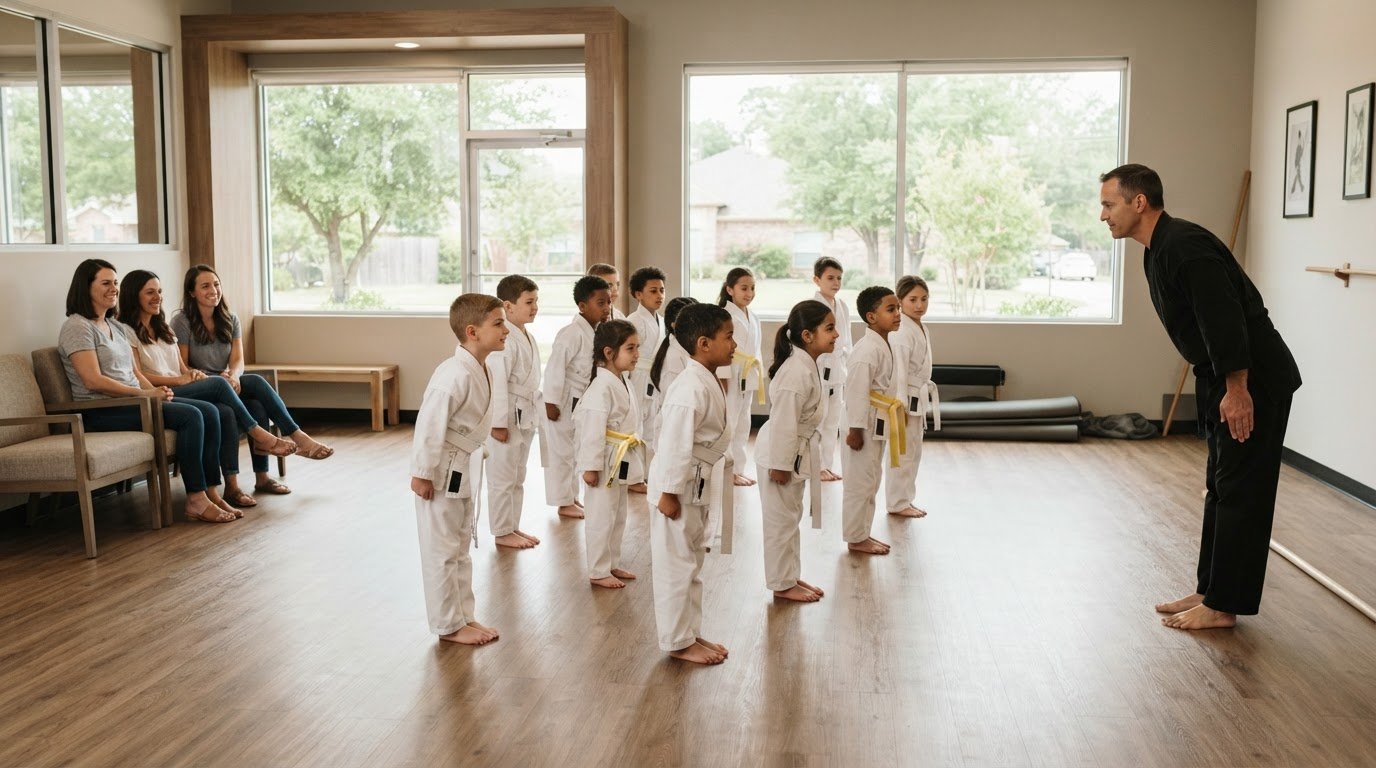
A first class lets your daughter experience the pace and teaching style while giving you a closer look at how the program works. Treat it as useful information, not a guarantee of what every future class will feel like. She may be quiet at first, need time to warm up, or leave excited to learn more. Any of these reactions can help you understand the fit.
Use this sequence to make the visit more useful:
Clarify her goals. Ask what she hopes to try, whether that’s learning movements, getting active, or simply seeing what a class is like.
Review the class information. Check the age or experience grouping, published schedule, and any clothing or participation guidance so she knows what to expect.
Observe the instruction. Notice how the instructor gives directions, includes students, and supports beginners as they follow along.
Talk afterward. Give your daughter room to describe what she enjoyed, what felt challenging, and what she’d like explained.
What should parents observe during the class?
Pay attention to whether instructions and transitions are clear to children. Do students understand where to go and what to practise next? Notice whether the instructor is attentive, demonstrates movements, and offers guidance suited to the students’ abilities. Respectful exchanges matter, too. A beginner may need extra reassurance, while another child may be ready to participate right away. Students won’t all respond identically.
A well-structured introductory class has clear instructions, attentive guidance, and practice suited to students’ abilities. Watch how the instructor responds when a child hesitates or makes a mistake. A calm correction or simple demonstration can help a beginner rejoin the activity without feeling singled out. These details give you a stronger basis for deciding whether the class could suit your daughter than a quick impression of the room.
How can parents help a beginner feel prepared?
Keep expectations simple. Explain that learning takes practice and that no one expects a beginner to arrive knowing the techniques. Choose comfortable clothing that allows movement, unless the class information specifies otherwise. Before class, remind her that it’s okay to listen, try, and ask questions. A little preparation can make a new setting feel more manageable without asking her to prove anything.
Afterward, ask open questions instead of starting with “Did you like it?” Try “What part felt enjoyable?” or “Was anything confusing?” Her answers may show that she liked a particular activity but felt unsure during a transition, or that she wants more time before deciding. Consider her perspective alongside what you observed, and remember that one visit is only a snapshot.
For families exploring martial arts for girls La Porte, a first class can clarify what kind of instruction feels encouraging and appropriately challenging. You can also explore Bushi Ban martial arts programs.
Explore Bushi Ban martial arts and leadership programs near La Porte
For families comparing martial arts for girls La Porte options, Bushi Ban brings martial arts training, fitness, after-school enrichment, and leadership development together. Its curriculum is tailored to age groups and skill levels, providing a structure suited to each student’s stage of learning. The program isn’t presented as girls-only; the emphasis is on helping each student participate and progress with appropriate instruction.
Which Bushi Ban options may fit a girl’s goals?
The right format depends on what your daughter wants from the experience and how it fits your family’s routine. Bushi Ban offers several options:
Martial arts and fitness classes provide regular instruction and physical activity for students developing their skills.
The after-school program combines martial arts training with structured enrichment after school. It’s an after-school program, not all-day child care.
Seasonal and holiday camps offer a martial arts-centered option during school breaks.
The Student Leadership Program gives students opportunities to assist instructors and develop teaching, public-speaking, and mentoring skills.
These formats serve different needs. A student interested in consistent skill practice may prefer regular classes. A family seeking structured enrichment after school may find the after-school program more relevant, while camps provide a martial arts-centered option during school breaks. Consider what your daughter enjoys, how much structure she wants, and what fits alongside school and family commitments.
Mentorship can become more active as a student gains experience. In the Student Leadership Program, instructor-assisting opportunities let students practise explaining and supporting learning while developing teaching and public-speaking skills. These are concrete ways to take on responsibility, though each child’s response and growth is individual. If leadership is a priority, consider whether she’s interested in helping others as well as continuing her own training.
Bushi Ban’s student leadership resources offer families another way to explore how leadership opportunities can complement training. As you compare formats, keep your daughter’s interests and routine in view. The goal isn’t to choose the most intensive option, but to find a supportive structure that fits her current needs and leaves room to keep learning.
What is a helpful next step for La Porte families?
Make a short list of what matters most to your family: skill practice, fitness, after-school structure, or leadership development. Then review the program information with your daughter and discuss which format appeals to her. A thoughtful choice starts with her goals and your family’s schedule, not assumptions about what girls should prefer.
To learn more about the available formats, explore Bushi Ban programs for your family.
Take the Next Step Toward Her Goals
The best next step isn’t deciding who your daughter should become. It’s making room for her to discover what she enjoys, what challenges her, and whether she wants to keep learning. Let her questions and reactions guide the conversation, and give her time to settle into a new experience. Progress can begin with curiosity.
As you consider martial arts for girls La Porte, choose an option that aligns with your family’s priorities and your daughter’s interests. A thoughtful start gives her room to practise, learn from guidance, and explore new responsibilities at her own pace.
Explore Bushi Ban programs for your family and choose the martial arts, after-school, camp, or leadership option that best fits your daughter’s interests and routine.
Frequently Asked Questions
What age can girls start martial arts?
There isn’t one starting age that suits every child; readiness, attention, and comfort in a group are useful guides. A child who can listen to a short direction, try an activity, and signal when she needs help may be ready to explore a class. Ask how instruction is organized for her age and experience, then consider whether the setting feels manageable for her as a beginner.
Do girls need previous experience to join martial arts classes?
No, girls can begin without previous martial arts experience. A first-time student can learn the class routine and practise foundational movements without already knowing techniques. For a smoother start, tell your daughter she can watch a demonstration, follow along as best she can, and ask for clarification. Bushi Ban tailors its curriculum to age groups and skill levels, giving families a way to consider how instruction may suit a new learner.
Are martial arts classes for girls different from classes for boys?
Martial arts fundamentals don’t need to differ by gender. A class can teach shared skills while instructors guide each student according to her age, experience, and learning needs. Grouping by readiness or experience helps organize instruction; it doesn’t mean girls need easier challenges. As you explore programs in La Porte, Pasadena, or Deer Park, consider whether the teaching gives your daughter a fair chance to participate and keep learning.
Can martial arts help girls build confidence?
Martial arts gives children chances to practise, receive feedback, and notice their own progress. Those experiences may support confidence over time, but no class can promise a particular result. A child doesn’t need to become more outgoing to benefit from learning. For families considering martial arts for girls La Porte, focus on whether your daughter feels encouraged to try, make mistakes, and return to a challenge at her own pace.
What should a girl wear to her first martial arts class?
Choose comfortable clothing that allows easy movement, unless the class has provided different guidance. A soft shirt and flexible pants can make it easier to stretch, step, and follow demonstrations than stiff or restrictive clothing. Review the class information for clothing expectations and help your daughter choose something she feels comfortable wearing. That way, she can focus on learning the routine rather than adjusting her outfit.
Can an after-school martial arts program work for a beginner?
Yes, a beginner may join an after-school martial arts program if the instruction and routine suit her needs. Bushi Ban’s after-school program combines martial arts training with structured enrichment; it isn’t all-day child care. For families in La Porte, Pasadena, and Deer Park, compare the format with your child’s after-school routine and consider whether she’s ready to take part in organized activities alongside martial arts practice.


Comments