
Start with the adults already in a boy’s life: relatives, family friends, teachers, coaches, and other trusted adults can all be positive role models for boys in Deer Park. The goal isn’t to find one perfect mentor. It’s to help a boy build steady, respectful connections with adults who listen, set a good example, and encourage his growth.
It’s understandable to want a supportive male presence as your son develops confidence, values, and life skills. Meaningful connections often grow through shared time, whether during an everyday activity, in a team or community setting, or at camp. This article explores where boys can meet mentors, what a steady presence can offer, and why a circle of caring role models can matter more than relying on one person alone. You’ll also find practical ways to support those relationships.
Key Takeaways
- Look for trusted adults already in a boy’s life, and let mentoring grow through shared activities and respectful conversation.
- Steady, side-by-side time can make it easier for boys to talk and learn what healthy relationships look like.
- A circle of caring adults can offer different strengths, perspectives, and sources of belonging.
- Pay attention to boundaries: an adult who encourages a child to keep secrets from parents is a safety concern.
Table of Contents
1. Places to find mentors in a boy’s life
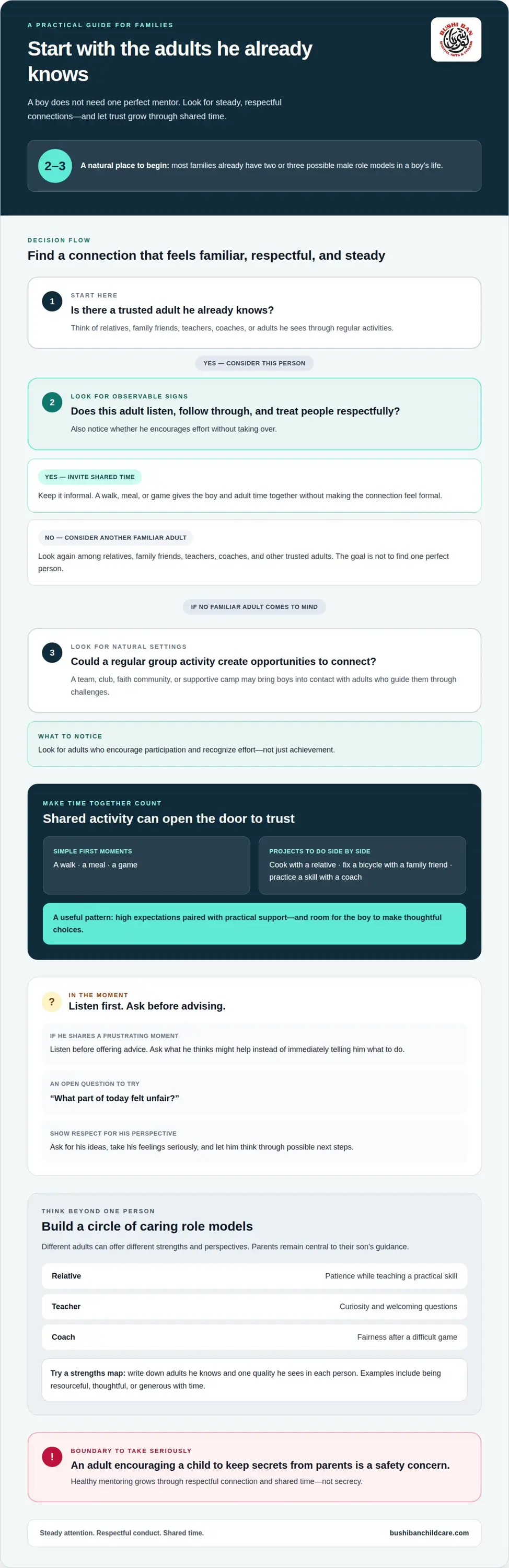
Most families already have two or three possible male role models in a boy’s life. Start with relatives, family friends, teachers, coaches, or trusted adults he sees through regular activities. The best place to begin is often a familiar setting where a child feels comfortable. Notice who listens, follows through, treats others respectfully, and encourages effort without taking over.
Make a simple first move this week: identify two men your son already knows. Consider an uncle who shares a hobby, a teacher who encourages curiosity, or a coach who models patience. Instead of asking someone to become a mentor, invite him to join a shared activity. A walk, meal, or game gives the boy and adult time together without making the connection feel formal.
Community activities can also create natural opportunities to connect. A team, club, faith community, or supportive camp may bring boys into contact with adults who guide them through challenges. Camps offer young people opportunities to tackle difficult tasks and build confidence as they work through them. Look for settings where adults encourage participation and recognize effort, not just achievement.
David Yeager highlights status and respect as important needs for young people. A mentor can honor those needs by asking for a boy’s ideas, noticing what he knows, and taking his feelings seriously. If your son describes a frustrating moment at school, listen before offering advice. Then ask what he thinks might help instead of immediately telling him what to do.
Good mentors pair high expectations with practical support. They encourage a boy to make thoughtful choices while recognizing his ability to decide. Shared projects make this easier: cooking with a relative, fixing a bicycle with a family friend, or practicing a skill with a coach. Everyday moments help adults build trust through attention and follow-through. Over time, a familiar adult’s example makes qualities like fairness, courage, and responsibility easier to notice and discuss.
2. The importance of steady male presence
A steady male presence gives a boy repeated chances to see how an adult handles everyday responsibilities. He might notice a father, uncle, teacher, or coach keeping a promise, admitting a mistake, or speaking respectfully during a disagreement. Those moments show what healthy relationships look like in practice. A brief conversation can help name the behavior: “He listened before responding,” or “He apologized and made it right.”
Consistency matters because trust develops through familiar actions over time. An adult who shows up regularly for a school event, practice, or planned activity demonstrates that the boy’s time and interests matter. He can also observe how that adult treats people in different roles, such as a neighbor, teammate, or service worker. Parents can point out these examples without turning them into a lecture.
Side-by-side activities can make conversation feel less intense. During a drive, a walk with the dog, or a shared meal, a boy can talk while focusing on a common task. Try an open question, such as “What part of today felt unfair?” Then listen before offering a solution. A calm response shows him that difficult feelings can be discussed honestly.
A steady presence doesn’t mean a man must have every answer. A trusted adult can model how to pause, ask for help, or change course after a poor choice. For example, a coach who calmly addresses a disagreement shows that respect includes accountability, not just politeness. Parents can reinforce the lesson by discussing what their son noticed and how he might apply it.
For families seeking another setting with regular shared activity, structured group activities can create opportunities for boys to learn from consistent adult examples. What matters is the pattern: reliable attention, respectful conduct, and conversations that help a boy recognize those qualities in everyday life.
3. Why boys benefit from multiple role models
Bill Milliken emphasizes that relationships, rather than programs, change children. Caring adults can also help young people feel connected to a community. A boy’s circle might include a relative, educator, and neighbor who each build trust differently. These connections show him that support comes from people who care, not from one person expected to meet every need.
Different role models offer different examples. A grandfather might demonstrate patience while teaching a practical skill. A teacher can show curiosity by welcoming questions, while a coach can model fairness after a difficult game. These examples help boys see that confidence, kindness, and responsibility can take many forms. They also give families more chances to discuss the choices and values they want to encourage.
A wider circle can offer perspective when a boy faces a challenge. If he feels discouraged about a school project, a supportive educator may help him break it into manageable steps. A trusted relative might share how they handled a setback, while another adult listens without rushing to solve the problem. Each person can offer a different kind of encouragement, while parents remain central to their son’s guidance.
Role models don’t need to agree on every preference or personality trait. What matters is a shared foundation of respect, honesty, and care. Parents can help by naming what their son learns from each relationship: “Your aunt gave you room to try,” or “Your instructor stayed calm during that disagreement.” Specific observations turn everyday interactions into useful lessons.
Try a simple strengths map together. Write down the adults your son knows, then note one quality he sees in each person. A family friend may be resourceful, a teacher thoughtful, and a neighbor generous with time. This exercise helps a boy recognize there isn’t just one way to lead, solve problems, or treat others well. It can also reveal which qualities he wants to practice himself.
4. How are mentors screened and what safety policies do Deer Park programs follow?
When exploring programs in Deer Park, focus on clear, observable safeguards rather than assumptions. Look for an explanation of how adults interact with children, how activities are supervised, and how concerns are handled. For example, notice whether staff give instructions in shared spaces and whether children know which adults they can approach for help.
Look for boundaries that protect a child’s relationship with parents. An adult encouraging a boy to keep secrets from his parents is a safety concern. If that happens, take the concern seriously and limit the adult’s access to the child. A surprise gift, private message, or request to hide an interaction can be a reason to pause and calmly discuss what happened with your son.
Concrete conversations help children recognize safe conduct. Explain that surprises, such as a birthday present, differ from secrets that make a child feel worried or pressured. A boy should know he can tell a parent about uncomfortable interactions without being blamed. Practice a simple response, such as, “I need to tell my parent about this,” so he has the words ready.
Before a program begins, review its written expectations for supervision, communication, and reporting concerns. Notice whether staff explain boundaries in child-friendly language and respond respectfully to questions. During an activity, observe whether adults keep interactions appropriate to the setting and whether children can openly seek help. These details offer a clearer picture than a general promise of safety.
After a session, ask your son specific, neutral questions: “Who helped you today?” or “Was anything uncomfortable?” Listen to his answer without leading him toward a particular response. If his account raises a concern, document what he said and take steps to protect his access to trusted adults. To explore a structured setting for youth activities, learn about youth programs.
Bushi Ban Child Care
Bushi Ban Child Care offers structured activities where boys can practice discipline, fitness, and leadership with adult guidance. For families looking for regular activities beyond informal mentoring, the After-School Martial Arts Program and Martial Arts & Fitness Classes offer opportunities to build skills through participation. Seasonal and Holiday Camps provide another setting for shared activities, while the Student Leadership Program helps students develop teaching and activity-leading skills.
These programs can complement, not replace, trusted relationships at home, school, and in the community. Consider them when your son would benefit from consistent group activities and opportunities to take responsibility. Each boy’s interests and needs differ, so choose the format that best fits your family’s goals.
Contact Bushi Ban Child Care to discuss which program may suit your son.
Make room for the next step
For families building a circle of positive role models for boys in Deer Park, a useful next step is choosing an activity that fits a child’s interests and gives him room to grow. A good fit can help him practice commitment, try new challenges, and discover strengths he can carry into school and home life. Involve your son in the choice by talking about what he enjoys and hopes to learn.
Bushi Ban Child Care offers an After-School Martial Arts Program, Seasonal and Holiday Camps, and Martial Arts & Fitness Classes. These structured activities can complement the encouragement boys receive from family members, educators, and other trusted adults.
Explore whether one of these options aligns with your family’s goals and your son’s interests. Contact Bushi Ban Child Care today to take the next step toward a positive, active learning experience. Every meaningful connection begins with showing up, listening, and encouraging a boy to keep growing.
Frequently Asked Questions
What programs in Deer Park provide positive male role models for boys?
Families seeking positive role models for boys in Deer Park can explore structured youth activities where boys learn from adult instructors and leaders. Bushi Ban Child Care offers martial arts and fitness programming, after-school activities, and seasonal and holiday camps. Consider which setting best matches a boy’s interests, whether he wants to practice physical skills or take part in activities during school breaks. These programs can complement his relationships with trusted adults.
What after-school programs in Deer Park help boys build confidence and leadership?
Bushi Ban Child Care’s After-School Martial Arts Program combines martial arts training with after-school activities focused on fitness and discipline. For boys interested in leading, the Student Leadership Program gives students opportunities to take leadership roles and assist instructors with teaching. A child who enjoys explaining a skill may find teaching practice engaging, while another may prefer building confidence through training and participation.
Are there scouting or youth leadership programs for boys in Deer Park?
Scouting and other youth leadership activities may appeal to boys who enjoy teamwork, service, and practical skills. Families exploring positive role models for boys in Deer Park can also consider Bushi Ban Child Care’s Student Leadership Program, where students develop teaching and activity-leading skills. A boy might practice helping lead an activity or supporting an instructor, building on interests he can also explore through school and community groups.