
Respect and discipline for kids in La Porte start with clear, steady limits, not harsh reactions. The American Academy of Pediatrics recommends positive discipline strategies that teach children to manage their behavior and support healthy development. State the limit, respond consistently, and guide your child toward an acceptable choice or activity.
It can be hard to respond calmly when challenging behavior keeps returning, especially when children are tired, frustrated, or still learning to express themselves. Practical, age-appropriate strategies can help you set clear expectations and guide behavior with care. Here are ways to use positive discipline, offer choices, redirect behavior, and follow through consistently.
Key Takeaways
- Build discipline on warmth and connection, then respond to behavior with calm, age-appropriate guidance.
- For school-age children, use focused attention, specific praise, and simple choices to encourage cooperation.
- Redirect unwanted behavior by offering an acceptable alternative, and reserve time-outs for appropriate situations.
- Set a few clear rules and follow through with consistent, behavior-related consequences.
Table of Contents
1. What’s the Best Way to Discipline My Child?
Begin with connection, then state the limit clearly. Children are more ready to learn when caregivers stay calm, explain what needs to change, and show them what to do instead. For example, say, “Hands are for helping,” then guide your child to use words or ask for a turn. Respect and discipline for kids in La Porte grow through repeated, respectful responses, not fear.
Parents can teach respect without harsh punishment by modeling it themselves. The American Academy of Pediatrics advises against spanking or hitting children. Instead, use calm words, set a clear boundary, and respond in a way related to the behavior. If a toddler hits, gently block the action, say, “I won’t let you hit,” and model asking for space. For unsafe behavior, stop the action first, then explain the limit simply.
Consider what a behavior may be communicating, especially with young children. Hunger, tiredness, frustration, or difficulty expressing a need can affect how a child responds. Before correcting them, name the feeling and suggest a positive activity: “You seem upset. Let’s take a breath, then choose a book.” Praise the next helpful step, such as sharing a toy or asking for help. This teaches a replacement behavior while supporting trust and well-being.
In La Porte, Texas, positive discipline for children starts with clear expectations, encouragement, and practice in respectful behavior. A structured activity, such as an After-School Martial Arts Program, gives children another setting to practice listening and self-control alongside the guidance they receive at home.
Caregivers in La Porte, Texas, who are concerned about their relationship with a child can seek support from a health professional. The American Academy of Pediatrics recommends professional support in this situation. Sharing specific examples, such as recurring outbursts or difficulty communicating, can help make the concern easier to discuss.
2. Discipline strategies for school-age children
For children ages six through 12, connect expectations with skills they can practice. After a disagreement, ask what happened, what they felt, and what they could try next. Naming emotions helps children separate feelings from actions: “You’re disappointed about stopping the game, but yelling isn’t okay.” Then agree on a respectful way to express frustration next time.
Focused one-on-one time can strengthen connection before correction is needed. Aim for 20 minutes together, or begin with five minutes of child-led attention. Put distractions aside and let your child choose a shared activity, such as drawing or talking about school. Notice helpful behavior specifically: “You waited while I finished speaking.” Parents can aim for up to three praises for every corrective comment, keeping feedback balanced and clear.
When emotions rise, pause before responding. Take five deep breaths, or step away briefly while your child remains in a safe place. The American Academy of Pediatrics advises parents not to spank or hit children. If you react sharply, apologize and explain what you’ll do differently next time. For younger children, keep directions short and engaging: offer two acceptable choices, such as putting away blocks before or after a story.
To coordinate discipline with your child’s school, share the behavior you’re addressing, the limit you’re teaching, and what response helps. Ask the teacher what they observe, then agree on consistent language, such as “Use words to ask for a turn.” A simple home-and-school plan helps children understand expectations in different settings.
Seek professional help if you feel persistently negative about your relationship with your child, or need support responding to recurring behavior. A health professional can help you discuss specific examples and plan next steps. Families wanting structured practice with listening and self-control can explore after-school support for children.
3. Preventing behavior problems with choices and redirection
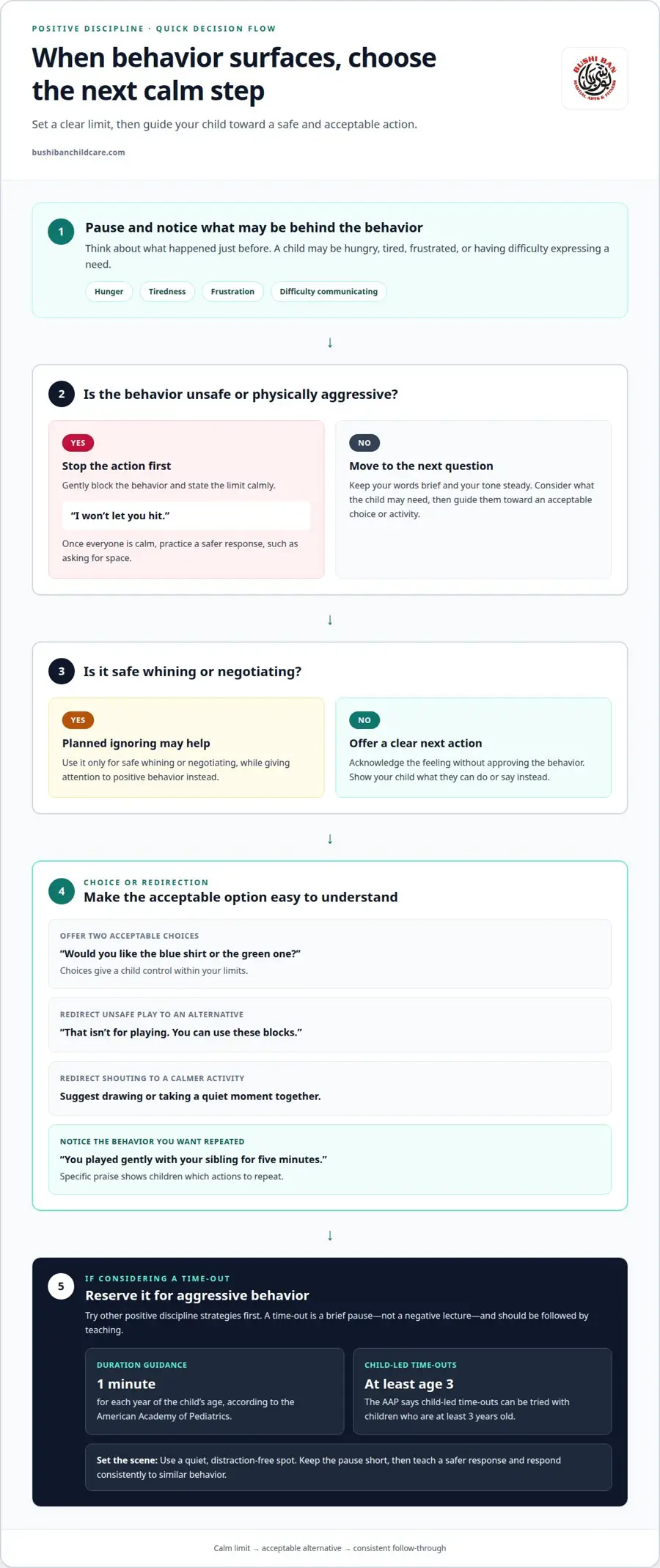
Choices can prevent power struggles by giving children control within your limits. Instead of asking whether your child will get dressed, offer two acceptable options: “Would you like the blue shirt or the green one?” If a child reaches for something unsafe, say, “That isn’t for playing. You can use these blocks.” A clear alternative makes it easier to understand what to do next.
Challenging behavior can signal frustration, fatigue, or difficulty communicating. Notice what happened just before it, then respond to the need without approving the action. If a child whines while waiting, for example, acknowledge the frustration and show them how to ask, “Can I have a turn?” For safe whining or negotiating, planned ignoring may help when you give attention to positive behavior instead.
Notice and describe positive behavior as soon as you see it. Say, “You played gently with your sibling for five minutes,” instead of offering general praise. Specific recognition shows children which actions to repeat. If your child starts shouting, redirect them to a calmer activity, such as drawing or taking a quiet moment together. Keep your words brief and your tone steady.
Reserve time-outs for aggressive behavior, such as hitting, and try other positive discipline strategies first. The American Academy of Pediatrics says a time-out can last 1 minute annually for each year of a child’s age. A time-out should be short and take place in a quiet, distraction-free spot. The American Academy of Pediatrics says child-led time-outs can be tried with children who are at least 3 years old.
If a child acts aggressively, stop the physical action and state the limit: “I won’t let you hit.” Once everyone is calm, help your child practice a safer response, such as asking for space. A time-out should be a brief pause, not a negative lecture, and should be followed by teaching. Respond to similar behavior with the same calm steps so your child knows what to expect.
4. Setting clear and consistent limits
For younger children, start with two or three rules they can understand and remember. Make each rule specific: “Walk inside” is clearer than “Behave.” Briefly explain why, then name the action you expect. A toddler who throws a toy may feel frustrated, so calmly say, “Toys stay on the floor,” and help them put it down. Clear wording makes limits easier to follow.
Choose consequences that relate directly to the behavior. If a child leaves toys scattered, pause the next activity until they help put the toys away. End the consequence when the related task is complete instead of extending it into an unrelated punishment. For an older child who misuses a phone, a short, realistic limit can be easier to explain and follow through on than taking it away for a week.
Consistency means responding to the same behavior with the same rule and follow-through. If running indoors leads to a reminder one day and no response the next, children may not know what to expect. State the limit calmly, give your child a chance to comply, and follow through with the consequence you explained. Avoid adding a new punishment in the heat of the moment.
Fair discipline also depends on caregivers sharing expectations. The American Academy of Pediatrics recommends that parents, family members, and child care providers agree on basic rules for babies. For older children, discuss household limits with other caregivers and use matching language, such as “Ask before borrowing.” Similar responses to similar behavior help children learn the boundary; conflicting responses can leave them unsure which rule applies.
Choose consequences you can calmly maintain, even on a stressful day. A brief, related loss of a privilege is more practical than a week-long restriction you may not sustain. Review the rule with your child after everyone settles, and explain what they can do differently next time. For added structure and practice with expectations, explore discipline support for children.
Bushi Ban Child Care: After-School Martial Arts Program
Bushi Ban Child Care’s After-School Martial Arts Program gives families a structured way to support children’s discipline beyond home routines. Martial arts and fitness classes combine physical activity with practice, while the Student Leadership Program helps students develop teaching and activity-leading skills. These programs complement family expectations by giving children another setting to practice focus, responsibility, and respectful conduct.
Consider the After-School Martial Arts Program if you want your child’s after-school routine to include martial arts and fitness. Seasonal and Holiday Camps provide an option during school breaks. Choose the program that fits your child’s interests and routine, and continue reinforcing the same clear expectations at home.
For details about the programs, visit Bushi Ban Child Care.
Build the Next Small Step Into Your Routine
Progress can start with one skill your child practices repeatedly, such as listening during a transition or asking for help before frustration grows. Choose a moment that regularly feels difficult and notice what happens just before it. A predictable cue, calm reminder, and recognition of effort can turn that moment into a learning opportunity. Adjust your approach as your child grows; the words or support they need may change over time.
For families working on respect and discipline for kids in La Porte, a structured activity can complement the expectations children practice at home. Bushi Ban Child Care offers an After-School Martial Arts Program, Seasonal and Holiday Camps, and Martial Arts & Fitness Classes. These programs give families options for organized activities that include movement and skill-building.
Take a thoughtful next step and explore whether a program fits your child’s interests and routine. Contact Bushi Ban Child Care to learn more. Keep celebrating each effort your child makes toward a more respectful, confident response.
Frequently Asked Questions
How can I manage different types of behaviors once the rules are set?
Match your response to the behavior’s purpose and safety level. If your child stalls during a routine, give a clear next step, such as putting shoes by the door. For safe attention-seeking, notice and praise a better way to ask. If behavior puts someone’s safety at risk, intervene immediately, then discuss a safer choice once everyone has settled.
What are the three most important core ideas for discipline?
Keep three ideas in mind: connection, clarity, and follow-through. Connection helps your child feel heard before you correct them. Clarity means stating what needs to change, such as “Please wait until your sister finishes speaking.” Follow-through means responding calmly as promised. Together, these practices make discipline easier to understand and help children build responsibility in everyday situations.
What’s the Best Way to Discipline My Child?
Use respectful guidance that teaches a better action instead of relying on fear or shame. If your child interrupts a conversation, teach a signal they can use to get your attention, then acknowledge it when they try. For families in La Porte, Texas, practicing one replacement behavior at a time can make expectations clearer at home and in daily routines.
Why positive discipline?
Positive discipline teaches skills children can use again, rather than simply ending one difficult moment. A child who learns to ask for help can use that skill during homework, play, or family routines. Calm correction also lets parents model respectful communication. The goal is not to remove limits, but to help children understand how to meet them.
What are effective age-appropriate discipline strategies for children?
Choose strategies that fit your child’s development and ability to understand instructions. Infancy covers birth through 12 months; toddlers may need brief directions and immediate guidance. Preschool and kindergarten age is three to five years, while school-age children are six through 12 years. Adolescents are 13 through 18 years; invite them into problem-solving conversations while keeping household expectations clear.