
Parents are encouraged to watch their children during self-defense classes in Pasadena, but they don’t have to stay. If you’re considering self-defense classes for kids in Pasadena, TX, you can observe a lesson and see how your child responds while choosing what works for your schedule.
It’s natural to want more than a place for your child to burn off energy. You’re looking for a supportive setting where they can build physical skills, practice focus, and grow in confidence at their own pace.
This guide explains what children may practice in class and how martial arts training can support fitness, confidence, and character. You’ll also find practical points to consider, including age-appropriate instruction, schedules, private lessons, and parent viewing, to help you decide what may suit your child and family.
Key Takeaways
- Compare age-appropriate class structure with your child’s readiness: Little Champs serves ages 5-7, while Jr. Grapplers serves ages 8-13.
- Look for instruction that combines movement and martial arts practice with opportunities to build focus and confidence at an individual pace.
- Consider how verbal assertiveness can help children respond to bullying, alongside physical skills.
- When weighing group classes against private lessons, consider your child’s age, learning style, and family schedule; private lessons are offered for ages 3-4.
Table of Contents
Kids' fitness, focus, confidence, and character
A child’s progress can show up in small moments, such as holding a stance or listening before moving. Look for classes that pair physical practice with clear expectations for respect and self-control.
Confidence and Self-Discipline
Confidence grows through practice, achievable challenges, and noticing personal progress. Every child’s path from white belt to black belt is different, so look for instruction that values steady effort over comparison. During class, notice whether children listen to directions, take turns, and try techniques again after a mistake. These steps connect discipline with self-belief.
Bullying Awareness and Confidence
Bullying awareness belongs alongside physical techniques, not in place of them. Three million children in the United States miss school each month because they fear bullies. A practical class discussion can help a child recognize an unkind interaction, use a clear voice, move toward safety, and tell a trusted adult. Ask how lessons build assertiveness without encouraging children to escalate conflict.
Movement supports fitness while giving children repeated chances to focus. For example, a lesson might have a student practice a balanced stance, follow an instructor’s cue, then repeat a movement with control. These activities develop coordination and attention. The goal isn’t to get it right on the first try, but to use feedback and make the next attempt more deliberate.
To understand how a program builds character, watch for specific behaviors during class. Does the instructor explain how to show respect to a partner? Do students wait their turn and follow directions before practicing techniques? These examples make values such as respect and discipline visible, rather than leaving them as abstract promises.
Notice whether movement practice includes balance, coordination, and controlled repetition.
Look for reminders about focus, respectful conduct, and listening.
Ask how instructors teach children to respond assertively and seek adult support when needed.
Children’s martial arts and self-defense instruction
No single style is best for every child. Karate, taekwondo, judo, and Brazilian jiu-jitsu differ in their approach. Families searching “self defense classes for kids Pasadena TX” can compare teaching style, age fit, and their child’s comfort.
Children’s Martial Arts Training
Children’s martial arts instruction can combine movement, technique, and structured practice. Watch how instructors demonstrate a movement, explain it in simple steps, and give students time to practice at their own pace. Ask what beginners do in a typical class and how feedback changes as skills develop. A welcoming first lesson lets children learn without pressure to compete or perform perfectly.
A child doesn’t need to arrive athletic. Beginners can start by following directions, trying basic movements, and taking breaks when needed. For example, a student who finds a sequence difficult can practice one part at a time, then connect the movements as coordination improves. Parents comparing “self defense classes for kids Pasadena TX” can look for instructors who adjust explanations and pacing for new students.
Nonviolent Self-Defense Skills
Self-defense for children should include choices that reduce conflict, not just physical techniques. Ask whether lessons cover using a firm voice, creating distance, moving toward a safer place, and telling a trusted adult. These steps give children a response plan for stressful situations. Physical practice should be framed as a last resort for protection, not a reason to confront or punish someone.
Class Safety and Instructor Qualifications
Before enrolling, observe how instructors organize partner practice and respond when a child feels uncomfortable. Look for clear boundaries, close supervision, age-appropriate drills, and an easy way for students to pause. Ask about instructors’ martial arts credentials and experience teaching children. A qualified instructor should explain class expectations plainly and show how students practice techniques with control.
During an introductory visit, notice whether your child can follow the lesson comfortably. If structured movement and guided practice suit their needs, explore children’s martial arts and fitness classes as a local learning option.
Verbal assertiveness and bullying prevention
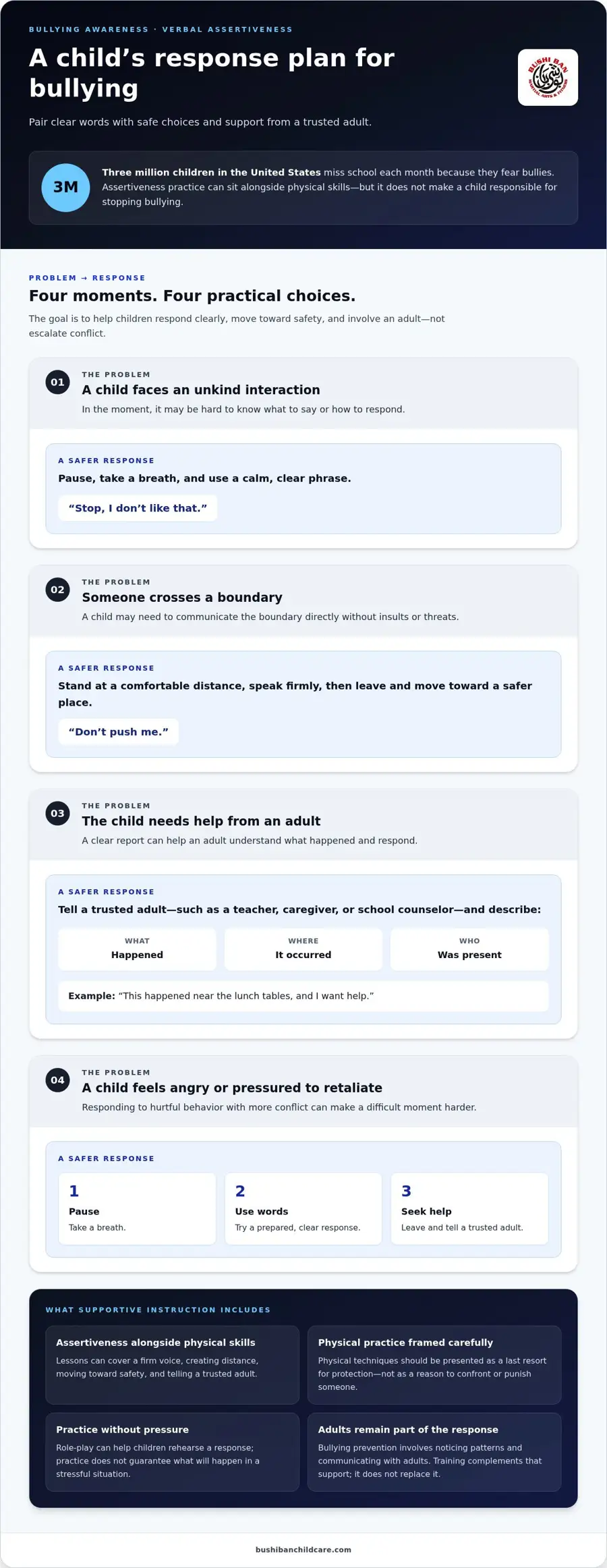
Bullying can affect a child’s willingness to participate at school. Three million children in the United States miss school each month because they fear bullies. Self-defense teaching can address a child’s response choices alongside physical techniques. A useful first step is practicing a calm, clear phrase such as, “Stop, I don’t like that,” then moving toward a trusted adult.
Verbal assertiveness means communicating directly without insults or threats. A child can rehearse standing at a comfortable distance, speaking firmly, and naming the behavior: “Don’t push me.” They can then leave and report what happened to a teacher, caregiver, or school counselor. Practice can make these steps easier to recall under stress, but it doesn’t make the child responsible for stopping someone else’s bullying.
Self-control matters in the school hallway, on the playground, and during class activities. If a classmate says something hurtful, a child can pause, take a breath, use a prepared response, and seek help instead of retaliating. This gives children a concrete way to manage anger while protecting their boundaries. Parents can reinforce the same sequence at home with a brief role-play about teasing or exclusion.
Bullying prevention also involves noticing patterns and involving adults. Encourage your child to describe what happened, where it occurred, and who was present. For example, they might tell a teacher, “This happened near the lunch tables, and I want help.” Clear details can help adults understand the situation and respond. Martial arts instruction should complement, not replace, communication between families and school staff.
Practice one firm boundary phrase and one way to leave the situation.
Identify trusted adults at school and at home before a problem arises.
Rehearse reporting specific details without blaming the child experiencing bullying.
Class schedule and private lessons
A workable class time helps children attend consistently around school, homework, and family routines. Compare available days and times with your child’s weekly commitments, and account for travel time. A class that fits between school pickup and dinner may be easier to maintain than one that makes the transition rushed. Ask how a typical class is organized and how students can rejoin after missing a session.
Age and learning style can help guide the choice between group classes and individual instruction. Private lessons are offered for children ages 3-4. For older children, a group setting can provide guided practice alongside peers, while individual attention may suit a child who benefits from a quieter pace. Think about whether your child prefers learning by watching, repeating movements, or receiving direct feedback.
Progress doesn’t follow one fixed calendar. Each student’s journey from white belt to black belt is different, so ask how instructors explain goals and help students develop skills over time. A child’s schedule, focus, and comfort with class activities can shape what steady participation looks like. Look for signs of progress beyond belt changes, such as remembering instructions or practicing a movement with greater control.
Adults can help a child prepare by setting a predictable routine. For example, pack comfortable exercise clothes and a water bottle before class day, then leave enough time to arrive without rushing. If a young child is new to structured activities, consider whether a private lesson or group class better matches their readiness. The right format should make participation manageable while leaving room to learn.
Compare class times with school, homework, travel, and family routines.
Ask how students progress and what instructors use to explain each next step.
Consider private lessons for ages 3-4, and weigh your child’s comfort with group learning.
Explore martial arts class options as you consider a schedule and learning format that fit your child.
Bushi Ban Child Care: After-School Martial Arts Program
Bushi Ban Child Care offers an After-School Martial Arts Program for families looking for a structured way to include martial arts after school. It may suit a child who enjoys active learning and is ready to practice skills as part of a regular routine.
For families considering other ways to support movement and personal growth, Bushi Ban Child Care also offers Martial Arts & Fitness Classes and a Student Leadership Program. Seasonal and Holiday Camps provide another option during school breaks. Consider your child’s interests and the routine your family wants when choosing a next step.
To explore the program and find an option that fits your family, visit bushibanchildcare.com.
Choose a First Step That Fits Your Child
Choosing self-defense classes for kids in Pasadena, TX can start a broader conversation about what helps your child feel ready to learn. Consider which setting feels manageable for your family, then ask your child what they hope to practice. Their interests can help turn a new activity into a routine they look forward to.
Bushi Ban Child Care offers an After-School Martial Arts Program, Seasonal and Holiday Camps, and Martial Arts & Fitness Classes. These options give families different ways to include structured activity during the school year or breaks. Consider the routine that works for your household and the kind of experience your child wants to explore.
When you’re ready to consider a next step, explore programs at Bushi Ban Child Care. A thoughtful start can help your child approach learning with curiosity and growing self-belief.
Frequently Asked Questions
Are Parents Allowed to Watch?
Yes, parents are encouraged to watch their children during classes. Observing lets you see how your child follows instruction and responds to the group setting. To help them stay focused, choose a viewing spot and let them participate without calling out directions. After class, ask what they enjoyed or found challenging; their answer can guide your next conversation about lessons.
Do Parents Need To Stay?
No, parents aren’t required to stay during children’s self-defense classes in Pasadena. You can decide whether observing suits your child and your family’s routine. For a first visit, explain what drop-off and pickup will look like so your child knows what to expect. A simple plan, such as saying goodbye at arrival and meeting afterward, can make the transition clearer.
My Child Is Not Athletic, Will They Feel Left Out?
Being naturally athletic isn’t a prerequisite for beginning martial arts. Children can learn at different paces, and a hesitant beginner can start by listening, watching a demonstration, and trying a movement. Help your child set a small goal for the first class, such as learning a new technique or remembering an instructor’s direction. That keeps the focus on personal effort, not comparison with classmates.
What should children bring or wear to their first self-defense class?
Children should wear comfortable clothes suitable for exercise and bring a water bottle to their first lesson. Choose clothing that allows them to move freely, such as a T-shirt and athletic pants. Before leaving home, have them use the restroom and pack their bottle in an easy-to-carry bag. A calm arrival gives your child time to settle in and listen to the instructor.
Which is better for kids’ self-defense: karate, taekwondo, judo, or Brazilian jiu-jitsu?
No single style is best for every child. Compare the teaching style, age fit, and your child’s comfort with karate, taekwondo, judo, and Brazilian jiu-jitsu.