
A strong youth activity gives children more than a chance to move. It can help them build skills, confidence, and a positive routine. Families exploring youth exercise programs in Deer Park can compare structured activities by age range, schedule, and the kind of movement their child enjoys.
It’s understandable to want an option that feels engaging and manageable for family life. A good fit is one your child looks forward to and can participate in comfortably.
This guide covers youth activities to consider, what schedules and sessions can involve, and how age ranges shape the experience. Martial arts and fitness classes, after-school programs, and seasonal camps offer different ways for children to stay active and develop skills.
Key Takeaways
- Explore recreational and educational activities to find engaging ways for children to learn, move, and take part in the community.
- Use event details and seasonal timing to spot activities that fit your family’s plans and your child’s interests.
- Compare age ranges and schedules to identify a routine that suits your child’s stage and your family’s week.
- Consider how kids’ and pre-teens’ needs differ when choosing an activity that encourages participation and steady skill-building.
Table of Contents
Recreational and educational youth activities
Deer Park families can consider organized recreation, sports, fitness classes, and outdoor activities. Look for a clear opportunity for children to move, learn, and take part.
Recreation Activities and Classes
Recreation can include instructor-led fitness, creative classes, and outdoor learning. Compare what children do during each session, not just the activity name. A class with guided practice may suit a child who enjoys structure, while open recreation may appeal to someone who prefers variety. The National Park Service connects youth and young adults with more than 400 national parks and programs in the United States, offering examples of recreation linked with education.
Outdoor education can also introduce age-based activities. Examples include squirrel hunting with an air gun for children ages 5 to 8, run-and-gun turkey hunting for children ages 9 to 12, and quiet ground-blind pursuits for children aged 13 and older. These are general activity examples, not Deer Park program listings.
Youth Sports and Activities
Sports give children a chance to practice movement, follow shared rules, and work toward a group goal. Deer Park families can compare youth sports, fitness instruction, and recreation by format and focus. Team games emphasize cooperation, while individual classes allow focused skill practice. Consider whether your child prefers structured drills, playful movement, or a mix.
Other options may combine physical activity with learning, such as nature-based recreation or educational programs. Look at the activity description to understand what participants will actually do. That detail helps distinguish an active class from an event centered mainly on observation or instruction.
Beginner and Fitness-Level Options
Beginners can start with activities that teach basic movements and explain rules step by step. A welcoming class gives children time to practice before performing skills independently. For varied fitness levels, look for sessions with different exercises or progressions, so participants can work at a suitable pace within the same activity.
The best beginner option is usually the one whose structure suits the child’s comfort and interests. A child who enjoys repetition may prefer a skills-based class; one who likes changing challenges may enjoy varied recreation. Compare the session format, instructions, and activity examples.
Each program manages its own enrollment. Registration materials explain any required waivers, parent consent, and forms, helping families understand the process before participation.
Youth program events and news
Youth events range from one-time activity days to recurring recreation-center classes. Deer Park families can compare the format, age group, registration window, and activities children will practice. A skills workshop may focus on instruction, while a sports event may include drills or team play.
Compare Deer Park events with options in Pasadena and La Porte by looking at the same details: activity type, location, schedule, age range, and participation requirements. These factors make the comparison practical without assuming nearby programs offer identical events. A convenient location may matter most for a recurring class; a distinctive activity may justify a longer trip.
News and event notices often explain how to participate. Use this simple sequence:
Note the event date, registration deadline, and location.
Review the intended age group and listed activities.
Identify any forms, equipment, or parent participation requirements.
Save schedule updates so changes don’t disrupt family plans.
Pay attention to safety details. For each Deer Park program, look for information about supervision, activity rules, emergency procedures, and staff qualifications. Instructor experience should relate to the activity, such as coaching sports or leading martial arts practice. These details clarify how children are guided during instruction and transitions.
For an event or class, the stated requirements explain what parents must provide, including any consent forms or waivers. Read those details alongside the schedule, so registration and arrival are straightforward. A recurring after-school martial arts program can also offer a structured setting for practicing movement and discipline beyond a one-day event.
Program age range and schedule
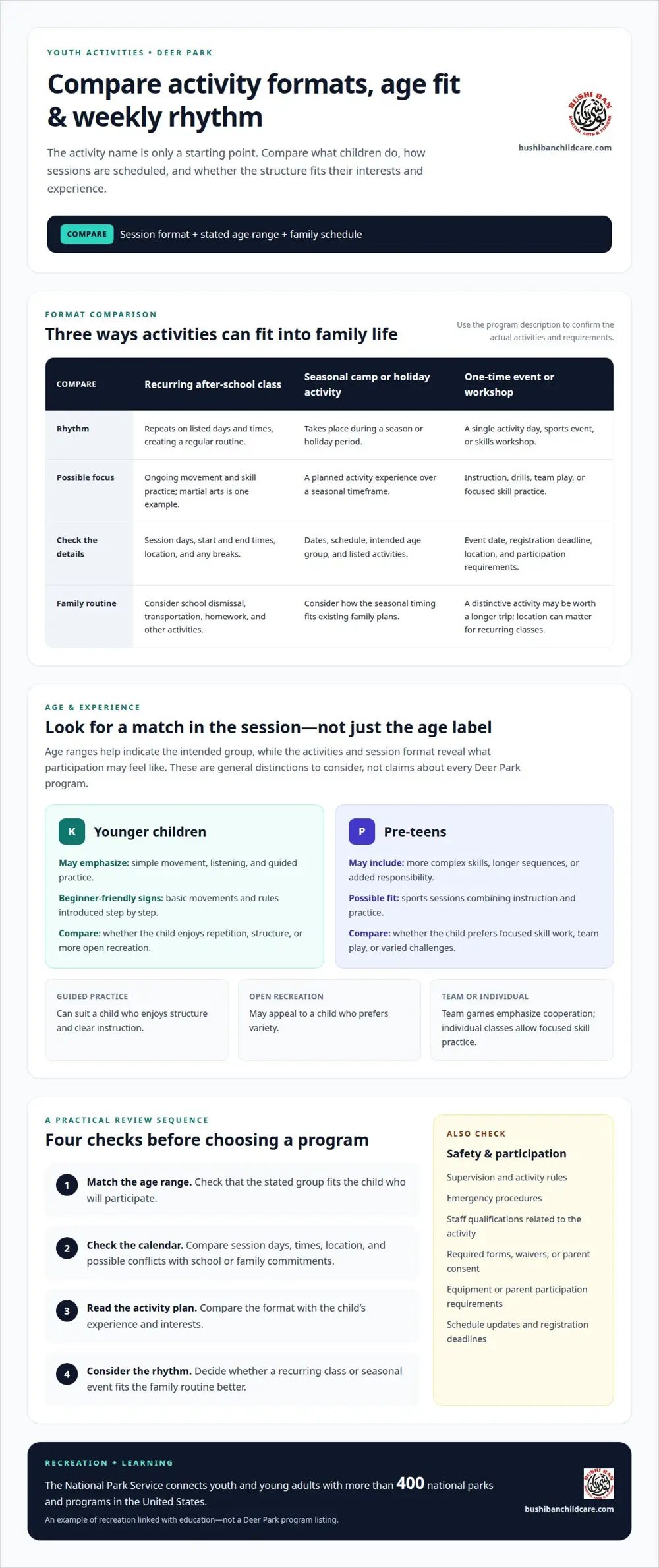
Age ranges help families match an activity to a child’s experience and stage. Programs for younger children may emphasize simple movement, listening, and guided practice. Activities for pre-teens may include more complex skills, longer sequences, or added responsibility. These are useful distinctions to consider, not claims about every Deer Park program.
Read each description for its stated age group and session format. A child new to organized exercise may benefit from a class that introduces one skill at a time. A pre-teen who enjoys sports may prefer sessions that combine instruction and practice. The listed activities reveal more about fit than the program name alone.
Compare schedules across the whole week. A recurring after-school class creates a different routine from a seasonal camp or holiday activity. Note the session days, start and end times, location, and any listed breaks. Then consider school dismissal, transportation, homework, and other activities. A workable schedule gives your child time to arrive prepared and take part without a rushed transition.
Use this sequence to assess an option:
Match the stated age range to the child who will participate.
Review the schedule and identify conflicts with school or family commitments.
Compare the session format with the child’s experience and interests.
Consider whether a recurring class or a seasonal event better fits the family routine.
Age and schedule go hand in hand. An activity may be difficult to maintain if its timing clashes with school pickup, while a convenient time may not suit your child’s interests. A pre-teen who enjoys structured skill practice, for example, may prefer a recurring class to a one-time event. Use the stated age range, activity plan, and calendar to make a practical choice in Deer Park.
Programs for kids and pre-teens
Children and pre-teens may need different kinds of challenge, even in the same activity. Younger children may respond well to clear demonstrations, short practice rounds, and frequent changes between movements. Older children may enjoy refining technique, following a longer sequence, or taking responsibility in a group task. Look beyond the activity label when comparing options.
For a younger child trying a class for the first time, simple directions and repetition can make participation easier. A pre-teen who enjoys movement may prefer progressive skills or opportunities to lead. Read the class description for examples of activities, then consider whether the format suits your child’s interests and confidence.
Families can compare options using a few practical questions:
Does the program describe activities suitable for the child’s age and experience?
Can children practice at their own pace while following the group’s instruction?
Does the session balance active movement with listening and skill development?
Will the schedule fit school routines and the family’s other commitments?
A supportive group can help children practice cooperation, patience, and respectful communication. Taking turns during a drill, for example, gives children a concrete way to participate with peers. A pre-teen demonstrating a familiar movement can practice responsibility while keeping the activity focused. Look for these qualities in a program’s structure, not as guaranteed outcomes.
Interests matter, too. A child who enjoys learning a sequence may prefer structured instruction, while another may be drawn to games and varied movement. Families can use an introductory description, sample activities, and the stated age range to identify a promising match. To explore a structured activity option for your child, view youth program options and consider which format best suits their interests.
Bushi Ban Child Care
Bushi Ban Child Care offers structured activities for families seeking skill-building and personal growth. The After-School Martial Arts Program and Martial Arts & Fitness Classes combine movement with disciplined practice, while Seasonal and Holiday Camps provide activities during school breaks. The Student Leadership Program helps students develop teaching and activity-leading skills. Families in Deer Park can consider whether recurring classes, school-break activities, or leadership opportunities best suit their child. Contact Bushi Ban Child Care to discuss the programs and choose a next step for your family.
Choose a Routine Your Child Can Grow With
Look beyond a single class and consider the routine your child can enjoy over time. A welcoming activity can encourage persistence, confidence, and progress at a comfortable pace. When comparing youth exercise programs in Deer Park, consider what will motivate your child to return: clear instruction, active participation, or chances to develop new skills.
Bushi Ban Child Care offers structured movement and development through its After-School Martial Arts Program, Seasonal and Holiday Camps, and Martial Arts & Fitness Classes. Start with your child’s interests and the kind of experience your family wants to support.
Contact Bushi Ban Child Care to discuss a suitable next step for your child. A thoughtful start can make room for steady progress and enjoyment.
Frequently Asked Questions
Which gyms and recreation centers in Deer Park offer youth fitness classes?
Families looking for youth exercise programs in Deer Park can explore Bushi Ban Child Care’s Martial Arts & Fitness Classes. Bushi Ban serves families in Deer Park, Pasadena, and La Porte, as well as across the Houston area. Classes focus on martial arts, self-defense, coordination, and overall fitness, offering children a structured alternative to a municipal gym or recreation-center class.
What ages can participate in youth exercise programs in Deer Park?
Bushi Ban Child Care’s martial arts and fitness curriculum is tailored to various age groups and skill levels. That lets children participate in instruction suited to their developmental stage and experience. The program details for a particular class are the guide to its intended participants. Families can use the stated age group and activity focus to find a suitable starting point for a child.
What sports, strength training, and fitness activities are offered to local youth?
Local children can take part in martial arts training, self-defense instruction, coordination practice, and fitness activities through Bushi Ban Child Care. A child interested in martial arts, for example, can develop movement skills while practicing structured techniques. The focus is martial arts and fitness rather than a named team sport, making these classes a fit for children drawn to this style of active learning.
What are the schedules and registration deadlines for youth exercise programs in Deer Park?
Schedules depend on the program type. Regular martial arts and fitness classes follow a recurring schedule, while Seasonal and Holiday Camps take place during school breaks and holidays. Families can plan around school and other commitments using the schedule and registration details for each program. Camps suit school-break periods; recurring classes support ongoing instruction.
How do Deer Park youth exercise programs compare with nearby Pasadena and La Porte options?
Compare activity type, location, schedule, age range, and participation requirements. The article does not describe specific Pasadena or La Porte programs.
What safety measures and staff qualifications do youth exercise programs in Deer Park have?
Review each program’s information about supervision, activity rules, emergency procedures, and staff qualifications. Staff experience should relate to the activity, such as coaching sports skills or leading martial arts practice.