
Youth Leadership in La Porte: A Guide for Families
What if leadership grows less from giving a child a title and more from helping them take small, supported steps? Families interested in developing leadership skills in youth La Porte can start with everyday moments: asking a child to make a plan, listen to another point of view, or take responsibility for a shared task. Leadership can feel abstract, especially when you’re deciding how much independence suits your child. Confidence and practical skills develop through practice, encouragement, and room to learn.
This guide covers ways to build communication, initiative, and follow-through at home, plus how to choose structured activities with meaningful opportunities to practice. In La Porte, Pasadena, and Deer Park, martial arts can offer a consistent setting for responsibility and communication. Bushi Ban Child Care’s Student Leadership Program gives students opportunities to take leadership roles and assist instructors, with an emphasis on character development, public speaking, and mentorship. These ideas can help you choose a supportive next step that fits your child.
Key Takeaways
Leadership is built through everyday actions like listening, following through, and taking responsibility, not just formal titles.
Help your child practice with a gradual cycle: observe, try a task, receive guidance, reflect, and try again.
Compare home, school, and coached group activities to find practice opportunities that fit your child’s needs.
For developing leadership skills in youth La Porte, start with one manageable skill and role, then agree on the support your child needs.
Bushi Ban’s Student Leadership Program offers guided roles that include assisting instructors, public speaking, and mentorship.
Table of Contents
What Youth Leadership Means in La Porte
Youth leadership is the ability to take responsibility, listen to others, communicate clearly, show initiative, and follow through in ways that support a group or shared goal. These are learnable skills, not a fixed personality type or a title reserved for the most outgoing child. A young person can lead by organizing their materials, sharing an idea respectfully, or helping a teammate understand a task.
The broader concept of Youth leadership includes young people taking an active role in their communities and development. For families, a practical starting point is to notice what a child is learning to do independently, then offer chances to practice with age-appropriate guidance. This makes developing leadership skills in youth La Porte less abstract: focus on the actions your child can practice now, rather than expecting every child to lead in the same way.
Which leadership skills can young people practice?
Responsibility means completing an agreed task and owning the result, including correcting something that was missed. Communication involves listening without interrupting, expressing an idea clearly, and asking for help when needed. Initiative might mean noticing that supplies were left out after an activity and suggesting a helpful next step instead of waiting for someone else to act.
Follow-through connects these skills. A child returns to the task, checks what remains, and completes what they agreed to do. Recognize effort and problem-solving, not only a perfect result. This helps children see leadership as a set of actions they can keep improving.
Why La Porte families can start with everyday opportunities
Home, school, teams, and structured activities offer different chances to practice. A child might help plan a family meal, take a turn coordinating a group project, or support a teammate during practice. These roles build habits that can be used in classroom collaboration, shared activities, and family routines. In school and community environments, hearing from youth mentors and speakers like Jeff Yalden can also reinforce personal accountability and positive peer influence. No single club or activity is essential, and a quieter child can lead through careful listening or dependable follow-through.
Consistency matters more than an impressive-sounding role. A familiar responsibility repeated over time gives a young person a chance to try, learn, and take on more ownership as confidence grows. Families in La Porte, Pasadena, and Deer Park can look at the routines and activities already in a child’s life, then identify one small, supported leadership opportunity. The goal is to make practice part of ordinary life, not add pressure.
How Supported Practice Builds Youth Leadership Skills
Children build leadership by taking action, receiving useful guidance, and getting another chance to try. Adults can set the stage without taking over: explain the goal, make the task manageable, and let the child make appropriate decisions. That steady process makes leadership a skill to develop, not a test the child has to pass perfectly.
Use this simple practice sequence:
Observe: Let the child watch how a task is handled, such as setting up materials or welcoming a new participant.
Try: Invite them to take on one clear part of the task.
Receive guidance: Offer a prompt or demonstration if needed, then give them room to continue.
Reflect: Ask what went well and what they might change next time.
Try again: Return to the task or gradually add responsibility as the child becomes ready.
Turn small responsibilities into leadership practice
Choose a role that fits the child’s abilities and explain what completing it looks like. A younger child might arrange activity materials; an older child could welcome a new participant or help organize a group task. Once the instructions are clear, avoid redoing the work immediately. A calm follow-up question, such as “What part felt easiest?” helps a child recognize their effort and identify a next step.
Use feedback to build confidence and follow-through
Specific encouragement shows children which actions to repeat. Instead of saying only “Great job,” recognize preparation, careful listening, persistence, or completing the task. If something goes wrong, use it as a chance to consider what could be adjusted and what would help next time. Clear, supportive feedback keeps expectations steady while reminding a child that mistakes are part of learning.
Coaching should help a child become more capable over time, not more dependent on adult direction. Offer enough support to keep the task manageable, then step back as the child gains experience. A structured group activity can provide regular chances to practice communication and responsibility with guidance. Developing Leadership in School-Age Children also offers parent-focused ideas for encouraging responsibility and decision-making.
Martial arts classes offer a structured setting for young people to practice participation, self-discipline, and communication. Families in La Porte, Pasadena, and Deer Park can learn more about Bushi Ban martial arts classes as one way to support regular practice.
Building Leadership Skills in La Porte
Children can practice leadership in familiar routines and coached group activities. Home and school responsibilities offer natural chances to contribute, while a structured activity can provide clear roles, instruction, and interaction with peers. These settings work well together: children can try skills in different situations and learn how to use them with growing independence.
What can children learn from leadership practice at home and school?
A household task can involve more than following directions. A child might help plan what’s needed, complete an agreed part, and check that the job is done. At school, a student may contribute an idea to a group assignment, organize shared materials, or help a teammate understand instructions. The role will vary, but each can offer a chance to listen, communicate, and follow through.
Make expectations clear, offer help when needed, and gradually step back. The goal isn’t to remove support all at once. It’s to let children take more ownership as they become comfortable with a task.
What makes a structured youth activity a useful setting?
A well-supported group activity gives young people a place to participate with others, receive guidance, and take on meaningful responsibilities. Look for observable opportunities: Does the child have a clear role? Is instruction supportive? Can participants practice communicating, helping peers, or mentoring with guidance? Martial arts classes, for example, offer a structured setting to practice responsibility and communication.
Bushi Ban’s Student Leadership Program gives students opportunities to take leadership roles and assist instructors, with an emphasis on character development, public speaking, and mentorship. For a closer look at how a guided program can support practice, explore this guide to student leadership programs.
Use the comparison below to focus on what a child can practice, rather than assuming a setting or label guarantees a particular outcome.
For families developing leadership skills in youth La Porte, look for a setting where a child can take part, receive appropriate guidance, and try again. Notice the practice itself: preparation, helpful communication, and follow-through. Those everyday signs offer a clearer picture of growth than a title alone.
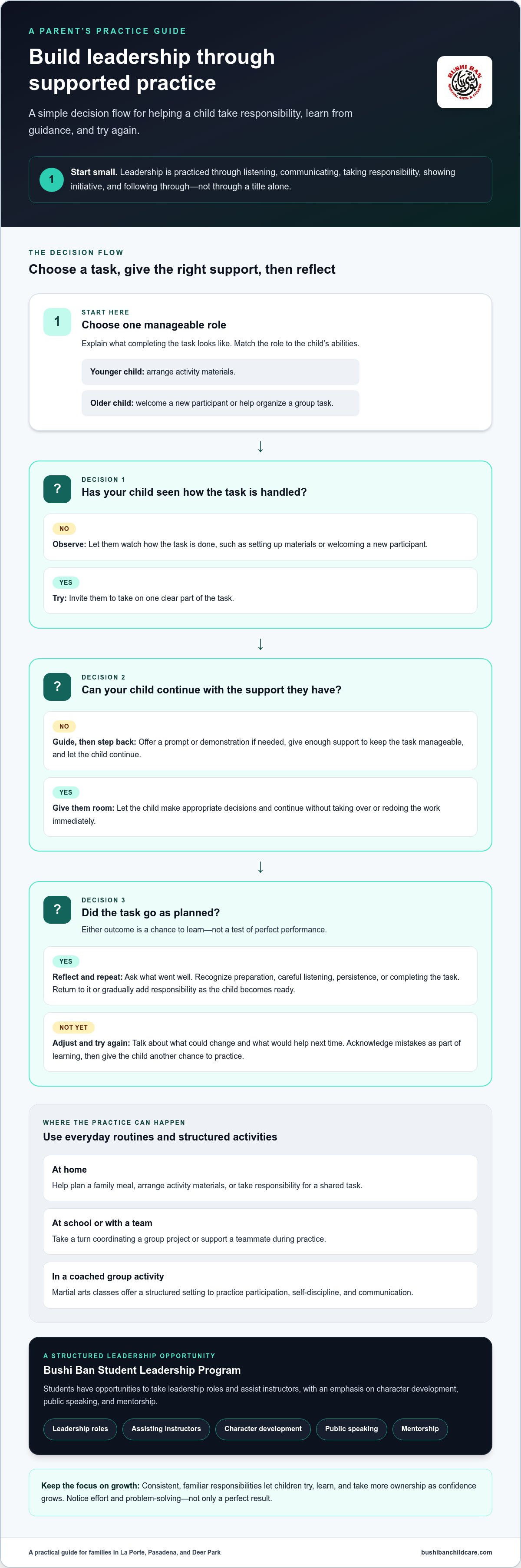
A Parent’s Step-by-Step Plan for Practicing Leadership Skills
A useful plan doesn’t need to be complicated. Choose one skill your child can practice, agree on a manageable role, and decide what support you’ll offer. Give your child a clear opportunity to take the lead at a level that feels challenging but achievable. This keeps developing leadership skills in youth La Porte grounded in your child’s interests and readiness.
Match leadership responsibilities to a child’s readiness
Begin with a task your child can understand and complete, such as preparing materials for an activity or helping plan one part of a family routine. Let their interests guide the choice: a child who enjoys welcoming others might greet a guest, while one who likes organizing could gather supplies. Explain what success looks like, and agree on whether you’ll offer a reminder, answer questions, or check in afterward.
Try this adaptable sequence:
Choose one skill. Focus on a specific area, such as clear communication, responsibility, or initiative.
Select a small role. Pick a task that gives your child a real contribution without placing too much on them.
Agree on support. Clarify what your child will handle and how you’ll help if they get stuck.
Give them room to act. Allow time for your child to make decisions and complete the task before stepping in.
Reflect and adjust. Talk briefly about what they learned, then decide whether to repeat the role or try a slightly greater challenge.
Reflect, celebrate progress, and choose the next challenge
After the task, keep the conversation curious and encouraging. Ask, “What felt easy?” “What was difficult?” and “What would you change next time?” Recognize a responsible choice or steady effort specifically, rather than comparing your child with a sibling or peer. If they’re ready, add one new element, such as planning the task themselves or explaining it to someone else. If it felt overwhelming, make the role smaller and try again.
Martial arts and fitness activities offer another setting to practice focus, communication, and self-discipline. For related ideas, read this guide to martial arts for focus and discipline. Bushi Ban’s Student Leadership Program gives students opportunities to take leadership roles and assist instructors, with an emphasis on character development, public speaking, and mentorship.
Ready to explore a structured opportunity for your child to practice leadership? Explore Bushi Ban’s Student Leadership Program.
Bushi Ban’s Student Leadership in La Porte
When a young person is ready to move beyond small, everyday responsibilities, a structured activity can offer guided chances to contribute. At Bushi Ban, martial arts classes provide a setting where students can practice responsibility and communication as they learn and participate. For families developing leadership skills in youth La Porte, this can complement practice at home or school with instructor-supported roles.
What leadership practice looks like at Bushi Ban
Bushi Ban’s Student Leadership Program gives students opportunities to take leadership roles and assist instructors. These responsibilities let students take part, communicate, and support an activity under instructor guidance. The program also emphasizes character development, public speaking, and mentorship. Speaking in front of others and helping guide peers are skills children can practice over time, with room to learn rather than pressure to be perfect from the start.
Martial arts participation offers a structured context for practicing habits like listening, following instructions, and being accountable within a group. As a student becomes ready for more guided responsibility, the Student Leadership Program provides a practical next step. Its focus is on meaningful participation and development, not a guaranteed result for every child.
How to take the next step as a La Porte family
Consider how your child responds to clear expectations, feedback, and opportunities to contribute. Are they interested in helping, explaining an idea, or taking responsibility for a shared task? Readiness doesn’t mean a child must already be confident or experienced. It can simply mean they’re open to trying with guidance and encouragement. Talk together about what kind of participation feels motivating and how they’d like support as they learn.
Bushi Ban serves families in La Porte, Pasadena, and Deer Park as part of the Houston area. Its structured martial arts setting and Student Leadership Program offer opportunities for children to participate and take on responsibility. Keep your child’s interests and comfort in mind as you consider a suitable next step.
Explore Bushi Ban’s programs and learn about opportunities for your child to participate and grow.
Give Your Child Room to Lead
Leadership grows through practice, not a title. A small responsibility at home, school, or an activity can help a child learn to communicate, follow through, and take initiative. Offer guidance, recognize effort, and let responsibility grow as your child becomes ready. This makes developing leadership skills in youth La Porte practical for families, whatever their child’s personality or starting point.
For young people ready to try guided roles, Bushi Ban’s Student Leadership Program offers opportunities to take leadership roles and assist instructors. Its emphasis on character development, public speaking, and mentorship gives students meaningful skills to practice within a structured setting.
Choose one manageable next step, then encourage your child to learn from the experience and try again. Explore Bushi Ban’s Student Leadership Program for an opportunity for families in La Porte, Pasadena, and Deer Park. With patient support and consistent practice, young people can build confidence in their ability to contribute and lead.
Frequently Asked Questions
Is leadership a skill that children can learn?
Yes. Leadership is made up of behaviors children can learn and strengthen over time. Listening carefully, taking responsibility, communicating clearly, and following through are practical starting points. Children can practice these skills through everyday roles at home or school and through supported group activities. Progress varies by child, so focus on opportunities to contribute and learn rather than expecting every young person to lead in the same way.
How can I help my child develop leadership skills at home?
Choose one manageable responsibility, explain what needs to be done, and give your child room to complete it. For example, they might prepare materials for a shared activity or take responsibility for one part of a family task. Afterward, talk briefly about what went well and what they might try differently. Offer specific praise for effort and follow-through, then gradually increase responsibility as your child shows they’re ready.
What leadership skills should youth develop first?
Listening, reliability, clear communication, cooperation, and initiative are strong foundational skills. A child might start by listening to a teammate’s suggestion, completing an agreed task, or asking a useful question when they need help. The right starting point depends on the child and the situations they encounter. Skills grow through repeated practice, helpful feedback, and meaningful chances to contribute, not by expecting a young person to master everything at once.
Can martial arts help develop leadership skills in youth?
Martial arts activities can offer structured opportunities to practice discipline, communication, responsibility, and supporting others. Students participate within a group and respond to instruction. These experiences may support leadership development, but they don’t guarantee a particular result. The quality of instruction and a child’s ongoing participation matter. In La Porte, Pasadena, and Deer Park, families can consider martial arts as one setting among several where young people can practice and grow.
What does a youth leadership program typically teach?
Youth leadership programs may help participants practice responsibility, public speaking, mentoring, listening, and contributing to a group. The structure varies, so consider whether young people get meaningful roles, supportive guidance, and chances to practice rather than only hearing about leadership. In Bushi Ban’s Student Leadership Program, students can take leadership roles and assist instructors, with an emphasis on character development, public speaking, and mentorship.
How can a shy child practice leadership?
A shy child can begin with a small, predictable role, such as helping prepare an activity or welcoming one person. Offer choices and explain what to expect, then encourage participation without requiring a child to speak publicly before they’re comfortable. Shyness isn’t a barrier to leadership. Listening, preparation, and dependable follow-through are also valuable ways to contribute. Let your child’s confidence and interests guide how responsibility grows over time.
Where can families in La Porte find youth leadership opportunities?
Families can explore leadership practice through school, community, and structured activity settings in La Porte, Pasadena, and Deer Park. Bushi Ban offers a Student Leadership Program with opportunities to take leadership roles and assist instructors. The program emphasizes character development, public speaking, and mentorship. Families developing leadership skills in youth La Porte can consider how this guided setting fits their child’s interests and readiness.

Comments