
Youth Leadership Training in Pasadena, TX: A Parent’s Guide
Leadership grows through chances to help, speak up, and take responsibility. That is the practical question behind choosing youth leadership training Pasadena families can feel good about. Look beyond inspiring promises: young people need supportive, hands-on opportunities to practice, not pressure to compete or perform.
Meaningful training gives students ways to build communication, mentorship, and activity-leading skills with guidance. At Bushi Ban Child Care, the Student Leadership Program extends martial arts learning into leadership roles, where students practice assisting instructors and helping lead activities. Students develop responsibility and character through participation, one experience at a time.
This guide explains what leadership activities can look like, how to compare a leadership track with school, volunteer, or enrichment options, and what to consider when deciding whether a program suits your child. It also offers a local perspective for families in Pasadena, Deer Park, and La Porte, Texas, so you can choose a practical next step for your family.
Key Takeaways
Meaningful leadership training gives young people practical chances to lead and support others, not just a title or a confidence-building message.
Use a simple practice-to-reflection framework to understand how leadership skills can develop.
Compare youth leadership training Pasadena options by looking at skill practice, mentorship, adult guidance, and the setting.
Volunteer service, diplomacy activities, and martial arts-based leadership each offer different ways to practice responsibility.
Bushi Ban students can develop leadership through teaching assistance and activity-leading practice in Pasadena, Deer Park, and La Porte.
Table of Contents
What Does Youth Leadership Training in Pasadena, TX, Actually Teach?
Youth leadership training gives young people structured opportunities to lead and support others. Look for observable actions: a student explains an activity, listens to a teammate, or follows through on a responsibility. Confidence can grow through practice, but leadership is more than feeling confident, earning a rank, or holding a title. Youth leadership can take different forms, and everyday actions make the idea concrete.
For families searching for youth leadership training Pasadena, this guide focuses on Pasadena, Texas. Bushi Ban’s Student Leadership Program is an advanced component of martial arts training. Students learn to take leadership roles and assist instructors with teaching, with an emphasis on public speaking, mentorship, and character development. The focus is on practicing responsibility in a learning environment, not simply being named a leader.
Which leadership skills can young people practice?
Public speaking can mean communicating an instruction or idea clearly enough for others to follow. Mentorship means offering appropriate help and encouragement to another student while respecting the instructor’s guidance. Responsibility can show up in preparing for and assisting with a group activity. Parents can look for these behaviors: Does the student communicate thoughtfully, support others, and take their part seriously?
How does a martial arts setting create leadership opportunities?
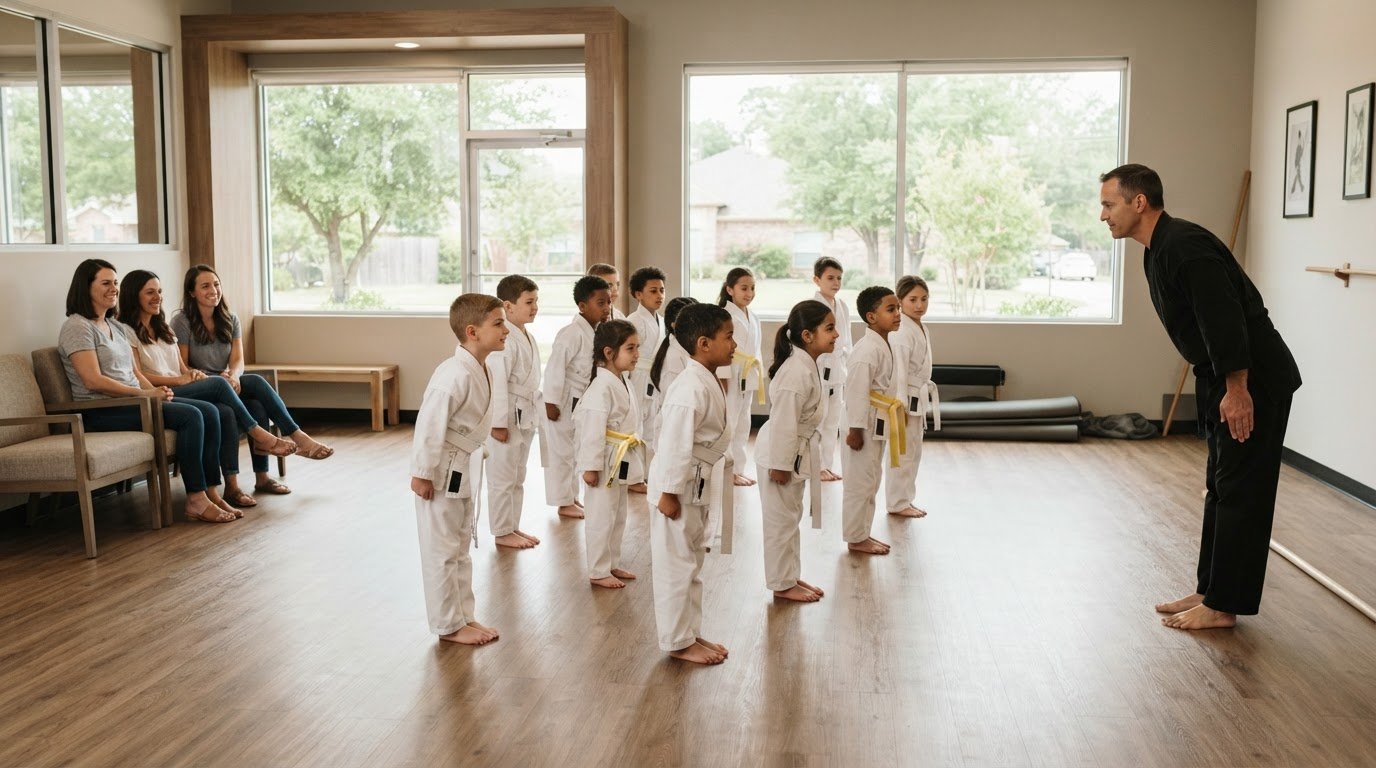
Martial arts practice gives students a shared activity where they learn from instructors and, as student leaders, assist with teaching. Leading an activity may involve listening to directions, explaining a next step clearly, and offering supportive guidance to classmates. These actions let a young person practice being helpful and accountable while remaining part of a group.
For example, a student assisting an instructor needs to pay attention to the explanation before helping others understand it. Leadership means contributing appropriately, not taking over, and treating fellow students with respect. Parents can use these moments to understand what the role involves beyond its name. Each student’s experience and progress will be individual.
How Does Martial Arts-Based Leadership Training Work?
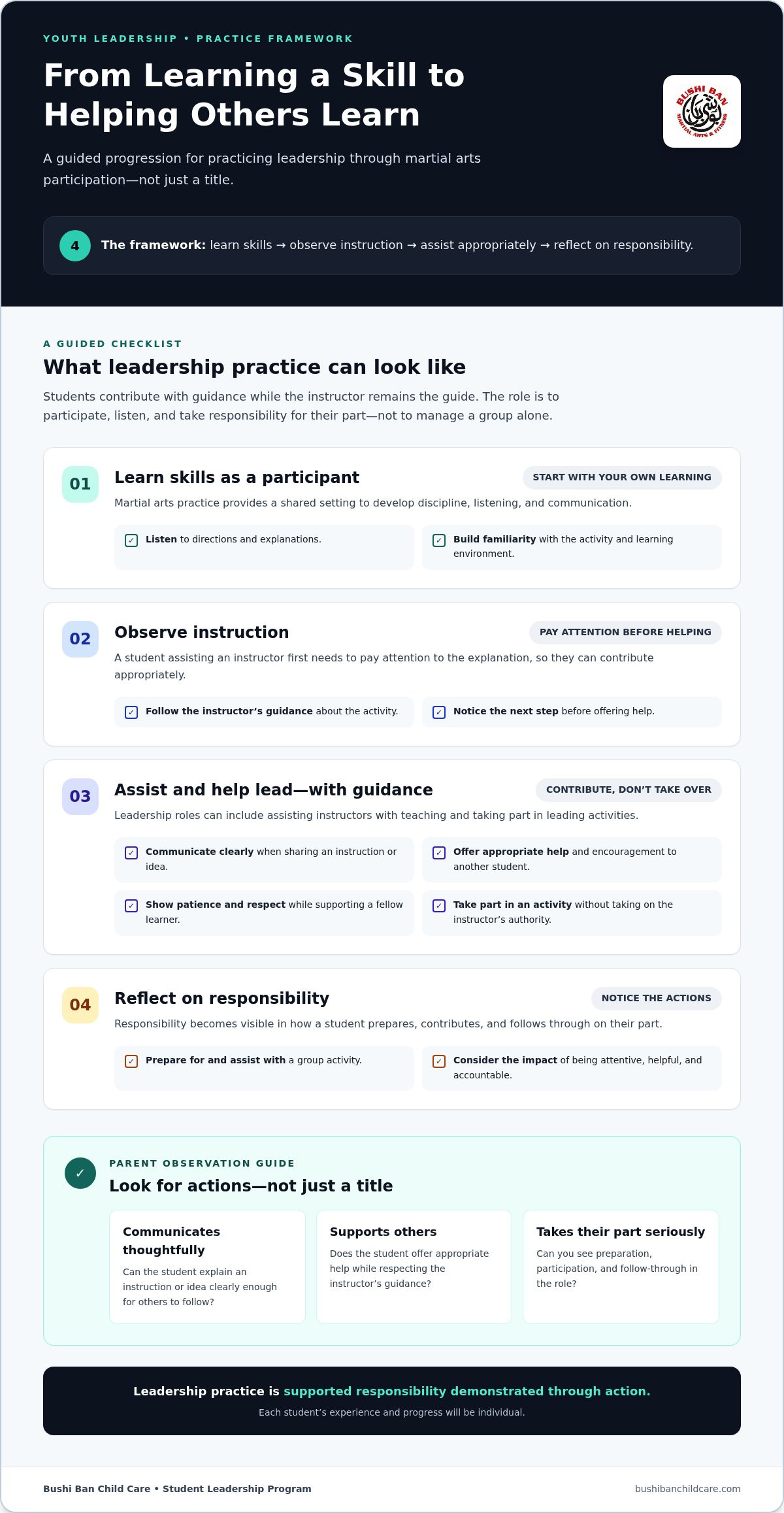
Martial arts gives students a structured setting to practice discipline, listening, and communication. A leadership role extends that learning: students move from developing their own skills toward helping instructors teach and taking part in leading activities. The experience is guided, with students contributing rather than taking on independent responsibility for other children.
A useful way to picture the process is: learn skills, observe instruction, assist appropriately, and reflect on responsibility. Students first learn as participants, then contribute through opportunities to assist instructors and lead activities. This framework can help parents recognize the progression from learning a skill to using it in support of others.
Leadership practice is supported responsibility demonstrated through action. This keeps the focus on what a young person does, rather than on a title or a promise about future results.
From learning martial arts to helping others learn
As students become familiar with martial arts instruction, assisting an instructor can give them a different perspective on the learning environment. They may help communicate a direction or contribute to an activity with guidance. The role is practice in being attentive and helpful, not a transfer of the instructor’s authority or responsibility.
This distinction matters to parents. A young person can learn to contribute without being expected to manage a group alone. The instructor remains the guide, while the student gets a chance to participate, listen, and take responsibility for their part.
Why mentoring and public speaking belong in the process
Mentorship doesn’t require a student to have all the answers. It can mean offering encouragement, showing patience, and setting a respectful example for another learner. Public speaking is practical, too: sharing an instruction or idea clearly calls for preparation and attention, not simply a loud voice.
These skills develop through opportunities to practice and appropriate adult guidance. The U.S. Department of Health and Human Services describes Positive Youth Development as an intentional, strengths-oriented approach. It offers a useful lens for seeing leadership as something young people can practice and build on.
For families considering youth leadership training Pasadena, Bushi Ban’s Student Leadership Program connects these ideas with martial arts participation through teaching assistance, activity-leading practice, public speaking, mentorship, and character development. Explore Bushi Ban programs in Pasadena to see how this structured setting connects martial arts and leadership practice.
How to Compare Youth Leadership Training in Pasadena
Programs can use the word “leadership” to describe very different experiences. Compare what a young person gets to practice, who provides guidance, and where activities take place. This table outlines broad program formats; the activities and structure vary by program.
For a closer look at what a student leadership program can involve, read this student leadership programs guide.
What signs show leadership is practiced, not just discussed?
Look for responsibilities you can picture: helping instructors with teaching, assisting with activities, or supporting other students. Check whether communication, mentorship, and character development are part of the program’s focus. These features describe what students practice, not guaranteed or measurable outcomes. Clear examples of student activities are a more useful basis for comparison than broad promises about future success.
Which program setting may suit your child?
A young person who enjoys movement, structured practice, and learning by doing may be drawn to martial arts-based leadership. A service-oriented student might prefer community contribution, while someone curious about world affairs may enjoy diplomacy-focused activities. No format suits everyone. Consider your child’s interests and preferred way of learning. For related context, read the martial arts focus and discipline guide.
As you compare youth leadership training Pasadena options, consider what the student will practice, how adults guide participation, and whether the setting feels engaging rather than pressuring. Those details help you identify a program that fits your child’s interests and offers a meaningful way to take part.
Is Youth Leadership Training More Than a Title? Questions Parents Can Use
It can be, when a student has real opportunities to practice, receives support, and takes responsibility for an appropriate part of an activity. A title alone doesn’t show what a young person is learning. For families considering youth leadership training Pasadena, look for meaningful actions and guidance rather than pressure to act like an adult.
An active leadership opportunity gives a student supported duties to practice; a title without meaningful duties is only a label. Skills take time to develop, and young people may show them in different ways. Look for progress in participation and responsibility, not a guaranteed outcome or a one-size-fits-all timeline.
How can parents assess responsibility and appropriate support?
In Bushi Ban’s Student Leadership Program, students learn to take leadership roles and assist instructors with teaching. Their contributions happen alongside instructor guidance, rather than leaving them to manage activities or other children alone. This structure gives students a chance to practice responsibility while continuing to learn.
Use questions like these to clarify what leadership looks like in practice:
What activities do student leaders take part in?
How do students assist instructors or encourage other learners?
How are communication, mentorship, and character development included?
What guidance helps students understand their responsibilities?
Specific answers distinguish described activities from broad claims about results. They also give you a clearer picture of how a student can contribute while continuing to learn.
How can families judge whether the program is a good fit?
Think about what draws your child in. Do they enjoy martial arts, structured activities, or helping others learn? Would they welcome opportunities to speak, offer encouragement, and take on a responsibility with support? A child doesn’t need to be naturally outgoing to explore leadership, but the setting should feel engaging and encouraging rather than overly competitive.
Consider how your young person responds to mentoring and speaking in front of others. Interest can grow with experience, and comfort levels differ. A good fit gives them room to participate and learn at their own pace, without assuming every student will develop in the same way.
Bushi Ban’s Student Leadership Program connects martial arts learning with teaching assistance, activity-leading practice, public speaking, mentorship, and character development. Explore Bushi Ban’s Student Leadership Program as a local option for families seeking guided leadership practice.
Explore Bushi Ban Youth Leadership Training Near Pasadena
For parents exploring youth leadership training Pasadena, Bushi Ban offers a pathway connecting martial arts participation with practical opportunities to take responsibility. Its Student Leadership Program is an advanced track where students learn to take leadership roles and assist instructors with teaching. The program serves families in Pasadena, Deer Park, and La Porte, Texas.
What families can expect from Bushi Ban’s leadership pathway
The focus is on active participation. Student leaders practice teaching and activity-leading skills while assisting instructors, bringing leadership into the martial arts learning environment. Students contribute to activities as part of their continued learning, so the role involves more than receiving a title.
The program also emphasizes character development, public speaking, and mentorship. These areas connect to everyday actions: sharing an idea clearly, encouraging another student appropriately, and approaching a responsibility with care. Each young person’s experience is individual, so view leadership as a chance to practice and develop skills over time, not a promise of a particular result.
As you consider whether this pathway suits your child, reflect on the interests and experiences that could make participation rewarding:
Does your child enjoy martial arts and learning through active participation?
Would they be interested in helping instructors or contributing to group activities?
Do opportunities to speak, mentor, and build character sound encouraging to them?
These questions connect the program’s focus with your young person’s interests. A child doesn’t need to have every leadership skill in place already. Curiosity, willingness to participate, and the chance to learn with guidance can provide a meaningful starting point.
Take the next step in Pasadena, Deer Park, or La Porte
Bushi Ban’s martial arts and student leadership programs provide a local option for families in Pasadena, Deer Park, and La Porte, Texas. Explore the martial arts and student leadership programs to learn about the pathways. Consider how martial arts learning and supported leadership practice might fit your child’s interests and goals. Growth takes practice, and every young person deserves room to discover how they can contribute.
Help Your Child Take a Meaningful Next Step
Youth leadership training Pasadena families can consider is built around practice, guidance, and real responsibility, not a title alone. As you compare options, look for specific ways students communicate, support others, and contribute. Remember that each young person develops at their own pace.
Bushi Ban’s Student Leadership Program is an advanced martial arts track where students learn to take leadership roles and assist instructors. Its emphasis on character development, public speaking, and mentorship connects martial arts learning with helping others. Families in Pasadena, Deer Park, and La Porte, Texas, can consider whether this approach suits their child’s interests.
Leadership begins with opportunities to participate and grow. Explore Bushi Ban’s youth leadership programs and take the next step toward supported leadership practice for your child. Every small step can help a young person discover new ways to contribute with care and confidence.
Frequently Asked Questions
What is youth leadership training?
Youth leadership training gives young people structured opportunities to practice leading and supporting others. Rather than focusing only on confidence, rank, or a title, meaningful training includes actions a parent can recognize, such as communicating clearly, assisting with an activity, or encouraging a peer. With adult guidance, students can try appropriate responsibilities and learn from the experience. Programs differ in their setting and approach, so consider what participants actually do.
What does a youth leadership program teach?
A youth leadership program may teach communication, responsibility, mentoring, and how to contribute to group activities. At Bushi Ban, the Student Leadership Program is an advanced track where students learn to take leadership roles and assist instructors with teaching. Its emphasis includes character development, public speaking, and mentorship. These are areas for practice, not guaranteed outcomes; each student’s experience and development can differ.
Can martial arts help children develop leadership skills?
Martial arts can provide a structured setting where students practice discipline and communication, and some programs connect that learning with leadership responsibilities. At Bushi Ban, student leaders learn teaching and activity-leading skills while assisting instructors. Helping with an activity, for example, calls for listening and communicating appropriately. This offers practical opportunities to contribute, though it doesn’t guarantee a particular result for every child.
How do I choose youth leadership training in Pasadena, TX?
When comparing youth leadership training Pasadena families can access, look for clear examples of student responsibilities, adult guidance, and opportunities to practice skills such as communication and mentoring. Consider whether your child is drawn to martial arts, community service, diplomacy activities, or another setting. Bushi Ban’s Student Leadership Program connects martial arts learning with instructor assistance and activity-leading practice. It serves families in Pasadena, Deer Park, and La Porte, Texas.
Is youth leadership training suitable for beginners?
It depends on what “beginner” means and how the program is structured. A child new to leadership may be interested in learning through supported practice, but Bushi Ban’s Student Leadership Program is an advanced track within martial arts. The leadership role involves taking responsibility and assisting instructors, so it differs from simply beginning martial arts classes. Consider your child’s interests and readiness for a more active role in learning.
What is the difference between youth leadership training and a volunteer program?
Youth leadership training and volunteering can both involve helping others, but their structure and focus may differ. A volunteer role centers on contributing service, while a leadership program may include deliberate practice in communication, mentoring, or leading activities. Bushi Ban’s Student Leadership Program is an advanced martial arts track where students take leadership roles and assist instructors. A volunteer opportunity may instead focus on a specific community or school service project.
How can I tell whether a youth leadership program offers real experience?
Look for concrete activities, defined responsibilities, and guidance from adults. Consider what participants do, whether they assist instructors or lead activities, and how communication, mentorship, and character development fit into the experience. Clear descriptions of practice are more useful than broad promises about results. At Bushi Ban, students learn teaching and activity-leading skills as part of the Student Leadership Program, giving families specific activities to consider when evaluating the opportunity.


Comments