
Empowering the Next Generation: A Guide to Kids Martial Arts Leadership Programs
What if your child didn’t have to feel naturally outgoing to become a confident leader? Leadership can develop through practice, encouragement, and meaningful responsibility. A kids martial arts leadership program gives students opportunities to build those skills while developing discipline on the mat, especially as they move from learning techniques to helping guide others.
Parents want more than another activity to fill the afternoon. If your child hesitates to speak up, struggles to take initiative, or wants a new challenge, a structured path from student to mentor may be a good fit. At Bushi Ban Child Care, the Student Leadership Program is an advanced next step from the After-School Martial Arts Program. It focuses on public speaking, mentorship, teaching, and leading activities.
This guide explains how leadership practice can help school-aged children develop confidence, communication, and empathy, and what to look for as they take on more responsibility. For families in Pasadena, Deer Park, and La Porte, it’s a closer look at how martial arts can give children opportunities to practice leadership on and off the mat.
Table of Contents
Beyond the Dojo: Why Youth Empowerment Programs are Essential Today
The 4 Pillars of an Effective Kids Martial Arts Leadership Program
Leadership Track vs. Standard Classes: Key Differences for Your Child
How to Evaluate Youth Empowerment Programs in Pasadena and Deer Park
Cultivating Mentors: The Bushi Ban Student Leadership Program Advantage
Beyond the Dojo: Why Youth Empowerment Programs are Essential Today
Youth empowerment means helping children build the confidence and skills to make age-appropriate decisions and take responsibility for their actions. It doesn’t mean leaving them to figure everything out alone. Instead, adults provide guidance and opportunities to contribute, make choices, and learn from the results. The broader idea of youth leadership also emphasizes helping young people develop the skills and knowledge to participate meaningfully in their communities.
Children may get chances to lead at school, but classroom routines must serve many students and learning needs. A structured after-school activity can offer another place to practice speaking up, following through, and taking initiative. Look for a program where children have a clear role and instructors explain what they can try next, rather than simply telling them to “be a leader.”
The Crisis of Confidence in School-Aged Children
A child in Pasadena, Deer Park, or La Porte might feel nervous introducing themselves, asking a question in class, or joining a new group. That hesitation doesn’t mean they lack potential. It may mean they need a supportive place to practice. When adults make every decision for a child, there can be fewer chances to experience the responsibility of contributing to a group.
Structured activities make those opportunities concrete. A student might volunteer to demonstrate a movement, help a classmate follow an instruction, or take responsibility for a small task. Notice whether instructors give specific feedback, such as recognizing clear communication or patient help, rather than praising only the result.
How Martial Arts Fills the Empowerment Gap
Martial arts can involve more than self-defense. Repeated practice asks students to focus, follow instructions, work through challenges, and keep learning. As children see their own progress, discipline can help them value the effort involved, not only praise or a next belt. The “Black Belt Mindset” can frame persistence, respect, and personal responsibility as habits to practice beyond training.
Youth empowerment brings together practical skills, confidence to act, and a willingness to use those abilities in service of others.
A kids martial arts leadership program can make that development more deliberate by giving students opportunities to practice public speaking, mentorship, and leading activities. These experiences help children rehearse communication, organization, and persistence in a group setting. They don’t guarantee academic or career success, but they can give children useful practice applying skills with others. At Bushi Ban, the Student Leadership Program is an advanced track focused on teaching and mentorship. Moving from student toward assistant instructor can be a meaningful milestone for a student ready to take on more responsibility.
The 4 Pillars of an Effective Kids Martial Arts Leadership Program
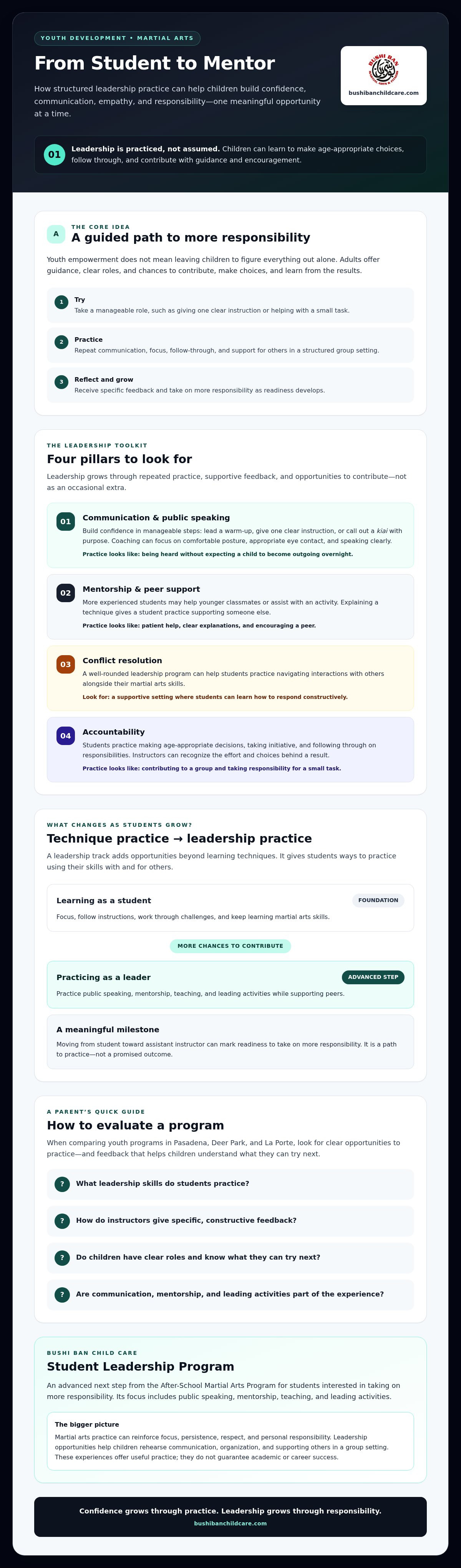
Leadership shouldn’t be treated as an occasional extra. It develops through repeated practice, supportive feedback, and chances to contribute. A well-rounded kids martial arts leadership program gives students opportunities to build communication, mentorship, conflict resolution, and accountability alongside martial arts skills. These pillars help children practice applying what they learn in class to interactions at school and at home. For parents comparing programs, effective youth programs can be a useful reference for thinking about intentional, supportive youth development.
1. Communication and Public Speaking
Confidence grows in manageable steps. A student who is hesitant to speak in front of a group might begin by leading a warm-up or giving one clear instruction. Calling out a kiai can also give a child practice projecting their voice with purpose. Instructors can coach practical details, such as standing comfortably, making appropriate eye contact, and speaking clearly. These activities let students practice being heard without expecting them to become outgoing overnight.
For more on how these skills fit into leadership development, explore Student Leadership Programs: Building Confident Leaders.
2. Mentorship and Peer Support
As students gain experience, they may have opportunities to help younger classmates or assist with an activity. Explaining a technique asks a student to communicate clearly, notice where someone may need help, and offer patient guidance. That process can reinforce the student’s own understanding while encouraging empathy. Leadership is not only about being in charge. It also means helping another person feel capable.
3. Conflict Resolution
Peer interactions can be challenging, even in a structured class. Students can practice pausing, listening, expressing concerns respectfully, and asking an instructor for help when needed. These habits give children ways to respond thoughtfully rather than react in the heat of the moment. A strong program treats respect and emotional self-management as skills to practice, not qualities children are simply expected to have.
4. Responsibility and Accountability
Leadership also means following through. A student might be responsible for remembering instructions, setting a positive example, or acknowledging a mistake and making a better choice next time. Clear expectations help children understand that their actions affect the group. Recognition should reinforce effort, care, and reliability, not only rank or performance.
From Student to Supportive Leader
At Bushi Ban, the Student Leadership Program is an advanced track focused on public speaking, mentorship, teaching, and leading activities. For families considering this next step after the After-School Martial Arts Program, moving from student toward assistant instructor can offer a way to practice leadership through service. Learn more about the Bushi Ban Student Leadership Program.
Leadership Track vs. Standard Classes: Key Differences for Your Child
Standard martial arts classes and a leadership track may share the same training environment, but they have different emphases. Standard classes generally focus on techniques, fitness, discipline, and personal progress. A kids martial arts leadership program adds practice in communication, mentorship, and teaching, helping students learn how to contribute to the group as well as develop their own skills.
Think of the difference as personal progress alongside contribution to others. A student may practice a movement to improve their form. A developing leader may also learn how to explain that movement or encourage a classmate who is struggling. These experiences can complement one another. Harvard Graduate School of Education describes positive benefits in a number of interrelated outcome areas for after-school programs, including social and personal development.
Ask a school how it distinguishes martial arts advancement from leadership development. Belt progression generally reflects progress in the martial arts curriculum. Some schools may use separate leadership recognition, such as a stripe, but systems vary. Don’t assume a “Leadership Stripe” is standard or part of every program. Ask what it represents, how students earn it, and whether leadership progress is assessed separately from technical skill.
Curriculum Deep Dive: What Happens in a Leadership Seminar?
Leadership learning can include non-physical practice, such as setting a goal, planning how to work toward it, and reflecting on what went well. A “mat chat” might invite students to discuss a character trait like integrity and consider how it applies while training, helping a peer, or keeping a commitment. For ideas to continue these conversations at home, see Essential Leadership Skills for Elementary Kids.
At Bushi Ban, the Student Leadership Program focuses on public speaking, mentorship, teaching, and leading activities. Ask how students practice these skills and what kind of feedback they receive. This advanced track has a different focus from simply attending a regular martial arts class.
Is Your Child Ready for the Leadership Track?
Readiness isn’t about being the loudest student. Notice whether your child attends consistently, shows interest in helping others, or asks for a new challenge. A quieter child can develop leadership skills through thoughtful explanations and one-to-one encouragement. Leadership practice can also build on the focus and discipline developed through martial arts training for focus and discipline.
If your child is curious about taking on more responsibility, ask whether the Student Leadership Program could be a next step after the After-School Martial Arts Program. Find out what students do, how the program fits alongside regular training, and what readiness looks like. More information is available through Bushi Ban’s student leadership opportunities.
How to Evaluate Youth Empowerment Programs in Pasadena and Deer Park
A polished program description doesn’t show exactly how leadership is taught. For families in Pasadena, Deer Park, and La Porte, look for clear examples of what students practice, how instructors guide them, and how responsibilities change as students gain experience. A strong kids martial arts leadership program should be able to explain how it helps students practice initiative and contribute to the group.
Ask about the curriculum. Is leadership a defined program with skills such as public speaking, mentorship, or leading activities, or is the word used only in general promotion? Ask for examples of what a student might do during a class.
Observe instructor interactions. Do instructors explain expectations, invite students to participate, and give constructive feedback? Notice whether children are corrected respectfully and given a chance to try again.
Clarify transportation arrangements. If school pickup matters to your family, ask directly whether it’s available, which schools are covered, and how arrangements work. You can review this after-school martial arts program overview, then confirm current details with the provider.
Ask how students contribute. Find out whether young leaders help classmates, lead activities, or take part in projects or events. Ask what those opportunities look like for students in Pasadena, Deer Park, or La Porte.
The Importance of Local Mentorship
A familiar local setting can help children build ongoing relationships with instructors who encourage their development. Ask how the team gets to know students and supports them over time. Families connected to PISD or DPISD can ask how the program’s schedule and expectations might fit their child’s school routine, rather than assuming one approach works for every family. A convenient location in or near Pasadena, Deer Park, or La Porte may also make regular attendance easier, which gives children more chances to practice skills consistently.
Safety and Professionalism Standards
Before enrolling, ask about instructor experience, relevant training, and whether background checks are part of the organization’s screening process. Don’t assume credentials or screening practices. Invite the provider to explain them. During a visit, notice whether the training space appears orderly and well maintained, and whether instructors set clear expectations for safe participation.
Ask how activities are adapted to students’ abilities and how coordination and fitness are developed appropriately. This guide to kids’ fitness and coordination can help you prepare questions about movement and physical literacy. A professional environment should support skill-building as well as thoughtful supervision.
To understand how these principles apply to Bushi Ban’s student leadership opportunities, explore the Student Leadership Program and ask about its curriculum, expectations, and fit for your child.
Cultivating Mentors: The Bushi Ban Student Leadership Program Advantage
Founded by Grandmaster Zulfi Ahmed, the Bushi Ban International system includes a Student Leadership Program for students ready to develop skills beyond martial arts technique. Its focus on public speaking, mentorship, teaching, and leading activities gives students practical ways to support others. Rather than being a separate named “Leadership Path,” the program is an advanced track where students can move from learning as a student toward taking on greater responsibility, with assistant instructor as an important milestone.
Martial arts training and leadership practice can reinforce one another: students develop physical skills while learning to communicate clearly and contribute to a group. Those habits may support participation at school, but the program is not tutoring and does not promise higher grades or college readiness. Ask how leadership skills are taught and how your child’s progress is discussed with your family.
Understanding Student Growth
Stories about improved grades or social standing can sound encouraging, but families should look for specific examples rather than assume those outcomes. Ask the program team what changes they’ve observed in students’ confidence, communication, or willingness to help peers, and whether they can share examples with families’ permission. Skills like speaking clearly, following through, and mentoring can be useful in later settings, but they should not be treated as guaranteed results.
Taking the First Step
If you’re in Pasadena, Deer Park, or La Porte, contact Bushi Ban to ask which location can answer questions about the Student Leadership Program and whether a trial class or introductory option is currently available. Ask what experience or readiness the program recommends, how students enter the advanced track, and what the transition toward assistant instructor involves.
Share your child’s interests and goals with the program team. For example, mention if they want to speak more confidently, enjoy helping younger students, or are looking for a new challenge. Ask how parents receive updates and how leadership practice connects with the After-School Martial Arts Program. Clear answers can help you decide whether the next step fits your child.
A Journey Built One Step at a Time
Leadership isn’t reserved for children who are already outgoing or sure of themselves. With guidance and practice, each student can work toward using their skills thoughtfully and supporting others. Moving from student to mentor takes time, and each act of responsibility can contribute to that growth. For families considering a kids martial arts leadership program, a useful starting point is a conversation about their child’s interests and the next skill they’re ready to practice.
Help Your Child Take the Next Step
Leadership grows through practice: speaking clearly, taking responsibility, and using new skills to support others. A kids martial arts leadership program can give children a structured way to develop those habits, with moving from student toward assistant instructor as a potential step in their growth.
Bushi Ban offers a Student Leadership Program focused on public speaking, mentorship, teaching, and leading activities. For families in Pasadena, Deer Park, and La Porte, ask how the program supports a child’s individual goals, what the student role involves, and what the next step could look like.
Contact Bushi Ban to ask about the Student Leadership Program and whether it’s a fit for your child.
Frequently Asked Questions
What is a youth empowerment program exactly?
A youth empowerment program helps children build skills and take an active role in age-appropriate decisions and responsibilities. Rather than making every choice for them, supportive adults provide guidance and opportunities to practice initiative. In a kids martial arts leadership program, for example, a student might learn to communicate clearly, help with an activity, and reflect on how their choices affect others. The goal is to build capability, not leave a child to manage everything alone.
Can a shy child really benefit from a leadership program?
Yes. A shy child can practice leadership without becoming the loudest person in the room. Confidence can develop through small, supported steps, such as speaking with a partner, explaining a technique, or helping one classmate. Ask how instructors encourage participation and adapt their guidance to different temperaments. A welcoming program should help a child stretch at a manageable pace, without treating quietness as a problem to fix.
How does martial arts teach leadership differently than team sports?
Martial arts and team sports can both offer opportunities to practice teamwork, discipline, and encouragement. Martial arts training often combines individual skill development with shared class routines, while team sports typically center on coordinated play toward a group goal. A leadership-focused martial arts track may add opportunities to explain techniques or assist with activities. The best fit depends on your child’s interests and how each program teaches responsibility and cooperation.
At what age should a child start a leadership-focused program?
There isn’t a confirmed universal starting age for leadership training, and Bushi Ban’s specific age requirements for its Student Leadership Program should be checked directly with the program. Readiness can depend on a child’s experience, interest, ability to follow guidance, and comfort taking on responsibility. Ask what age or skill prerequisites apply, how instructors assess readiness, and what opportunities look like for students at your child’s stage.
Are there leadership programs for kids near Pasadena and Deer Park?
Yes. Bushi Ban serves families in Pasadena, Deer Park, and La Porte, Texas, and offers a Student Leadership Program as an advanced track. The program emphasizes public speaking, mentorship, teaching, and leading activities. Contact Bushi Ban to confirm which location and current program details are relevant to your family. You can also ask how students move from regular martial arts learning toward greater leadership responsibility.
What specific skills are taught in the Bushi Ban Student Leadership Program?
The Bushi Ban Student Leadership Program focuses on public speaking, mentorship, teaching, and leading activities. Students can practice communicating instructions, supporting peers, and contributing to class activities. It’s an advanced track within the Bushi Ban system founded by Grandmaster Zulfi Ahmed. Ask the program team how students practice these skills, what responsibilities they take on, and how the transition toward assisting instructors works.
Does a leadership program take time away from regular martial arts training?
Program structures differ, so ask how leadership learning fits alongside martial arts instruction before enrolling. At Bushi Ban, the Student Leadership Program is an advanced track, distinct from regular after-school martial arts and holiday camps. Its focus includes public speaking, mentorship, teaching, and leading activities. Find out how students balance these responsibilities with technical practice and whether participation changes your child’s regular class schedule.
How do leadership skills learned in the dojo translate to the classroom?
Skills practiced in a martial arts setting may give children useful ways to approach classroom situations. Explaining an activity can provide practice organizing thoughts, while listening to instructions and following through can support classroom routines. Helping a peer can also encourage patience and consideration. These skills don’t guarantee better grades, but parents and teachers can look for opportunities to apply communication and responsibility across settings.


Comments