
How Structured After-School Activities Improve Focus and Grades in 2026
What if the key to your child’s highest report card isn't found in a textbook or an extra hour of tutoring, but on a martial arts mat? Many parents in 2026 find themselves caught in the "after-school slump," watching their children trade classroom focus for hours of mindless screen time. You want an environment that offers more than just a safe place to wait until five o'clock; you want a space that actively builds your child's future. By choosing structured after school activities that prioritize discipline and physical vitality, you can bridge the gap between school-day exhaustion and evening success.
We understand the anxiety that comes with choosing the right care, especially when you're looking for enrichment rather than just a babysitter. This article explores how replacing traditional daycare with structured martial arts training can transform your child’s academic performance and self-discipline. You'll learn the science behind how physical movement improves focus, how character-building programs foster independence, and why a structured environment is the ultimate tool for better grades. Let’s look at how a shift in your afternoon routine can lead to a more confident, focused child at home and in the classroom.
Table of Contents
Why Structured After-School Activities are Critical for Child Development in 2026
In 2026, parents are redefining what the hours between school and home should look like for their children. Structured after school activities are no longer viewed as a luxury; they're an essential component of a child’s developmental ecosystem. Unlike traditional daycare, these programs are goal-oriented environments with clear progression paths that reward effort and consistency. This period, often called the "Third Space," acts as a bridge between the academic rigors of the classroom and the relaxation of home. It’s here that a child’s identity is often forged. When this time is left unstructured, specifically during the critical gap from 3 PM to 6 PM, we often see behavioral backsliding. Without a clear objective, children naturally default to passive consumption rather than active growth. They need a mentor, a mission, and a map to navigate their potential.
Research into structured after-school programs shows that these environments provide the stability children need to internalize new habits. In 2026, the trend is clear: parents are moving away from the "holding pen" mentality of traditional daycare. They want programs that offer a measurable return on their child's time. A structured environment provides this by setting clear expectations and celebrating every small victory along the way. It turns the "after-school slump" into a period of high-growth enrichment that benefits the entire family.
The Difference Between Supervision and Structure
Supervision keeps kids safe; structure keeps them growing. It’s a vital distinction for any family. When a child enters a room without a plan, the result is often "screen fatigue" as they turn to tablets or television to fill the void of a long day. A structured after school activities program replaces this passive habit with active engagement. By placing your child in a positive peer group where everyone is working toward a common goal, you're fostering a sense of belonging that screen time can't replicate. This routine builds a social safety net that encourages them to engage with the world rather than withdraw from it.
Meeting the 2026 Developmental Milestones
Many elementary students in 2026 continue to face a "focus deficit," which is a lingering challenge in maintaining attention during long school days. Physical movement isn't just a break from this mental load; it's a biological necessity. It serves as the best antidote to the mental fatigue that leads to tantrums or homework battles. Engaging the body helps reset the brain, making it easier for children to tackle academic tasks later in the evening. This holistic approach is exactly what parents find when exploring martial arts for focus and discipline. It’s about building a foundation of vitality that supports every other area of their lives.
The Science of Focus: How Martial Arts Trains the Developing Brain
How often does your child struggle to sit still or follow directions after a long day of desk work? While many view the hours after 3 PM as a time for rest, the developing brain is actually primed for a specific kind of engagement that traditional classrooms often miss. Structured after school activities like martial arts leverage this window to stimulate the prefrontal cortex; this is the area of the brain responsible for executive function, impulse control, and complex decision-making. When a child executes a spinning kick or a precise block, they aren't just moving their limbs. They're firing neural pathways that demand intense concentration and coordination. This development of proprioception, or the sense of where one's body is in space, has a direct correlation to classroom behavior. A child who is physically grounded and aware of their body is significantly less likely to fidget and more likely to maintain attention during a teacher's lecture.
Supporting this holistic approach, research from Harvard highlights that the most effective programs combine physical activity with social-emotional learning to produce lasting academic results. We see this through our "Respect-Focus-Action" cycle. First, the student shows respect to the instructor and peers, which clears the mental slate and prepares them for learning. Next, they narrow their focus to the specific task or technique at hand. Finally, they execute the movement with precision. This mental blueprint becomes second nature over time. The Black Belt Mindset translates to academic success by teaching a student to view a complex multi-step math problem as a series of manageable strikes rather than an overwhelming obstacle.
Building the 'Focus Muscle' Through Repetition
Mastering a martial arts form, known as a Kata, is the ultimate exercise in blocking out external distractions. It requires a child to memorize dozens of specific movements in a precise sequence, demanding a level of mental endurance that few other hobbies provide. During these sessions, immediate feedback from our instructors helps correct behavior in real-time, teaching children that precision and effort lead to visible progress. While some might see repetitive drills as "boring," they're actually high-level concentration training. Each repetition strengthens the brain's ability to stay on task, even when the initial novelty wears off. If you're looking for a way to strengthen your child's resolve, our after-school martial arts program offers a proven path toward mastery.
Developing Social and Emotional Regulation
Martial arts provides a safe, nurturing space for children to experience and manage frustration. When a technique doesn't work on the first try, they learn to take a deep breath and try again rather than giving up. We emphasize controlled breathing techniques that help lower heart rates and reduce the physical symptoms of anxiety. This skill is incredibly useful during school tests or stressful social situations. By building confidence through martial arts, students realize they have the internal tools to handle pressure. They walk into their classrooms the next morning with a sense of calm authority over their own emotions and actions. The role of structured after school activities in fostering this cognitive growth is what sets our leaders apart from their peers.
Connecting the Dojo to the Classroom: Improving Grades Through Discipline
Does your child struggle to transition from the freedom of the afternoon to the focus required for evening homework? Many parents worry that adding more to their child’s schedule will lead to burnout. However, the "Discipline Transfer" proves that rules learned in the dojo quickly become habits at the school desk. When a child participates in structured after school activities, they aren't just learning to kick and punch; they're practicing the art of following a multi-step process. This mirrors the exact mental effort needed to study for a semester grade or complete a complex project. Instead of seeing martial arts as a distraction, think of it as the laboratory where the habits of success are tested and refined.
The relationship between a student and a martial arts instructor is fundamentally different from the one they have with a traditional daycare caregiver. While a caregiver provides safety and supervision, an instructor provides mentorship and high expectations. This distinction is critical for academic success. A mentor challenges a child to reach for the next belt, a process that teaches them how to set and achieve long-term goals. These benefits of afterschool programs extend far beyond the mat, helping students view their teachers as partners in their education rather than just authority figures to be navigated. When a child learns that effort leads to progression, their report card becomes a reflection of their personal pride.
Translating Respect to Teacher Interactions
The "Yes, Sir/Ma'am" culture of martial arts is about more than just polite words. It's a system of acknowledging and respecting leadership. When children practice this daily, it naturally carries over into the classroom. Teachers often report that students with martial arts backgrounds are the ones who practice active listening and follow instructions the first time they're given. By reducing classroom disruptions through better self-regulation, these children create a better learning environment for themselves and their peers. They don't just hear the lecture; they engage with it because they've been trained to value the source of the information.
The Homework-Discipline Connection
We often hear the objection that martial arts takes away from precious homework time. In reality, it makes that time more efficient. We teach a "First Things First" mentality, where the discipline of the dojo helps students tackle their most difficult tasks before they lose focus. Physical activity is a natural cure for the "brain fog" that sets in after seven hours in a classroom. A quick, intense workout increases blood flow to the brain, which sharpens mental clarity. Industry professionals and educators report that "the synergy between physical vitality and mental sharpness" creates a foundation where "cognitive retention flourishes and academic anxiety fades away." Instead of a two-hour struggle at the kitchen table, you'll find a child who can sit down, focus, and finish their work with confidence.
Structured Martial Arts vs. Traditional Daycare: A Parent’s Comparison
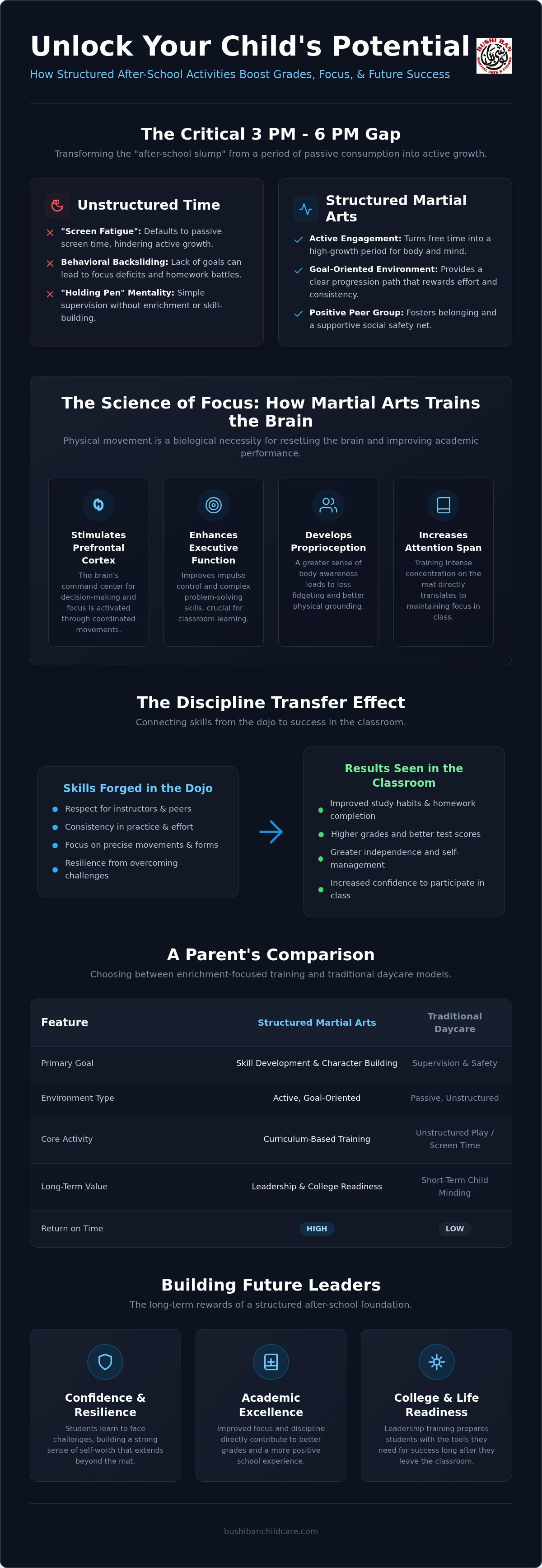
When you evaluate where your child spends their afternoon, are you looking for a holding pen or a launching pad? Traditional daycare models frequently rely on "free play," which often translates to unsupervised screen time or aimless activity. While this keeps a child safe, it doesn't necessarily keep them growing. In contrast, structured after school activities follow a curriculum-based model designed for long-term development. Instead of just passing the time, students are earning the next rank, mastering a new form, or refining their self-discipline. This shift from passive supervision to active achievement is what separates a basic service from a true partnership in your child's upbringing.
Consider the cost-to-value ratio of your current choice. You can pay for simple supervision, or you can invest in a life skill that pays dividends for decades. The difference is often found in the people leading the program. Traditional daycare staff are frequently temporary employees or babysitters with minimal specialized training. Our instructors are certified martial arts mentors who have dedicated years to their craft. They don't just watch your child; they guide them. This professional excellence is coupled with a "Transportation Advantage" that simplifies your life. We focus on providing reliable transportation from local schools in Pasadena, Deer Park, and La Porte directly to our dojo, ensuring your child’s transition to a place of growth is seamless and safe.
Evaluating the Environment
Is your child's after-school space designed for rest or for achievement? A dojo is a purposeful environment where the very air suggests focus and respect. Wearing a uniform, or Gi, creates an immediate sense of belonging and equality that street clothes can't provide. It signals to the child that they've entered a space where their actions matter. This structure is especially vital for older elementary students who often outgrow the "playroom" feel of traditional daycare. They need challenges that match their maturing minds, and a curriculum-based program provides the progression they crave.
The Outcome: What Your Child Brings Home
The true test of an after-school program is the child who walks through your front door at the end of the day. A child left to unstructured play often comes home tired and irritable, immediately reaching for the TV remote. A student from the Bushi Ban After School Program returns energized, carrying a sense of pride in what they accomplished on the mat. As they grow, they may even enter our Student Leadership Program, where older students begin to mentor younger ones. This transition from student to leader is a powerful path to college readiness. If you're ready to see this transformation, check our 2026 schedule for the Pasadena and Deer Park area today.
Building Future Leaders in Pasadena: The Bushi Ban Approach
Founded circa 1980 by Grandmaster Zulfi Ahmed, Bushi Ban Child Care has spent decades serving families in Pasadena, Deer Park, and La Porte. We don't just provide a place for children to go; we act as a dedicated partner in their upbringing. Our philosophy, rooted in the vision of Grandmaster Ahmed, focuses on holistic development. This means we value a child’s emotional intelligence and leadership potential just as much as their physical agility. When you choose structured after school activities at our facilities, you’re enrolling your child in a legacy of excellence that has shaped thousands of young lives in our community. We invite you to see the focus and grades transformation firsthand as your child moves from the classroom to the mat.
The Student Leadership Program Advantage
True mastery goes beyond earning a black belt. In our program, we encourage older students to step into the role of mentors through our Student Leadership Program. This "Leadership Path" teaches them how to communicate effectively, manage group dynamics, and lead with empathy. These aren't just mat skills; they are vital public speaking and mentorship tools that serve elementary and middle schoolers as they prepare for the high-pressure environments of competitive high schools and colleges. By learning to teach others, our students internalize their own discipline on a deeper level. This ensures that the academic improvements and self-regulation they develop during our structured after school activities become a permanent part of their character.
Ready to Start in Pasadena, Deer Park, or La Porte?
We know that convenience is key for busy 2026 schedules. That's why we prioritize specialized after-school martial arts transportation, picking up students directly from their schools and bringing them to a safe, structured environment. During your child's first week at Bushi Ban, they'll be welcomed with nurturing warmth and introduced to the clear expectations of our dojo. They won't feel like just another face in a crowd. Instead, they'll find a supportive community where their personal growth is the primary goal. If you're ready to move beyond the limitations of traditional daycare, we invite you to schedule a tour of our Pasadena or Deer Park facilities today. Discover how a balanced approach to fitness and character education can create a brighter, more disciplined future for your family.
Transform Your Child’s Afternoon into a Path for Success
The choice between passive supervision and active development is one of the most impactful decisions you can make for your child's 2026 school year. By prioritizing structured after school activities, you're giving your child more than just a safe place to wait for the workday to end. You're providing a bridge between the physical discipline of the dojo and the cognitive focus required for academic excellence. This transition turns the afternoon slump into a period of high-growth mentorship where a child learns that their effort directly leads to achievement both on the mat and in the classroom.
At Bushi Ban, we've been serving Houston families since 1980, offering a unique blend of character education and physical vitality. Our state-of-the-art facilities in Pasadena and Deer Park provide the perfect backdrop for mentorship from world-class martial arts instructors who are dedicated to your child's holistic growth. It's time to trade traditional babysitting for a program that builds future leaders and improves report cards. Enroll Your Child in Bushi Ban’s Structured After-School Program Today and watch their confidence soar. We're excited to partner with you in your child's journey toward a brighter, more focused future.
Frequently Asked Questions
How do structured after-school activities help with ADHD or focus issues?
Martial arts provides the routine and immediate feedback loops that help children with ADHD manage their energy effectively. By engaging in structured after school activities, students learn to break down complex tasks into manageable steps. This process strengthens the prefrontal cortex, which helps them filter out distractions. It's not just about burning off energy; it's about teaching the brain how to narrow its focus through intentional, repetitive movement and clear expectations.
Is martial arts safe for children who have never done sports before?
Yes, martial arts is exceptionally safe for beginners because our curriculum is designed for individual progression. We focus on coordination and basic body mechanics before moving into more advanced techniques. Our instructors are trained to nurture a child's confidence, ensuring they feel supported as they learn new skills. Unlike team sports where a child might feel left behind, martial arts allows every student to advance at their own pace in a controlled, professional environment.
Does the Bushi Ban program include time for homework?
We prioritize academic success by dedicating specific time for students to work on their assignments. While we focus strictly on martial arts and fitness enrichment, we understand that a balanced afternoon includes completing school responsibilities. Our instructors encourage a "First Things First" mentality, helping children understand that discipline on the mat translates to diligence at their desks. This ensures your child returns home with their physical and academic goals well underway for the evening.
What is the best age to start a structured after-school martial arts program?
Most children find success starting a structured program between the ages of 5 and 7. At this developmental stage, they're physically capable of following complex movements and mentally ready to grasp the concepts of respect and discipline. However, we offer tailored classes for various age groups to ensure the curriculum matches their maturity. Starting early helps establish a foundation of physical vitality and character that benefits them throughout their entire elementary school experience.
How does the Student Leadership Program differ from regular classes?
The Student Leadership Program is an advanced track that focuses on mentorship and public speaking rather than just physical technique. While regular classes build personal skill and fitness, the leadership program teaches students how to assist instructors and guide their peers. This curriculum emphasizes character development and prepares kids for the social and academic challenges of middle and high school. It’s a powerful way to transition from being a student to becoming a community leader.
Do you provide transportation from schools in Deer Park and La Porte?
We provide reliable transportation from several local schools in Pasadena, Deer Park, and La Porte directly to our facilities. Our focus is on ensuring a seamless transition from the classroom to the dojo so parents don't have to worry about afternoon logistics. By choosing our structured after school activities, you're opting for a program that handles the commute and the enrichment. Please contact our office to verify the specific pickup routes currently available for your child's school.
What happens if my child isn't interested in 'fighting'?
Martial arts at Bushi Ban is about self-discipline and character, not aggression or "fighting." We teach self-defense as a tool for confidence and safety, emphasizing that the best way to handle a conflict is to avoid it. Most of our curriculum focuses on individual forms, fitness, and leadership skills. Children who aren't interested in combat often thrive here because they enjoy the personal challenge of mastering new movements and earning their next belt rank.
How quickly will I see improvements in my child's school grades?
While every child is different, many parents report seeing improved focus at home and school within the first few months. As students internalize the discipline of the dojo, they naturally apply those same habits to their homework and classroom behavior. Better grades are a byproduct of the increased concentration and self-regulation skills they practice daily. Consistency is key, and the long-term academic benefits become even more apparent as the child progresses through our belt system.


Comments